Cable Chop (High to Low)
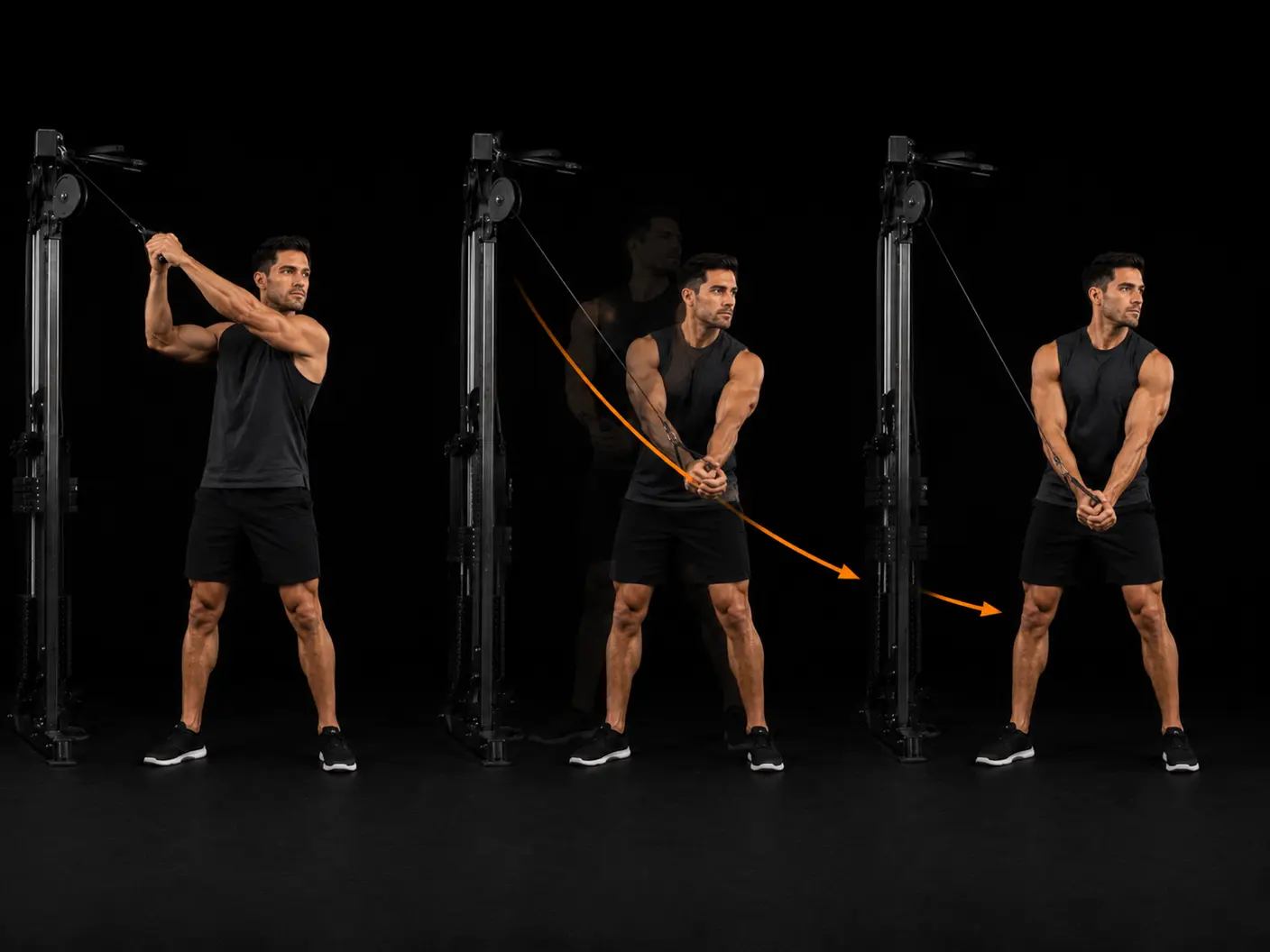
The cable chop (high to low) is a rotational core exercise performed on a cable machine, pulling a handle from head height diagonally down and across the body to the opposite hip. It trains the anti-rotation and rotation demands of the core simultaneously, requiring the obliques and transverse abdominis to generate and control force through a diagonal plane of movement. It suits intermediate trainees looking to develop functional core strength for sport or general athletic conditioning.
How to do it
Set a cable at head height. Stand side-on. Grip the handle with both hands high. Rotate and pull the cable down and across the body to the opposite hip. Drive through the hips and core. Reverse slowly.
Coaching cues
- Rotate through the hips
- Drive the cable across
- Tall torso
- Slow return
Why train it
- The diagonal pull pattern directly loads the obliques through their natural line of action, making it one of the more mechanically honest exercises for rotational core development.
- By demanding that the hips drive the movement rather than the arms, the exercise reinforces the connection between the lower body and core that underpins most athletic actions.
- The slow, controlled return phase trains anti-rotational stiffness, teaching the core to resist unwanted movement as much as to produce it.
- The cable's constant tension throughout the range of motion keeps the lats, shoulders, and glutes engaged as stabilising contributors, making it a genuinely compound core exercise.
Common mistakes
- Pulling with the arms rather than rotating through the hips — initiate the movement from the hips and let the arms transmit that force rather than generate it.
- Losing a tall torso by bending forward or collapsing through the spine — maintain a braced, upright position from set-up to finish.
- Rushing the return phase — resist the cable on the way back under control, as this eccentric portion is where much of the anti-rotational benefit is developed.
- Standing too close to the cable stack, which restricts the range of motion — position yourself far enough away that there is meaningful tension on the cable from the starting position.
Primary: Obliques, Transverse Abdominis.
Secondary: Latissimus Dorsi, Anterior Deltoid, Gluteus Maximus.
Equipment
Good for
Easier variation
Band chop — lower intensity, home-friendly.
Similar movements
Frequently asked
- What muscles does the cable chop (high to low) work?
- The primary muscles are the obliques and transverse abdominis, which drive and control the rotational movement. The lats, shoulders, and glutes contribute as secondary stabilisers throughout the pattern.
- How many sets and reps should I do for the cable chop?
- For most general fitness and athletic performance goals, 3 sets of 10 to 12 repetitions per side works well. Prioritise clean mechanics and a controlled return over loading the cable heavily.
- What is the difference between a cable chop and a cable woodchop?
- They refer to the same movement — the high-to-low cable chop is commonly called a woodchop because it mirrors the motion of chopping wood. The direction (high to low versus low to high) changes the emphasis slightly, with the high-to-low version placing greater demand on the obliques in a downward-pulling pattern.
- Is the cable chop suitable for building a stronger core for sport?
- Yes — the movement closely replicates the rotational demands found in throwing, swinging, and striking actions, making it a practical addition to an athletic performance programme. Ensure the hip drive cue is well established before adding significant load.
- What can I use if I do not have access to a cable machine?
- A resistance band anchored at head height can replicate the movement pattern reasonably well, though it will alter the tension curve compared with a cable. A medicine ball slam performed with a rotational component is another option, though it changes the eccentric loading characteristic entirely.
Want this movement in a plan built for you?
Adaptiv programmes the right exercises for your goal, equipment and experience — then adapts them as you train.
Build my programme