Russian Twist (Weighted)
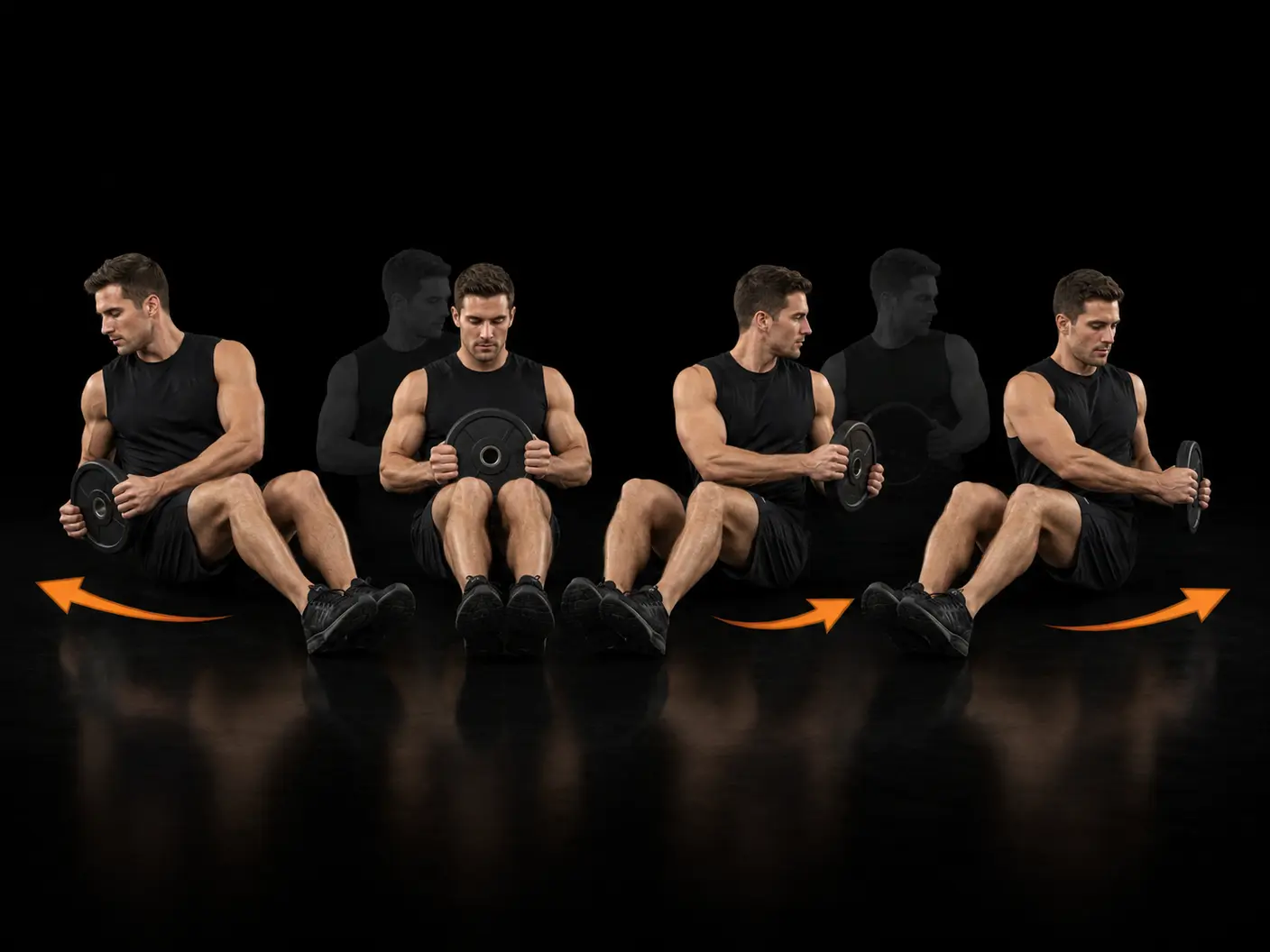
The weighted Russian twist is a seated rotational exercise that trains the obliques through repeated, controlled rotation of the torso against external load. Performed with a medicine ball or plate at a 45-degree lean, it challenges the core's ability to produce and resist rotation simultaneously — a pattern relevant to sport, daily movement, and structural conditioning alike. It suits a broad range of trainees, from those building general fitness to athletes developing rotational power endurance.
How to do it
Sit with knees bent, heels on the floor or lifted for more challenge. Lean back 45°. Hold a medicine ball or plate at the chest. Rotate the torso side to side, tapping the weight lightly near the floor on each side. Control the rotation through the core, not the arms.
Coaching cues
- Rotate through the core
- 45° lean back
- Control the weight
- Smooth tempo
Why train it
- The 45-degree lean places the trunk in a position that increases demand on the obliques throughout the full range of motion, supporting targeted hypertrophy of the lateral core musculature.
- Adding a medicine ball or plate introduces progressive overload to a bodyweight movement, allowing strength and work capacity to be tracked and increased systematically over time.
- The rotational pattern directly transfers to sport and functional activity, training the obliques and rectus abdominis to work together across transverse plane movements.
- Lifting the heels off the floor increases the stability challenge by removing a base of support, offering a straightforward progression variable without requiring additional equipment.
Common mistakes
- Rotating with the arms rather than the torso — initiate each rep from the ribcage and drive the movement through the core, keeping the arms relatively passive.
- Collapsing the lower back into a rounded position — maintain a neutral or slightly extended spine at the 45-degree lean throughout the set, not just on the first rep.
- Moving at an uncontrolled, fast tempo — each rotation should be deliberate in both directions; rushing reduces oblique engagement and shifts load away from the target muscles.
- Letting the hips rock side to side during rotation — the pelvis should remain stable throughout; movement should occur at the thoracic spine and waist, not the hips.
Primary: Obliques.
Secondary: Rectus Abdominis, Hip Flexors.
Equipment
Good for
Easier variation
Bodyweight Russian twist — no load.
Similar movements
Frequently asked
- What muscles does the weighted Russian twist work?
- The primary muscles trained are the obliques, which drive and control the rotational movement. The rectus abdominis and hip flexors act as secondary stabilisers, working to hold the trunk position and manage the load throughout each rep.
- How many sets and reps should I do for the weighted Russian twist?
- For hypertrophy and general fitness, 3–4 sets of 10–16 reps per side is a practical starting range. Select a weight that allows smooth, controlled rotation without the spine rounding or the hips shifting, and prioritise tempo over load in the early stages.
- Should my heels be on the floor or lifted?
- Keeping the heels on the floor reduces the stability demand and is the more accessible starting position. Lifting the heels increases the challenge to the hip flexors and core stabilisers, making it a useful progression once the base pattern is consistent.
- What is a good alternative to the weighted Russian twist?
- The cable woodchop or landmine rotation trains a comparable rotational pattern with more control over resistance and a standing position that may suit those who find the seated position uncomfortable. Pallof press variations are also effective for training anti-rotation through the same muscles.
- Is the weighted Russian twist suitable for beginners?
- It is classified as a foundational movement, so it is accessible to most beginners, though building familiarity with the bodyweight version first is advisable. Those who are new to core training should prioritise holding a neutral spine and smooth tempo before adding load or progressing to the heels-up variation.
Want this movement in a plan built for you?
Adaptiv programmes the right exercises for your goal, equipment and experience — then adapts them as you train.
Build my programme