Sled Drag (Backward)
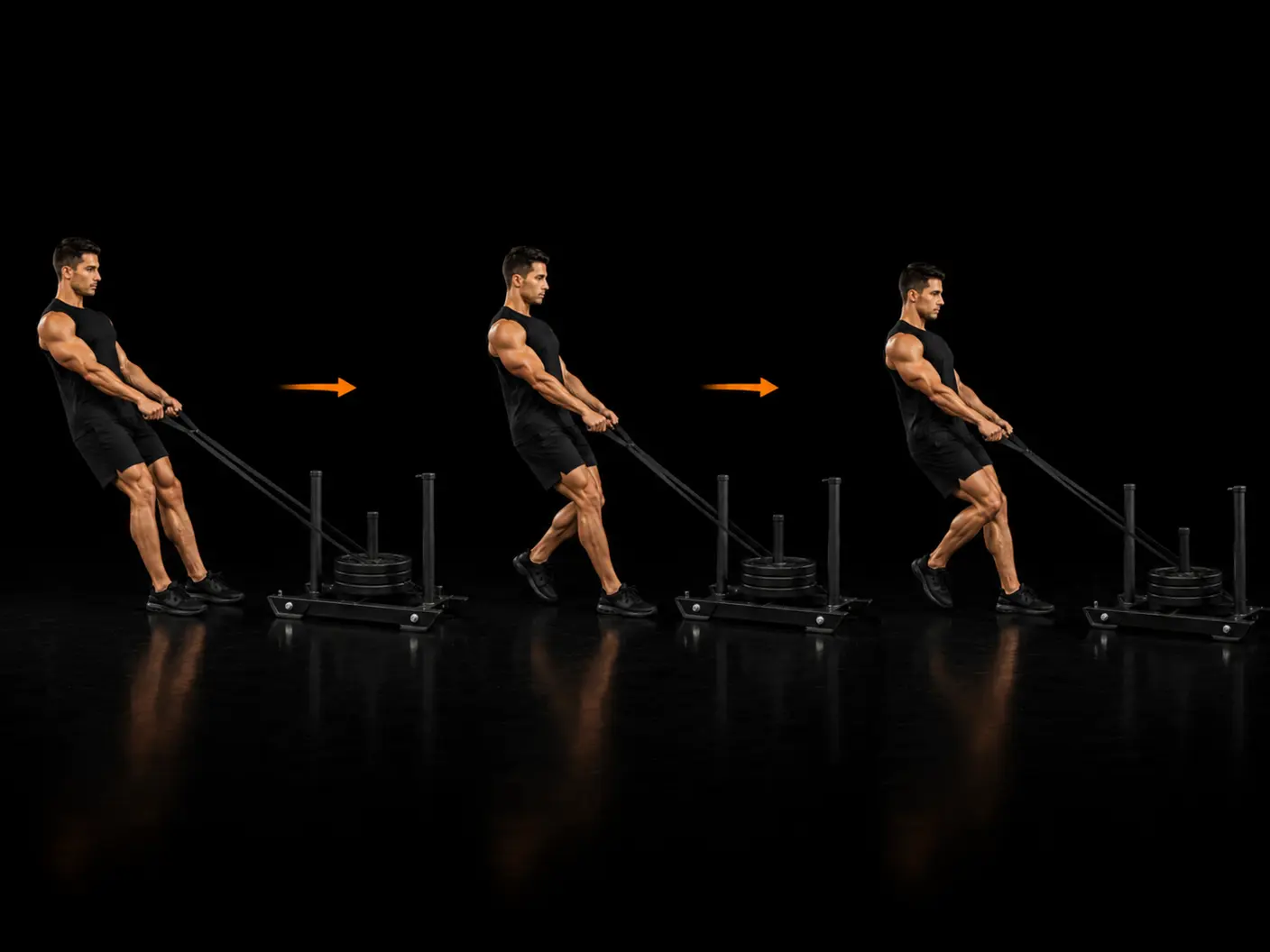
The backward sled drag is a loaded conditioning exercise performed by facing the sled and walking backwards, pulling the resistance through straps or a belt attached at the waist or hands. It trains the lower body in a linearly demanding pattern that places sustained stress on the quads, glutes, calves, and core without a significant eccentric loading phase. It suits intermediate trainees looking to build work capacity, support fat loss, or develop athletic qualities transferable to field and court sports.
How to do it
Face the sled, attached by straps or a belt. Walk backward, pulling the sled. Drive the quads on each step. Walk for distance or time.
Coaching cues
- Drive the quads
- Tall posture
- Steady pace
- Breathe steady
Why train it
- The near-absent eccentric component makes it a practical option for accumulating lower body volume with reduced delayed-onset muscle soreness between sessions.
- Sustained quad drive across each step builds meaningful strength-endurance in the anterior chain, which carries over to accelerating, decelerating, and change-of-direction tasks.
- Because the core must remain braced to transfer force from the legs through the straps, each rep reinforces midline stability under a moving, real-world load.
- Scalable by distance, time, and plate load, the backward sled drag integrates cleanly into conditioning circuits or as a standalone finisher for general fitness and body composition goals.
Common mistakes
- Leaning too far back from the hips — maintain a tall, upright posture throughout so force transfers efficiently through the straps rather than being bled off through a collapsed spine.
- Taking short, shuffling steps — extend each stride enough to produce genuine quad drive, as abbreviated steps reduce mechanical output and limit the training stimulus.
- Holding the breath — settle into a steady, rhythmic breathing pattern that matches your pace, as breath-holding elevates fatigue rate and undermines output over longer distances.
- Allowing the straps or belt to go slack — keep consistent tension on the sled at all times, as a slack line means wasted steps and an uneven training stimulus.
Primary: Quadriceps, Gluteus Maximus, Gastrocnemius, Rectus Abdominis.
Secondary: Hamstrings, Hip Flexors.
Equipment
Good for
Easier variation
Lighter load or shorter distance.
Similar movements
Frequently asked
- What muscles does the backward sled drag work?
- The primary muscles loaded are the quadriceps, glutes, calves, and core. The hamstrings and hip flexors contribute as secondary movers to control stride mechanics and hip position.
- How should I programme sets and reps for the backward sled drag?
- Because this is a distance- or time-based movement rather than a rep-based one, a common approach is three to six working sets of 20–40 metres or 30–60 seconds, with rest periods long enough to maintain consistent pace across each set. Load and volume should be adjusted based on your current conditioning level.
- Is the backward sled drag suitable for fat loss?
- Yes — it is listed as a primary goal for this exercise. The combination of sustained muscular effort and cardiovascular demand makes it an effective tool within a broader programme designed around energy expenditure and body composition.
- What are good alternatives if I do not have a sled?
- The backward sled drag is specific to the sled and strap setup, so a direct like-for-like substitution is difficult. Resistance band walks, step-ups, and leg press variations can target some of the same musculature, though they will not replicate the continuous loaded conditioning stimulus.
- How heavy should the sled be for this exercise?
- Select a load that allows you to maintain tall posture and a steady pace for the full working distance or time. If your technique deteriorates before the set is complete, reduce the load — pace and posture quality are more important than the weight on the sled.
Want this movement in a plan built for you?
Adaptiv programmes the right exercises for your goal, equipment and experience — then adapts them as you train.
Build my programme