Sled Drag (Forward)
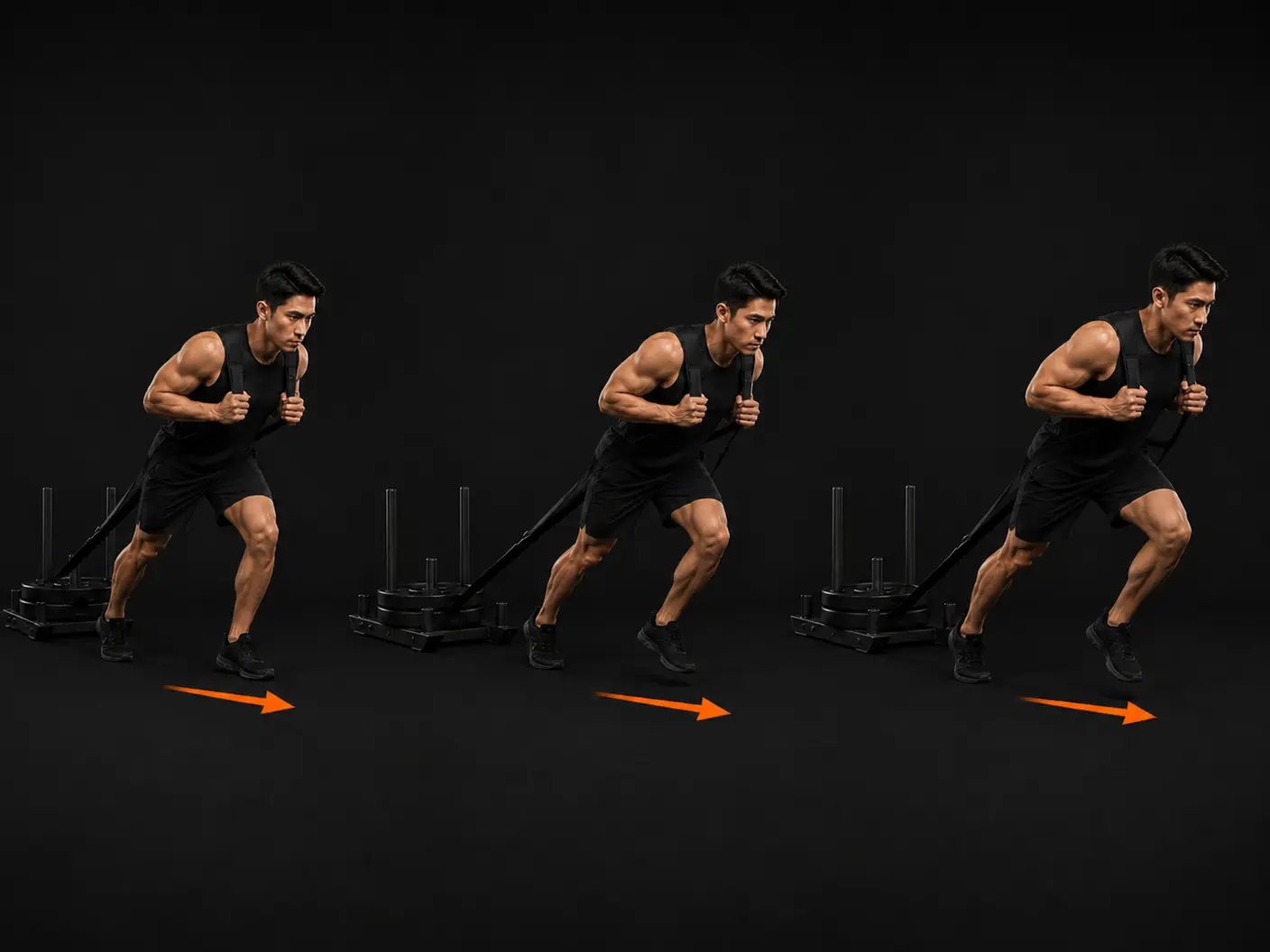
The forward sled drag is a loaded conditioning exercise performed by facing away from the sled and walking forward, pulling the weight via straps or a belt attached at the waist. It trains the posterior chain and core under sustained demand, making it an effective tool for developing work capacity alongside lower-body strength endurance. It suits intermediate trainees looking to build general fitness or support fat loss without the spinal loading associated with barbell movements.
How to do it
Face away from the sled, attached by straps or a belt at the waist. Walk forward, pulling the sled. Drive the legs, lean slightly forward. Walk for distance or time.
Coaching cues
- Lean forward slightly
- Drive the legs
- Steady pace
- Breathe steady
Why train it
- Develops posterior chain endurance by placing sustained demand on the glutes, hamstrings, and calves across distance or time.
- Provides a low-impact conditioning stimulus that elevates heart rate and metabolic demand without heavy eccentric loading on the joints.
- Reinforces upright, forward-leaning posture under load, which has carry-over to general athletic movement quality.
- Pairs well with strength sessions as a finisher, adding conditioning volume without significantly fatiguing the primary movers used in compound lifts.
Common mistakes
- Walking upright rather than leaning forward — maintain a slight forward lean from the ankles to keep tension on the straps and drive the sled efficiently.
- Taking short, shuffling steps — use deliberate, full strides and actively drive each leg into the ground to maintain momentum and engage the glutes and hamstrings.
- Holding the breath — establish a steady breathing rhythm from the outset, as irregular breathing accelerates fatigue and reduces the quality of longer efforts.
- Allowing the hips to sway side to side — brace the core throughout to keep the pelvis stable and transfer force cleanly through each stride.
Primary: Gluteus Maximus, Hamstrings, Gastrocnemius, Rectus Abdominis.
Secondary: Quadriceps.
Equipment
Good for
Easier variation
Lighter load or shorter distance.
Similar movements
Frequently asked
- What muscles does the forward sled drag work?
- The primary muscles worked are the glutes, hamstrings, calves, and core. The quads contribute as secondary movers during each stride.
- How far or how long should I drag the sled?
- Programme the drag by distance or time depending on your goal — intervals of 20–40 metres or 30–60 seconds suit most conditioning blocks. Rest periods should allow quality to be maintained across all sets, typically a 1:1 to 1:2 work-to-rest ratio.
- How much weight should I use on the sled?
- Start conservatively and select a load that allows you to maintain a consistent pace and good posture for the full distance or time. If your stride shortens significantly or your pace drops sharply before the set ends, reduce the load.
- Is the forward sled drag suitable for fat loss?
- Yes — it is listed as a primary training tool for fat loss because it sustains elevated heart rate and energy expenditure over the duration of each effort. Used in circuits or as a conditioning finisher, it can contribute meaningfully to overall caloric demand.
- What are good alternatives to the forward sled drag if I do not have access to a sled?
- Resisted walks using a resistance band anchored behind you, loaded carries such as a farmer's carry, or incline treadmill walking can replicate some of the conditioning and lower-body demand. However, none will fully replicate the specific loading pattern of a sled drag, so access to the equipment is worth seeking out.
Want this movement in a plan built for you?
Adaptiv programmes the right exercises for your goal, equipment and experience — then adapts them as you train.
Build my programme