Sled Push (Prowler)
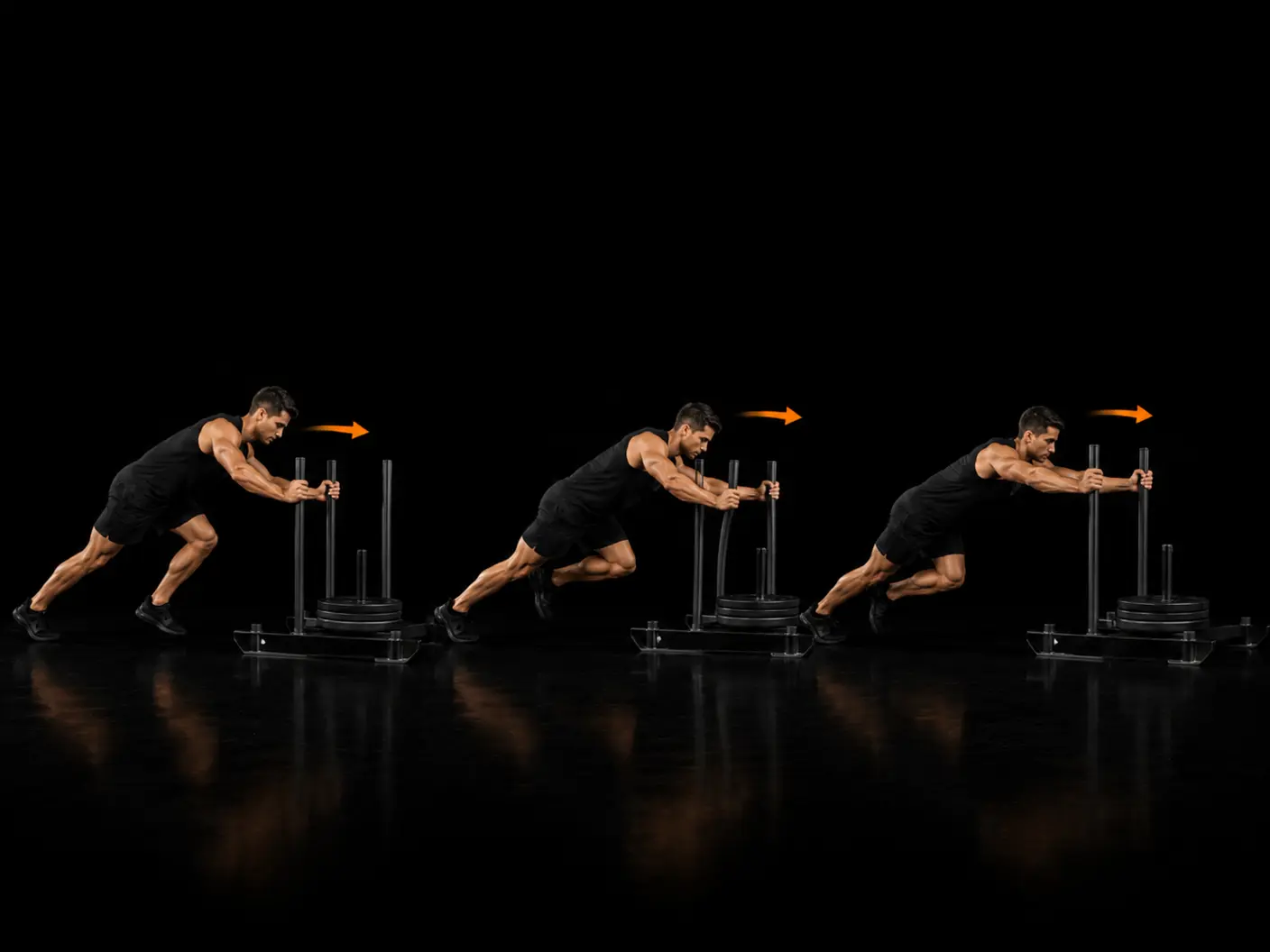
The sled push, commonly performed on a prowler-style sled, is a loaded conditioning drill that trains the lower body under sustained horizontal force production. It challenges the quads, glutes, hamstrings, and calves in a pattern that closely mirrors athletic acceleration, making it relevant for both sport performance and general fitness. Because the load is self-limiting — the sled simply stops if effort drops — it suits a wide range of trainees from intermediate gym-goers to competitive athletes.
How to do it
Grip the high or low handles of a sled. Drive the legs with long, powerful strides; keep the torso angled forward into the sled. Do not let the feet drift behind the body. Push for distance or time.
Coaching cues
- Drive the legs
- Torso angled forward
- Long strides
- Push with intent
Why train it
- The movement places the quads, glutes, and hamstrings under continuous tension throughout the push, making it an effective tool for developing lower-body strength-endurance.
- Because it involves no eccentric loading phase, muscle soreness is typically lower than with barbell movements, allowing it to be programmed more frequently within a training week.
- The sustained cardiovascular demand makes it a practical option for fat loss protocols, conditioning blocks, or as a finisher within a strength session.
- The forward-leaning body position and requirement to stabilise the torso throughout the push means the core and shoulders accumulate meaningful secondary work without isolating them separately.
Common mistakes
- Letting the feet drift too far behind the body — keep each foot strike close to directly beneath the hips to maintain drive and avoid losing power into the ground at a shallow angle.
- Standing too upright — angle the torso forward into the sled so that your body forms a roughly 45-degree line, allowing you to transfer force efficiently through the handles.
- Taking short, choppy steps — use long, deliberate strides to maximise the ground contact and power output each step produces.
- Pushing through the arms rather than the legs — the arms hold position and transfer force, but the drive should come from extending through the hips and knees with each stride.
Primary: Quadriceps, Gluteus Maximus, Gastrocnemius, Hamstrings.
Secondary: Rectus Abdominis, Triceps Brachii, Anterior Deltoid.
Equipment
Good for
Easier variation
Lighter load or shorter distance.
Similar movements
Frequently asked
- What muscles does the sled push work?
- The primary muscles trained are the quads, glutes, hamstrings, and calves. The core, triceps, and shoulders contribute as secondary stabilisers throughout the movement.
- How should I programme sled push for conditioning?
- A common approach is 4–6 sets of 20–40 metres with 60–90 seconds of rest for general conditioning, or shorter maximal efforts of 10–15 metres with fuller recovery for more power-focused work. Adjust load so that you can maintain long strides and a forward torso position throughout each effort.
- Can the sled push be used for fat loss?
- Yes — it produces a high cardiovascular demand without the technical complexity of Olympic lifts or the joint loading of heavy squats, making it a practical tool in fat loss programmes. It can be used as a standalone conditioning session or as a finisher after strength work.
- Is the sled push suitable for beginners?
- It is classified as an intermediate movement, primarily because managing load selection, stride mechanics, and torso angle simultaneously requires some foundational body awareness. Beginners can use it with light or no additional load once basic lower-body movement patterns are established.
- What is the difference between the high and low handle positions on a prowler?
- The high handles place the body in a more upright position and are generally better suited to heavier loads or longer distances where posture management is a priority. The low handles require a more aggressive forward lean and tend to increase demand on the hips and posterior chain, making them a useful choice for speed or acceleration-focused efforts.
Want this movement in a plan built for you?
Adaptiv programmes the right exercises for your goal, equipment and experience — then adapts them as you train.
Build my programme