Hill Sprints
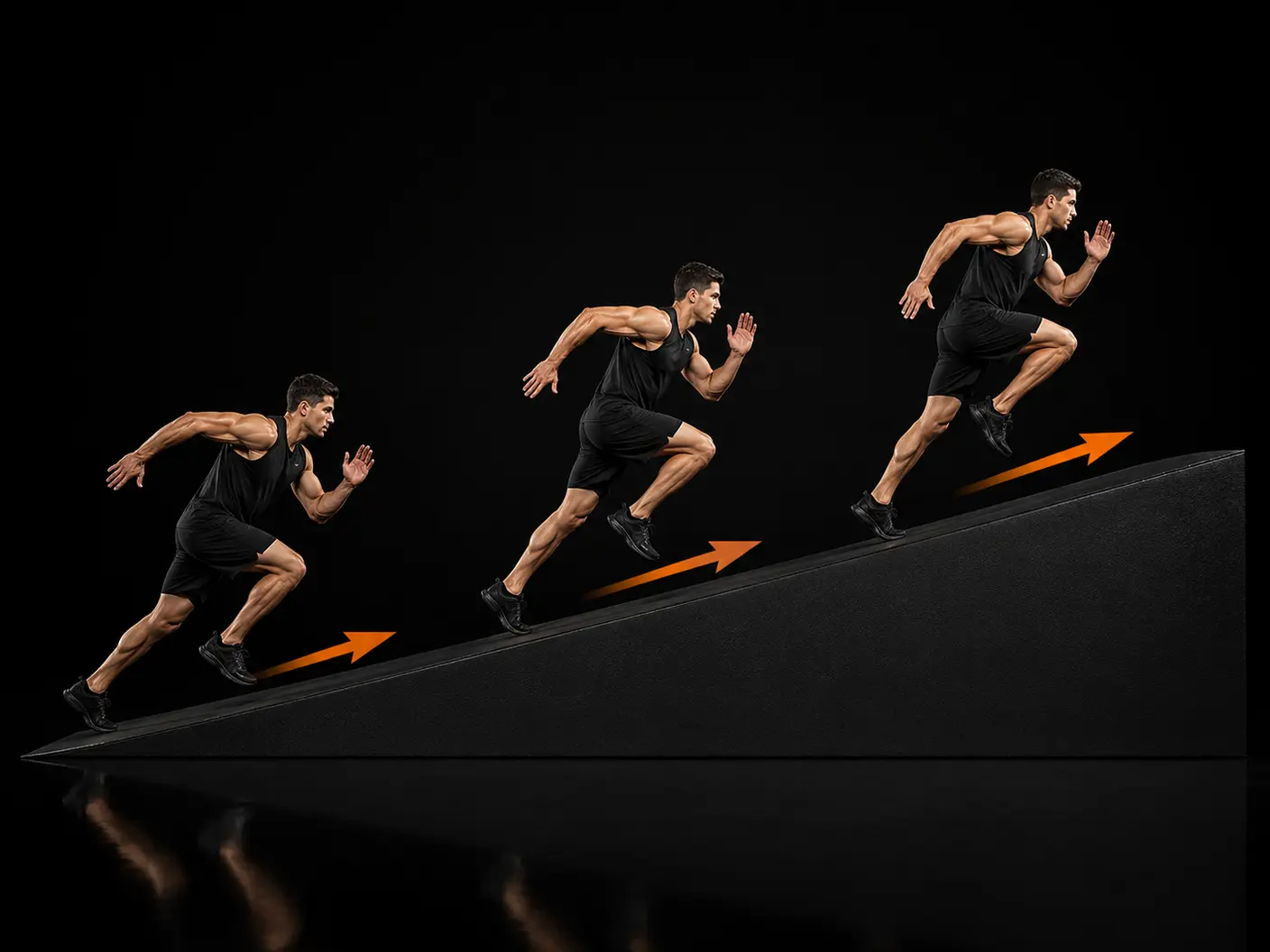
Hill sprints are a high-intensity conditioning method performed on a moderate incline of 10–20%, combining repeated short maximal efforts with active walking recovery. The incline shifts the demand onto the posterior chain and reduces the eccentric loading on the legs compared with flat sprinting, making the stimulus both productive and slightly more forgiving on the muscles. They suit intermediate athletes and those looking to develop lower-body power, cardiovascular capacity, or support fat loss through high-output work.
How to do it
Find a hill with a moderate incline (10–20%). Sprint up for 10–20 seconds. Walk down to recover. Repeat. The hill reduces eccentric loading vs flat sprinting.
Coaching cues
- Drive the knees
- Short strides
- Push up the hill
- Walk down recovery
Why train it
- The incline places a pronounced demand on the glutes, hamstrings, and quads, building lower-body strength and power alongside cardiovascular fitness in a single session.
- Because the hill reduces eccentric loading relative to flat sprinting, accumulated fatigue and muscle soreness are generally lower, allowing more frequent sessions within a training week.
- Short, maximal efforts repeated over a session create a significant metabolic demand, making hill sprints an efficient tool within a fat-loss programme.
- The pattern reinforces key athletic mechanics — knee drive, triple extension, and rhythmic arm action — that transfer directly to sport and field-based performance.
Common mistakes
- Overstriding up the hill — shorten your stride and focus on rapid turnover, keeping ground contact directly beneath your centre of mass.
- Losing forward lean and sitting upright — maintain a slight lean into the gradient to keep the glutes and hamstrings engaged through each push-off.
- Neglecting the walk-down recovery — walking down fully before the next effort is integral to the session; cutting it short compromises sprint quality and increases injury risk on subsequent reps.
- Sprinting at submaximal intensity — hill sprints derive their value from near-maximal effort on every rep, so if speed drops markedly across the set, extend your recovery or reduce the number of reps.
Primary: Gluteus Maximus, Hamstrings, Quadriceps, Gastrocnemius.
Secondary: Rectus Abdominis.
Equipment
Good for
Easier variation
Shorter hill or less steep gradient.
Similar movements
Frequently asked
- What muscles do hill sprints work?
- Hill sprints primarily target the glutes, hamstrings, quads, and calves. The core acts as a secondary stabiliser throughout each effort to maintain posture and transfer force efficiently up the incline.
- How many reps and sets should I do for hill sprints?
- A typical session for an intermediate trainee might involve 6–10 efforts of 10–20 seconds each, with a full walk-down recovery between reps. Start at the lower end of that range and add reps progressively as work capacity improves.
- Are hill sprints better than flat sprints for fat loss?
- Both modalities create a high metabolic demand, but the reduced eccentric stress of hill sprints means they can be repeated more frequently and with less soreness, which can support consistent training over time — a key factor in any fat-loss programme.
- What incline is best for hill sprints?
- A moderate gradient of 10–20% is the recommended range. Shallower than 10% reduces the posterior-chain emphasis, while steeper inclines can compromise sprint mechanics and place excessive stress on the Achilles and calf complex.
- Can beginners do hill sprints?
- Hill sprints are classified as an intermediate movement, primarily because they require a base level of conditioning and sprint mechanics before maximal efforts can be performed safely. Beginners would benefit from building aerobic capacity and learning basic sprint technique on flat ground before progressing to incline work.
Want this movement in a plan built for you?
Adaptiv programmes the right exercises for your goal, equipment and experience — then adapts them as you train.
Build my programme