High Knees
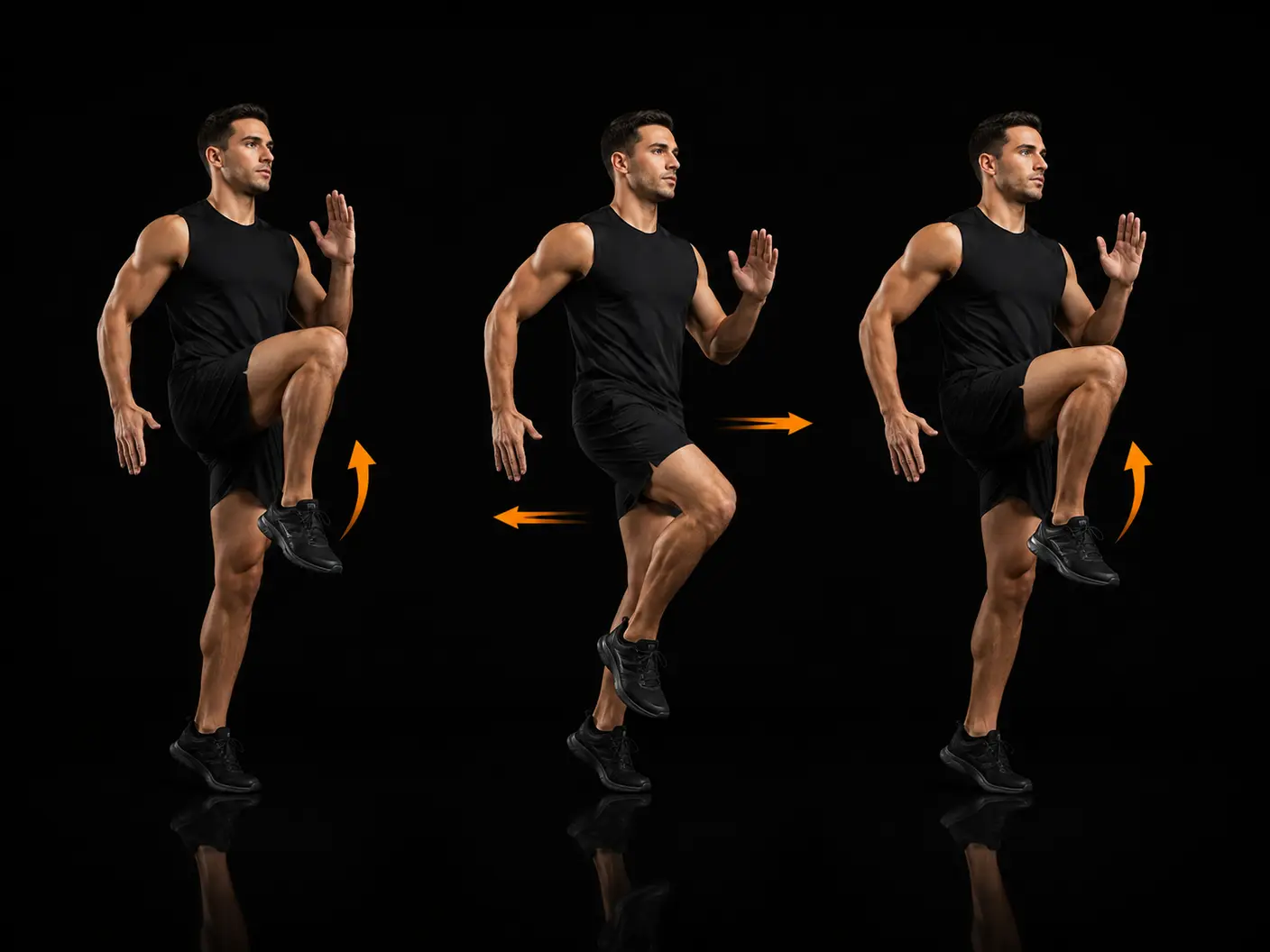
High knees are a bodyweight conditioning drill performed by running in place, alternately driving each knee to hip height in a controlled, rhythmic pattern. The movement trains hip flexor strength, quadriceps drive, and cardiovascular conditioning simultaneously, with the core and glutes working to stabilise the trunk throughout. It suits beginners establishing an aerobic base and more advanced athletes using it as a warm-up activator or metabolic finisher.
How to do it
Stand tall and run in place, driving each knee up to hip height in an alternating pattern. Pump the arms in opposition — right arm drives with the left knee. Stay on the balls of the feet and keep the torso upright. Drive the pace to increase metabolic demand.
Coaching cues
- Knee to hip height
- Arms pump in opposition
- Tall chest
- Stay on the toes
Why train it
- The repeated knee-drive pattern directly loads the hip flexors and quadriceps, reinforcing the same mechanics used in sprinting and jumping.
- Because intensity is governed entirely by pace, high knees can be scaled from a gentle warm-up drill to a demanding conditioning bout without any equipment changes.
- Performing the movement on the balls of the feet strengthens the calves and improves foot-contact mechanics relevant to running and agility work.
- The requirement to maintain a tall, upright torso under fatigue develops core endurance and postural control in a dynamic, functional context.
Common mistakes
- Letting the knees stay low — focus on driving each knee to hip height on every rep rather than simply shuffling the feet quickly.
- Leaning back through the torso — keep the chest tall and the gaze forward so the spine stays neutral rather than hyperextending at the lumbar.
- Allowing the arms to cross the midline — pump each arm directly forward and back in opposition to the opposite knee to keep movement efficient and balanced.
- Landing flat-footed — stay on the balls of the feet throughout so each ground contact is brief and the calves remain actively engaged.
Primary: Hip Flexors, Quadriceps.
Secondary: Gastrocnemius, Rectus Abdominis, Gluteus Maximus.
Equipment
Good for
Easier variation
Marching in place — slower tempo, no explosive knee drive.
Similar movements
Frequently asked
- What muscles do high knees work?
- The primary muscles are the hip flexors and quadriceps, which drive the knee upward and control its descent. The calves, glutes, and core work as secondary stabilisers throughout the movement.
- How many sets and reps should I do for high knees?
- Because high knees are a time-based drill, programme them in durations rather than rep counts — 20 to 30 seconds per set is a practical starting point, with 3 to 5 rounds depending on where they sit in the session. Reduce rest periods progressively to increase metabolic demand over time.
- Are high knees suitable for fat loss?
- They are a useful tool within a fat-loss programme because they raise heart rate quickly and require no equipment. They are best used as part of a structured conditioning circuit rather than as a standalone method.
- Can high knees replace running?
- High knees replicate some of the muscular and cardiovascular demands of running and are a practical substitute when space is limited, but they do not fully replicate the biomechanics of outdoor or treadmill running over distance. Use them as a complement to, rather than a replacement for, structured running work if athletic performance is the goal.
- Are high knees appropriate for beginners?
- Yes — the foundational difficulty rating reflects that no equipment or prior training history is required. Beginners should start at a controlled pace to establish correct knee height and arm mechanics before increasing speed.
Want this movement in a plan built for you?
Adaptiv programmes the right exercises for your goal, equipment and experience — then adapts them as you train.
Build my programme