Jumping Jack
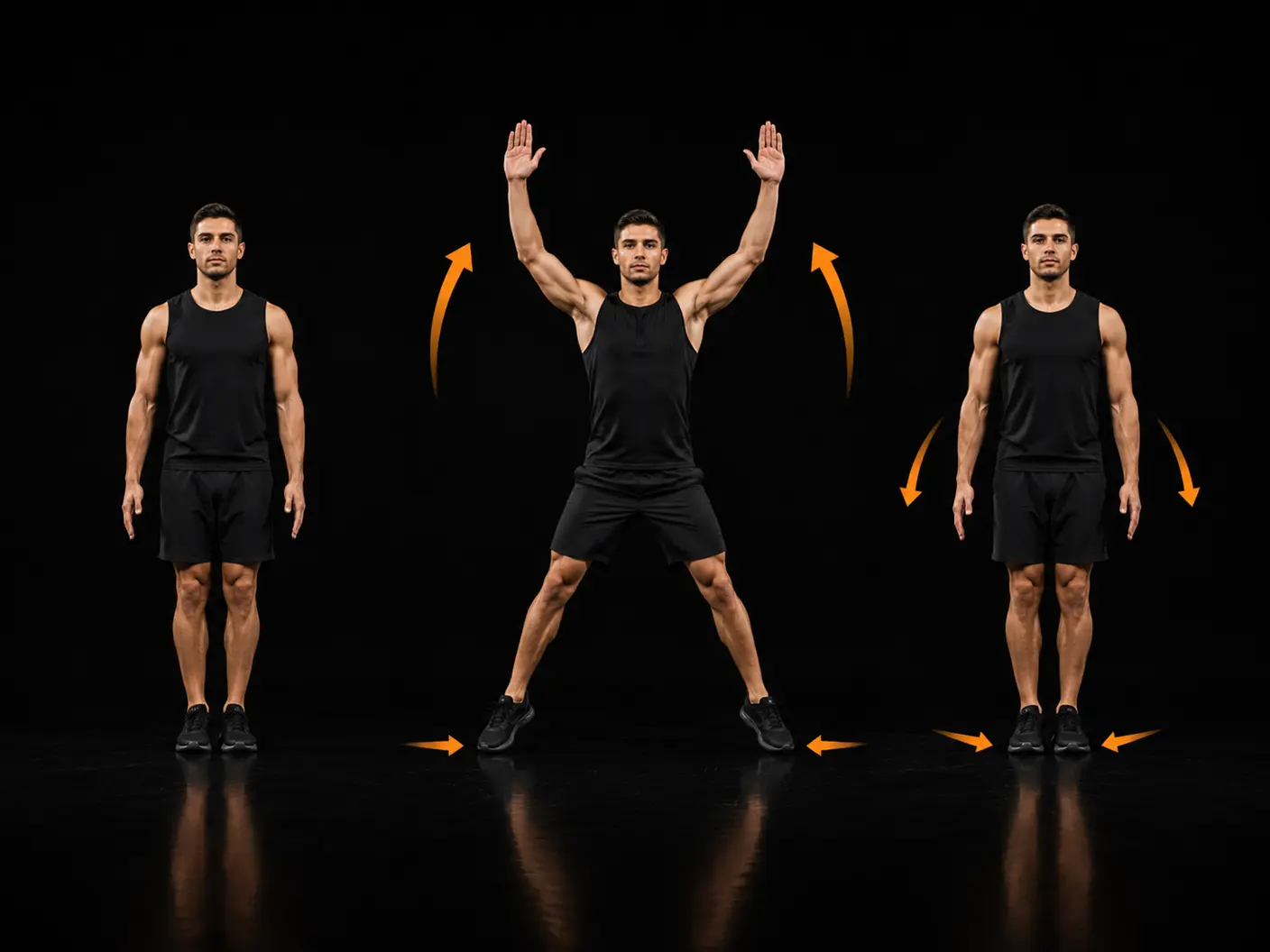
The jumping jack is a full-body conditioning movement that combines simultaneous lower-body abduction and upper-body elevation in a continuous, rhythmic cycle. It trains cardiovascular output, coordination, and basic movement fluency without any equipment. Its low technical demand makes it well suited to warm-ups, circuit training, and those returning to structured exercise.
How to do it
Stand tall, feet together, arms at sides. Jump feet out to shoulder-width while raising the arms overhead to a Y position. Jump feet back together as arms return to sides. Maintain a light, rhythmic pace and land softly on the balls of the feet.
Coaching cues
- Soft landing
- Arms reach overhead
- Light and rhythmic
- Stay tall
Why train it
- Elevates heart rate quickly, making it an efficient tool for general cardiovascular conditioning and fat-loss-focused sessions.
- The simultaneous arm and leg action develops whole-body coordination and rhythm that carries over to more complex athletic movements.
- Repeated soft landings on the balls of the feet reinforce good landing mechanics and calf resilience over time.
- Requiring no equipment and minimal space, it can be programmed into any setting from a commercial gym floor to a home environment.
Common mistakes
- Landing flat-footed or on the heels — keep contact on the balls of the feet throughout to absorb force correctly and maintain the light, rhythmic quality of the movement.
- Letting the torso lean forward or the posture collapse — stay tall through the spine on every rep so the hips and shoulders remain stacked.
- Swinging the arms rather than lifting them — reach the arms actively overhead into a Y position so the deltoids are engaged rather than momentum doing the work.
- Using an erratic, uncontrolled tempo — aim for a consistent, steady rhythm rather than sprinting through reps, which reduces coordination and increases the risk of a sloppy landing.
Primary: Gluteus Medius, Gastrocnemius.
Secondary: Anterior Deltoid, Quadriceps.
Equipment
Good for
Easier variation
Step jacks — step one foot out and back instead of jumping.
Similar movements
Frequently asked
- What muscles do jumping jacks work?
- The primary muscles are the hip abductors, which drive the legs outward, and the calves, which manage each landing and push-off. The deltoids are secondarily loaded as the arms raise overhead, and the quadriceps assist in controlling the landing and returning to standing.
- How many sets and reps should I do?
- For a warm-up, two to three sets of 20–30 repetitions are typically sufficient to raise core temperature. In a conditioning circuit, 30–60 seconds of continuous effort works well, with rest periods scaled to the overall session intensity.
- Are jumping jacks good for fat loss?
- They are a practical tool within a fat-loss programme because they raise heart rate with minimal technical barrier and can be performed anywhere. Like all conditioning work, their contribution to fat loss depends on overall programme structure and nutritional habits rather than the exercise alone.
- What are good alternatives to jumping jacks?
- Movements with a similar conditioning pattern include star jumps, lateral step-touches for a lower-impact option, or skipping, all of which train rhythmic full-body coordination. If joint loading is a concern, speak with a qualified professional before selecting an alternative.
- Can beginners do jumping jacks?
- Yes — jumping jacks are classified as a foundational movement precisely because the technique is straightforward and the load is self-regulated by bodyweight. Beginners should focus on the coaching cues: soft landings, reaching the arms fully overhead, and maintaining an upright posture throughout.
Want this movement in a plan built for you?
Adaptiv programmes the right exercises for your goal, equipment and experience — then adapts them as you train.
Build my programme