Skip (A-Skip)
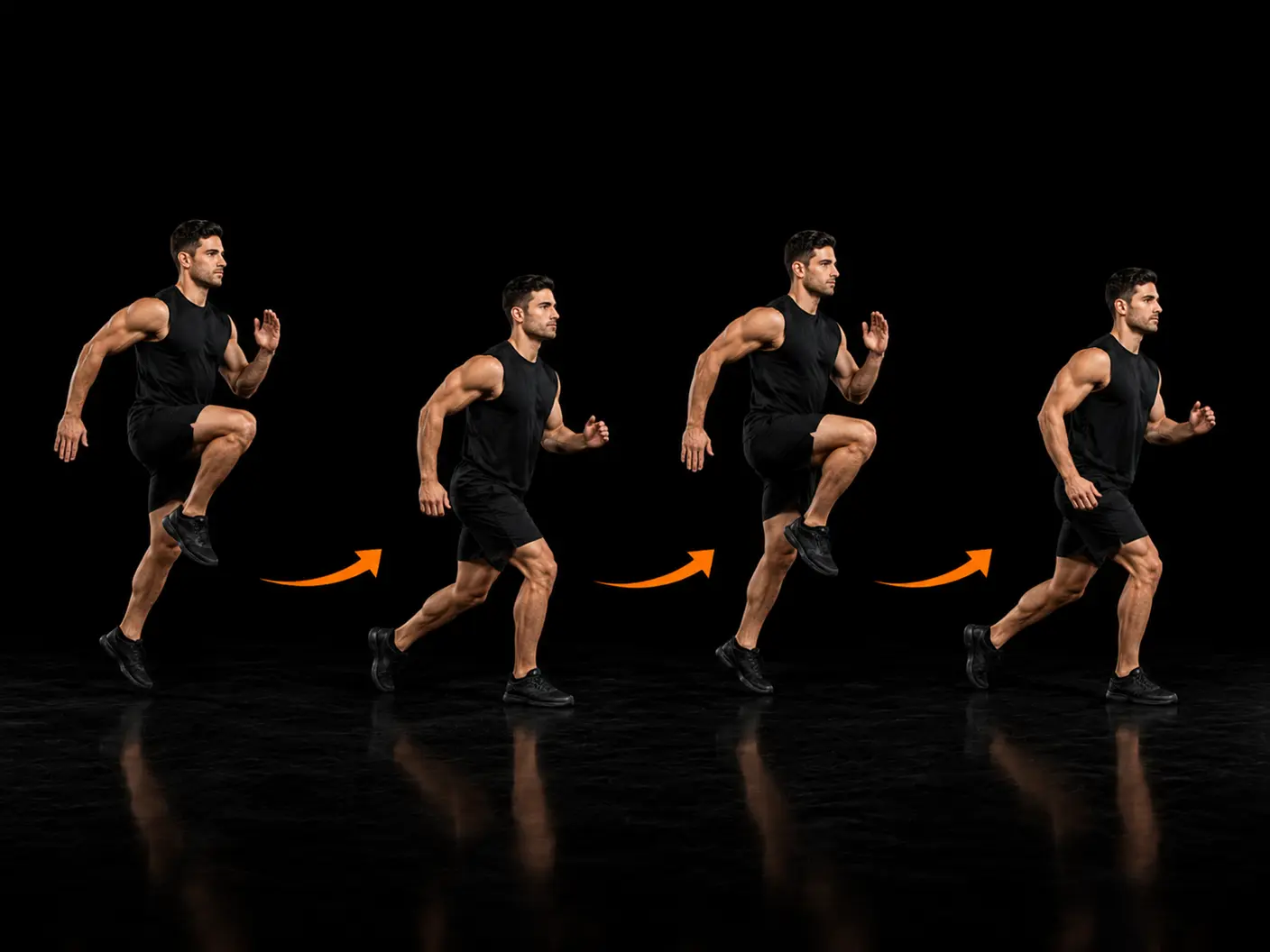
The A-skip is a foundational plyometric drill that combines a rhythmic alternating skip pattern with an exaggerated high knee drive and a brief calf extension on the support leg. It trains the co-ordination between hip flexion, ground contact mechanics, and arm opposition — qualities that underpin sprinting and general athletic movement. It suits beginners learning to move athletically as well as more experienced athletes using it as a warm-up or neuromuscular primer.
How to do it
Drive one knee up aggressively while hopping off the other foot. The hop leg performs a slight calf extension. The opposite arm drives forward in sync with the knee drive. Alternate legs in a rhythmic skip pattern, moving forward. The A-skip biases high knee drive and calf contact.
Coaching cues
- High knee drive
- Tall posture
- Arm opposition
- Light foot contact
- Rhythmic tempo
Why train it
- The emphasis on high knee drive develops hip flexor strength and reinforces the mechanics of an efficient running stride.
- Repeated brief calf extensions on the support leg build lower leg stiffness and improve ground contact quality under rhythmic loading.
- The requirement for arm opposition and upright posture trains whole-body co-ordination and reinforces tall, controlled movement patterns.
- Because it requires only bodyweight and open space, it integrates easily into warm-up routines, circuit sessions, or track-based conditioning work.
Common mistakes
- Letting the torso lean forward — maintain tall posture throughout by keeping the chest up and eyes forward.
- Driving the knee without extending the support calf — push off actively through the ball of the foot on each hop to engage the lower leg correctly.
- Using sluggish or mismatched arm swing — drive the opposite arm forward decisively in time with each knee drive to reinforce rhythm and posture.
- Making heavy, flat-footed contacts — aim for light, springy ground contact rather than stomping, which undermines the plyometric intent of the drill.
Primary: Hip Flexors, Gastrocnemius, Gluteus Maximus.
Secondary: Quadriceps, Hamstrings, Rectus Abdominis.
Equipment
Good for
Easier variation
Walking knee drive — slow the pattern to a march, focusing on knee lift without the hop.
Similar movements
Frequently asked
- What muscles does the A-skip work?
- The primary muscles are the hip flexors, calves, and glutes. The quadriceps, hamstrings, and core are also engaged as secondary contributors to support posture and stabilise the movement.
- How many sets and reps should I do for the A-skip?
- Because it is a co-ordination and rhythm drill, the A-skip is typically prescribed by distance rather than reps — 2 to 4 sets of 20 to 30 metres works well in most warm-up or activation contexts. Rest fully between efforts so quality of movement does not deteriorate.
- Is the A-skip suitable for beginners?
- Yes — it is classified as a foundational movement, meaning the technique is accessible to those new to athletic training. Focus on rhythm and posture before trying to increase speed or height of the knee drive.
- What is the difference between an A-skip and a B-skip?
- The A-skip prioritises the upward knee drive with a light calf hop, whereas the B-skip adds a pawing or leg extension action as the raised foot returns to the ground. Both drills complement each other and are common fixtures in sprint mechanics warm-up sequences.
- Can I use the A-skip to improve my running performance?
- The drill is directly relevant to running mechanics, particularly the hip flexion pattern, arm opposition, and ground contact qualities that determine stride efficiency. Programming it as part of a structured warm-up before speed or conditioning sessions is a practical way to reinforce those patterns over time.
Want this movement in a plan built for you?
Adaptiv programmes the right exercises for your goal, equipment and experience — then adapts them as you train.
Build my programme