Hopping Calf Raise
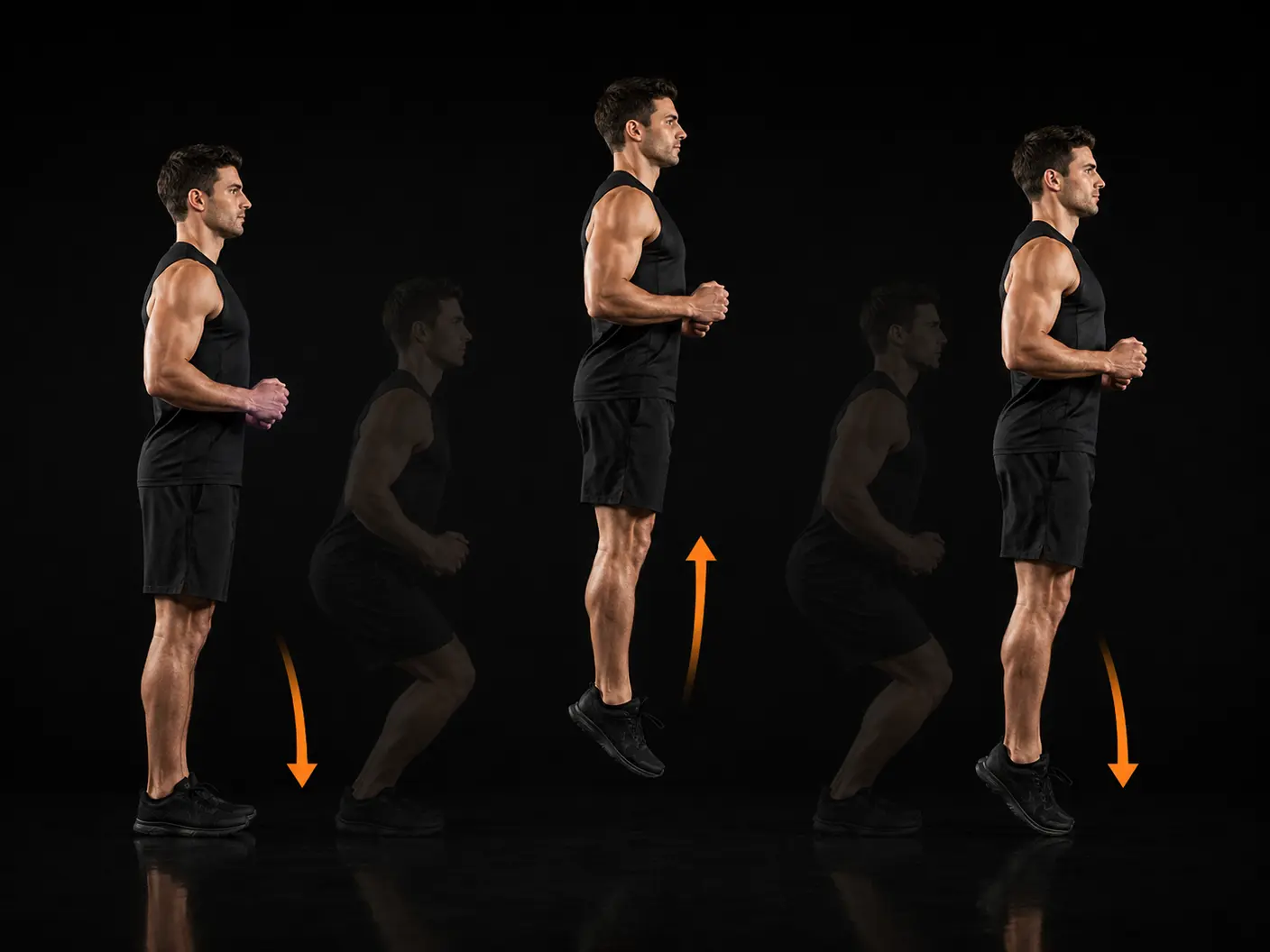
The hopping calf raise is a plyometric bodyweight exercise that trains the stretch-shortening cycle of the ankle complex, requiring the gastrocnemius and soleus to absorb and express force in rapid succession. Unlike a conventional calf raise, the emphasis here is on minimising ground contact time and maximising the speed of each rebound — making it a reactive power drill rather than a slow, loaded strength exercise. It suits intermediate trainees looking to develop lower-leg stiffness, elastic energy return, and the kind of ankle mechanics that underpin running, jumping, and change-of-direction tasks.
How to do it
Stand feet hip-width, arms at sides or chest. Pogo hop in place using only the ankles — knees stay nearly locked. Minimise ground contact time. Land on the balls of the feet and rebound immediately. Continue for reps or time.
Coaching cues
- Stiff knees
- Ankle pops
- Minimal ground contact
- Balls of the feet
Why train it
- Develops reactive ankle stiffness, which directly supports performance in sprinting, jumping, and court-based sports where rapid force transmission through the lower leg is essential.
- Trains both the gastrocnemius and soleus under high-frequency loading conditions, improving the capacity of the calf complex to cycle through stretch and contraction quickly.
- Requires no equipment, making it straightforward to programme as a warm-up drill, a finisher, or a stand-alone plyometric stimulus within a bodyweight session.
- The high-repetition or timed nature of the exercise places a meaningful metabolic demand on the lower leg musculature, making it a practical inclusion in fat-loss-focused conditioning blocks.
Common mistakes
- Bending the knees throughout the movement — keep the knees nearly locked so that all propulsion and absorption is directed through the ankle rather than distributed into the knee and hip.
- Landing through the mid or heel of the foot — make contact exclusively on the balls of the feet to maintain the elastic rebound quality the exercise demands.
- Spending too long on the ground between hops — treat each landing as a brief touch rather than a pause, and redirect force upward as quickly as possible to preserve the plyometric stimulus.
- Using excessive arm swing to generate momentum — keep the arms at the sides or held at the chest so the calf complex is responsible for producing the hop, not the upper body.
Primary: Gastrocnemius, Soleus.
Equipment
Good for
Easier variation
Double-foot calf raise on the ground — builds the motor pattern without impact.
Similar movements
Frequently asked
- What muscles does the hopping calf raise work?
- The primary muscles are the gastrocnemius and soleus, which together make up the calf complex at the rear of the lower leg. The ankle stabilisers act as secondary contributors, managing the lateral and rotational forces that occur during each landing and rebound.
- How many sets and reps should I do?
- Because this is a reactive, time-sensitive drill, it is often more practical to programme it by duration rather than strict rep count — sets of 10 to 20 seconds with full recovery between efforts work well. For rep-based programming, 3 to 4 sets of 15 to 25 contacts is a reasonable starting point, with rest long enough to maintain ground-contact quality across all sets.
- Is this exercise suitable for beginners?
- The movement is rated intermediate, primarily because maintaining stiff knees and a fast, controlled rebound requires a degree of lower-leg strength and body awareness that many beginners have not yet developed. Those new to plyometric training would benefit from consolidating a standard calf raise and basic pogo drills before progressing to the full hopping calf raise protocol.
- What are good alternatives if I find this too demanding?
- A slow, controlled bodyweight calf raise is the logical regression, as it loads the same primary muscles with none of the reactive demand. Double-leg low-amplitude pogo hops with soft knees are another stepping stone, allowing the trainee to practise ground-contact awareness before adding the stiff-knee constraint.
- Can the hopping calf raise help with running performance?
- The stiffness and reactive ankle mechanics trained in this exercise closely mirror the demands placed on the lower leg during running, particularly at higher speeds. Regularly including it in a programme can help reinforce the elastic qualities that contribute to efficient foot strike and propulsion, though it should sit alongside broader sprint and strength work rather than replace it.
Want this movement in a plan built for you?
Adaptiv programmes the right exercises for your goal, equipment and experience — then adapts them as you train.
Build my programme