Pogo Hops
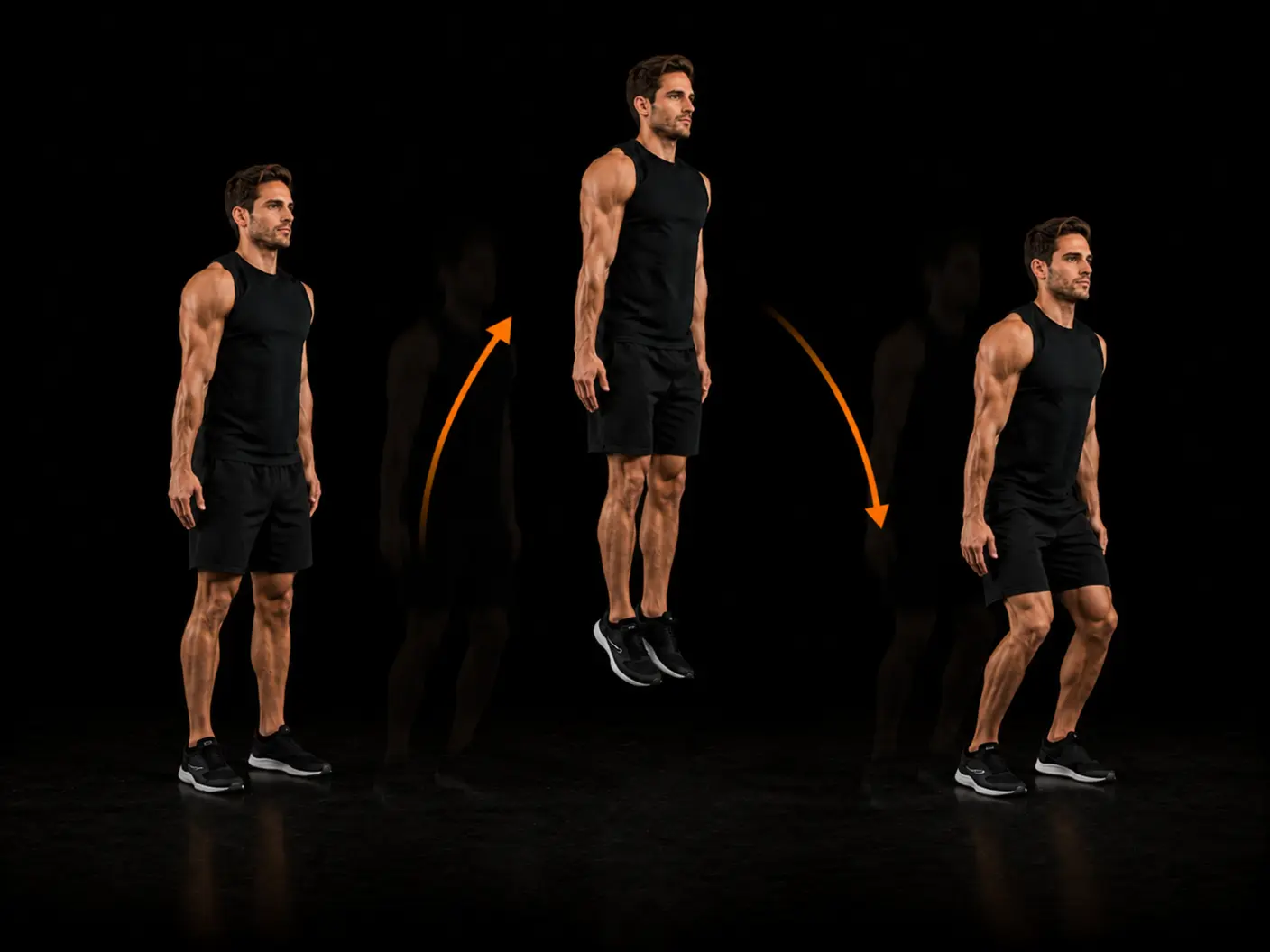
Pogo hops are a foundational plyometric drill that trains the stretch-shortening cycle through rapid, stiff-legged ankle drive. The movement isolates the calves and Achilles tendon as the primary force producers, with the knees remaining nearly straight throughout and contact time kept deliberately short. They suit anyone building a base of reactive strength — from team-sport athletes to runners looking to improve ground contact efficiency.
How to do it
Stand feet hip-width. Hop in place using only ankle drive; knees stay nearly straight. Minimise ground contact time. Land on the balls of the feet and rebound. Continue for reps or time.
Coaching cues
- Stiff knees
- Ankle pops
- Fast contact
- Balls of the feet
Why train it
- Develops elastic stiffness in the Achilles tendon and calf complex, a key quality underpinning running economy and jumping performance.
- The minimal ground contact time trains the nervous system to produce force rapidly, improving reactive strength without significant muscular fatigue or loading.
- Because the movement is bodyweight-only and technically straightforward, it can be used as a daily drill or warm-up primer without meaningful recovery cost.
- The core and quadriceps work isometrically to maintain posture and leg stiffness, making pogo hops a useful introduction to whole-body tension under plyometric conditions.
Common mistakes
- Allowing the knees to bend deeply on landing — keep them nearly straight so the ankle and Achilles absorb and return force rather than offloading to the knee.
- Spending too long on the ground between hops — focus on the shortest possible contact time, treating the floor like a hot surface you want to leave immediately.
- Landing through the heel rather than the ball of the foot — contact should occur at the forefoot to allow the calf and Achilles to load and rebound correctly.
- Letting the torso collapse or sway — brace the core and keep the body upright so force travels vertically rather than being dissipated through postural breakdown.
Primary: Gastrocnemius.
Secondary: Quadriceps, Rectus Abdominis.
Equipment
Good for
Easier variation
Double-contact pogo — pause briefly between hops.
Similar movements
Frequently asked
- What muscles do pogo hops work?
- The primary muscles are the calves and Achilles tendon, which are responsible for the rapid ankle extension driving each hop. The quadriceps and core contribute isometrically, maintaining leg stiffness and postural control throughout the drill.
- How many sets and reps should I do for pogo hops?
- For reactive strength development, 3–5 sets of 10–20 contacts, or 10–20 seconds of continuous hopping, works well with full recovery between sets. Quality of contact — stiffness, minimal ground time — matters considerably more than volume.
- Are pogo hops suitable for beginners?
- Yes, the foundational difficulty rating reflects that they require no equipment and the loading is modest. However, individuals who have not previously trained plyometrics should start with shorter sets and prioritise landing mechanics before increasing duration or pace.
- What are good alternatives to pogo hops?
- If you want a similar ankle-stiffness stimulus with slightly more progression, single-leg pogo hops increase the demand on each limb individually. For those who need to reduce impact, calf raises performed with a fast, rhythmic tempo can begin to develop the same tissue qualities before introducing a plyometric element.
- How do pogo hops improve athletic performance?
- They develop the ability to store and return elastic energy through the Achilles tendon quickly, which directly contributes to sprint acceleration, jump height, and running efficiency. Regular exposure to short ground contact times also conditions the neuromuscular system to produce high rates of force development — a quality that transfers across most team and track sports.
Want this movement in a plan built for you?
Adaptiv programmes the right exercises for your goal, equipment and experience — then adapts them as you train.
Build my programme