Spoto Press
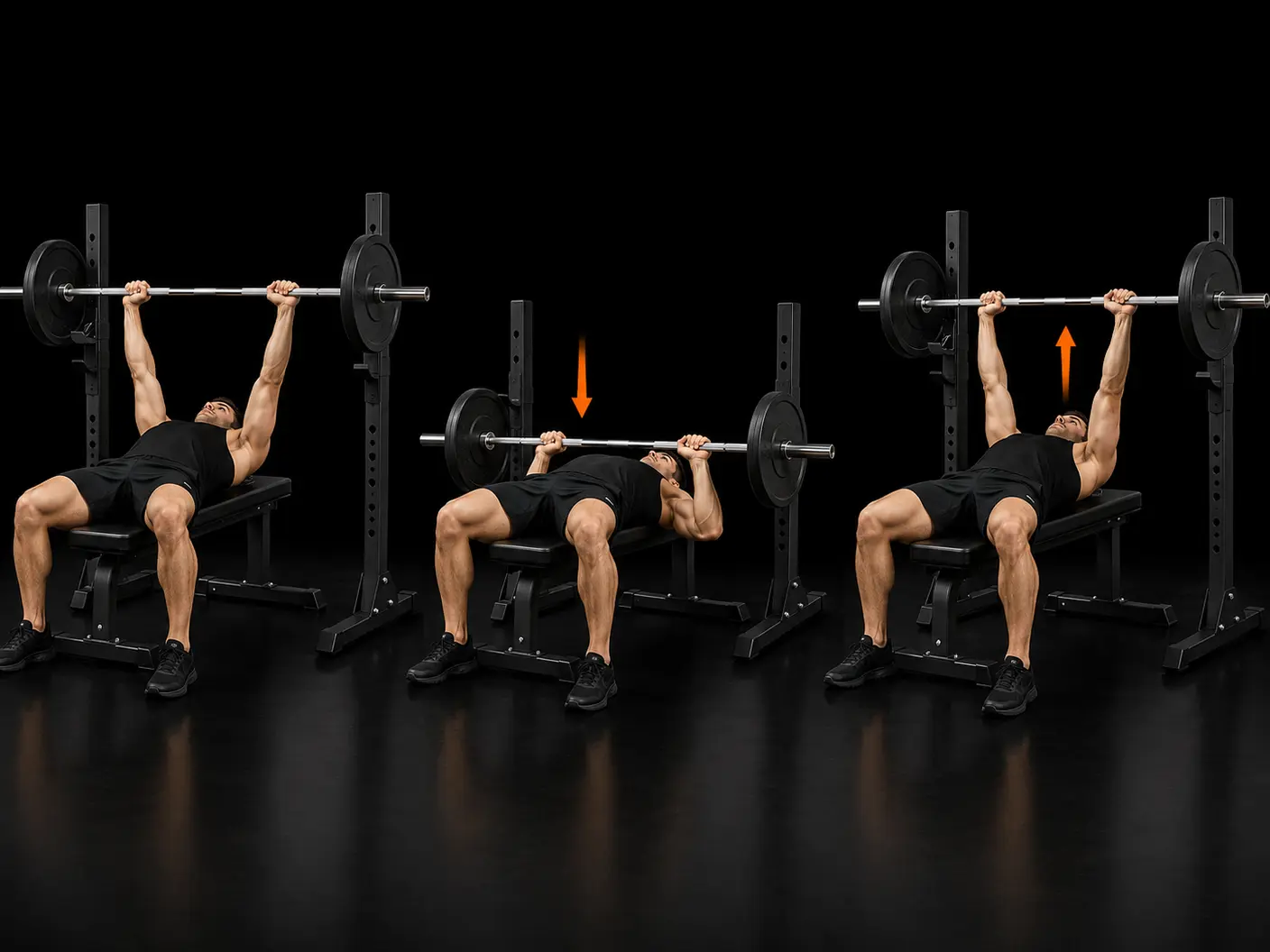
The Spoto press is a flat bench press variation in which the bar is lowered to within 1–2 inches of the chest and held in a strict pause before pressing back to lockout — never making contact with the sternum. By eliminating the stretch reflex at the bottom of the lift, the movement forces the pectoral major and triceps to generate force from a position of near-full stretch without any elastic assistance. It suits intermediate to advanced pressers looking to address sticking points and build genuine strength through the bottom range of the bench press.
How to do it
Set up as a flat bench press. Unrack. Lower the bar toward the chest but stop 1–2 inches above; pause for a count. Without letting the bar touch the chest, press back up to lockout. The pause without chest contact eliminates stretch reflex.
Coaching cues
- Hover 1–2 inches above chest
- Pause and hold
- Strict pause
- Press with intent
Why train it
- Removing the stretch reflex forces the pectoralis major and triceps to produce force independently, building strength at the weakest point of the bench press.
- The controlled hover and pause develop positional awareness and bar path discipline that transfer directly to competition or max-effort bench pressing.
- Holding the bar off the chest under load increases time under tension through the bottom range, providing a targeted stimulus for hypertrophy in the pectorals.
- Programming the Spoto press alongside conventional bench work creates a measurable reference point for identifying and correcting sticking-point weaknesses.
Common mistakes
- Allowing the bar to touch the chest — maintain a deliberate hover of 1–2 inches throughout the pause so the stretch reflex is never engaged.
- Cutting the pause short — count a full, unhurried beat before initiating the press; rushing defeats the purpose of the variation.
- Losing upper back tightness during the hold — keep the scapulae retracted and depressed for the duration of the pause, not just on the descent.
- Pressing with a lazy or drifting bar path — drive the bar back toward lockout with the same intent as a working set, keeping the path consistent from rep to rep.
Primary: Pectoralis Major, Triceps Brachii.
Secondary: Anterior Deltoid.
Equipment
Good for
Easier variation
Paused bench press (on chest) — easier entry to pause work.
Similar movements
Frequently asked
- What muscles does the Spoto press work?
- The primary movers are the pectoralis major and triceps. The anterior deltoid acts as a secondary contributor throughout the press.
- How is the Spoto press different from a regular paused bench press?
- A standard paused bench press rests the bar on the chest before pressing; the Spoto press holds the bar 1–2 inches above the chest without contact. That distinction removes the stretch reflex entirely, making the movement considerably more demanding at the bottom position.
- What sets and reps should I use for the Spoto press?
- For strength development, three to five sets of three to five reps at 70–80 % of your bench press one-rep max is a practical starting point. Because the pause position is mechanically demanding, err on the side of slightly less load than you might expect to manage.
- Where does the Spoto press fit in a programme?
- It works well as a primary pressing movement on an upper-body or push day, or as a close variation placed after a main bench press to address bottom-range weakness. It is not well suited to high-rep fatigue work given the precision the pause demands.
- Are there alternatives if I find the Spoto press too advanced?
- A paused bench press — where the bar rests on the chest — is a logical regression that still reduces reliance on the stretch reflex while offering a more stable bottom position. Once you are comfortable controlling a full pause on the chest, progressing to the hover of the Spoto press becomes more manageable.
Want this movement in a plan built for you?
Adaptiv programmes the right exercises for your goal, equipment and experience — then adapts them as you train.
Build my programme