Split Jump (Lunge Jump)
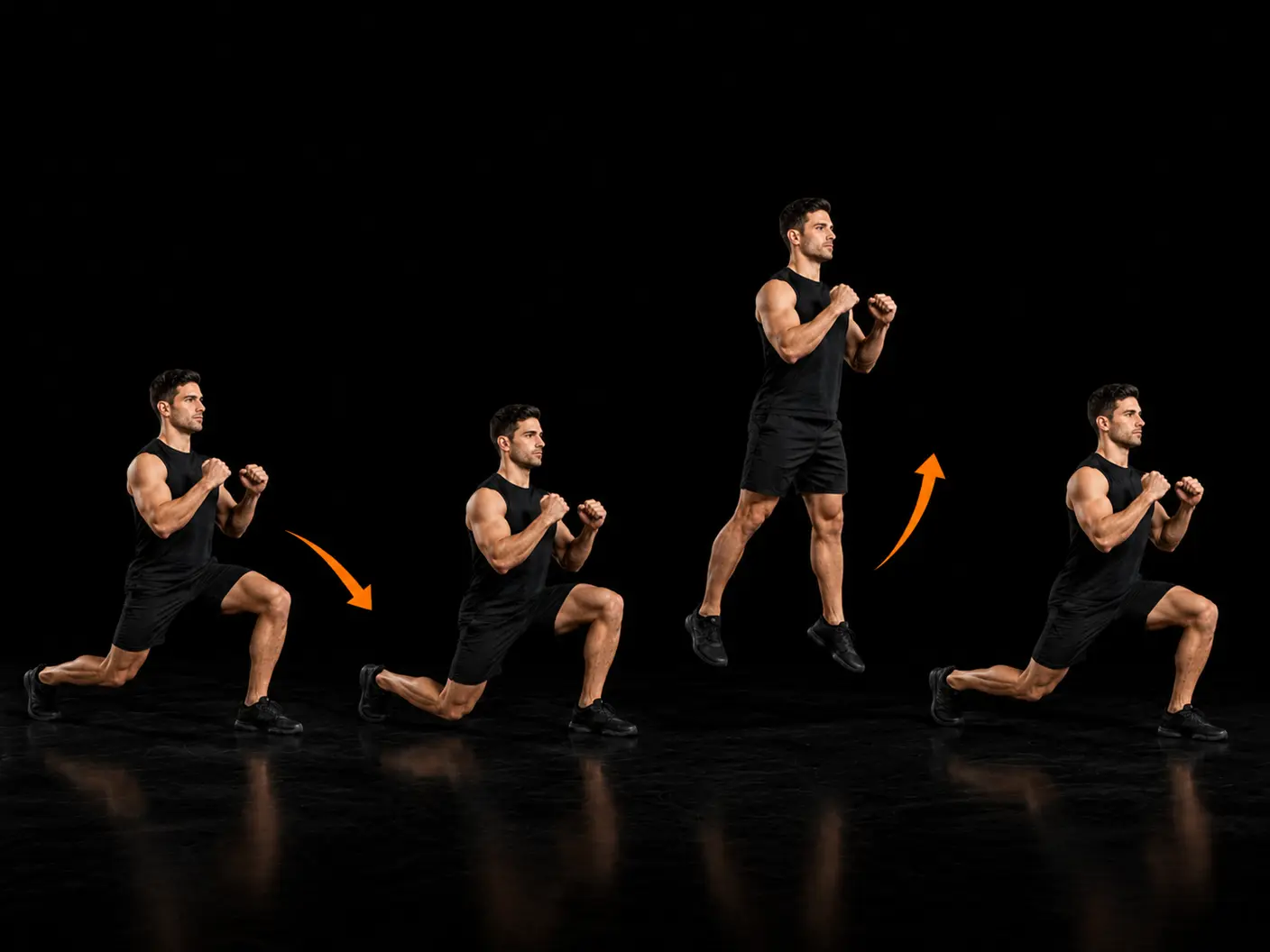
The split jump, also known as the lunge jump, is a plyometric compound movement that trains lower-body power through repeated explosive split-stance takeoffs and landings. It challenges the quadriceps, glutes, hamstrings, and calves to produce and absorb force rapidly, while the core works throughout to maintain an upright torso position. It suits intermediate trainees looking to develop athletic power, improve conditioning, or add intensity to bodyweight training.
How to do it
Start in a split stance lunge position. Descend into a lunge and then explode upward, switching foot positions in mid-air to land in the opposite split stance. Absorb the landing with a soft, bent-knee catch and immediately descend into the next repetition.
Coaching cues
- Explode off both feet
- Switch in the air
- Soft landing
- Stay tall through the torso
Why train it
- Develops lower-body explosive power by requiring maximal force production through each takeoff, making it directly transferable to sprinting, jumping, and change-of-direction tasks.
- Trains both legs under near-equal load within each set, helping to identify and address asymmetries in strength or coordination between limbs.
- Elevates heart rate significantly due to the continuous, high-intensity nature of the movement, supporting caloric expenditure and cardiovascular conditioning without equipment.
- Reinforces deceleration mechanics through the repeated soft-landing requirement, building the capacity to absorb impact safely across the ankle, knee, and hip.
Common mistakes
- Landing stiff-legged — allow the ankle, knee, and hip to bend on contact to absorb force effectively and reduce impact through the joints.
- Letting the torso lean excessively forward — maintain a tall spine throughout the movement by keeping the chest up and shoulders back as described in the coaching cues.
- Allowing the front knee to collapse inward on landing — focus on tracking the knee over the toes of the landing foot as you catch each repetition.
- Performing shallow, tentative jumps — commit to a full lunge depth on each landing and drive through both feet simultaneously to generate meaningful height during the switch.
Primary: Quadriceps, Gluteus Maximus.
Secondary: Hamstrings, Gastrocnemius, Rectus Abdominis.
Equipment
Good for
Easier variation
Static reverse lunge — remove the jump component and build single-leg strength.
Similar movements
Frequently asked
- What muscles does the split jump work?
- The primary muscles are the quadriceps and glutes, which drive the takeoff and control the landing. The hamstrings, calves, and core contribute as secondary muscles, assisting with propulsion, ankle stability, and torso control respectively.
- How many sets and reps should I do for split jumps?
- For power development, 3–4 sets of 6–10 repetitions per leg works well, with full recovery between sets to maintain quality. For conditioning purposes, work-to-rest intervals such as 20–30 seconds on with equal rest can be used, though technique should not be compromised for volume.
- Are split jumps suitable for beginners?
- This movement is rated intermediate, so a solid foundation in the bodyweight lunge and basic jumping and landing mechanics is advisable before progressing to split jumps. Beginners would benefit from mastering the static lunge and a basic two-foot jump landing first.
- What are good alternatives to the split jump?
- If you want a lower-impact option within a similar pattern, the reverse lunge or walking lunge trains the same primary muscles without the plyometric demand. For a less technically complex plyometric alternative, squat jumps provide explosive lower-body training from a more symmetrical stance.
- Can split jumps help with fat loss?
- Split jumps are listed as suitable for fat loss goals because their high-intensity, compound nature elevates heart rate and demands significant energy output. They are most effective in this context when programmed as part of a structured circuit or interval session rather than performed in isolation.
Want this movement in a plan built for you?
Adaptiv programmes the right exercises for your goal, equipment and experience — then adapts them as you train.
Build my programme