Spiderman Push-Up
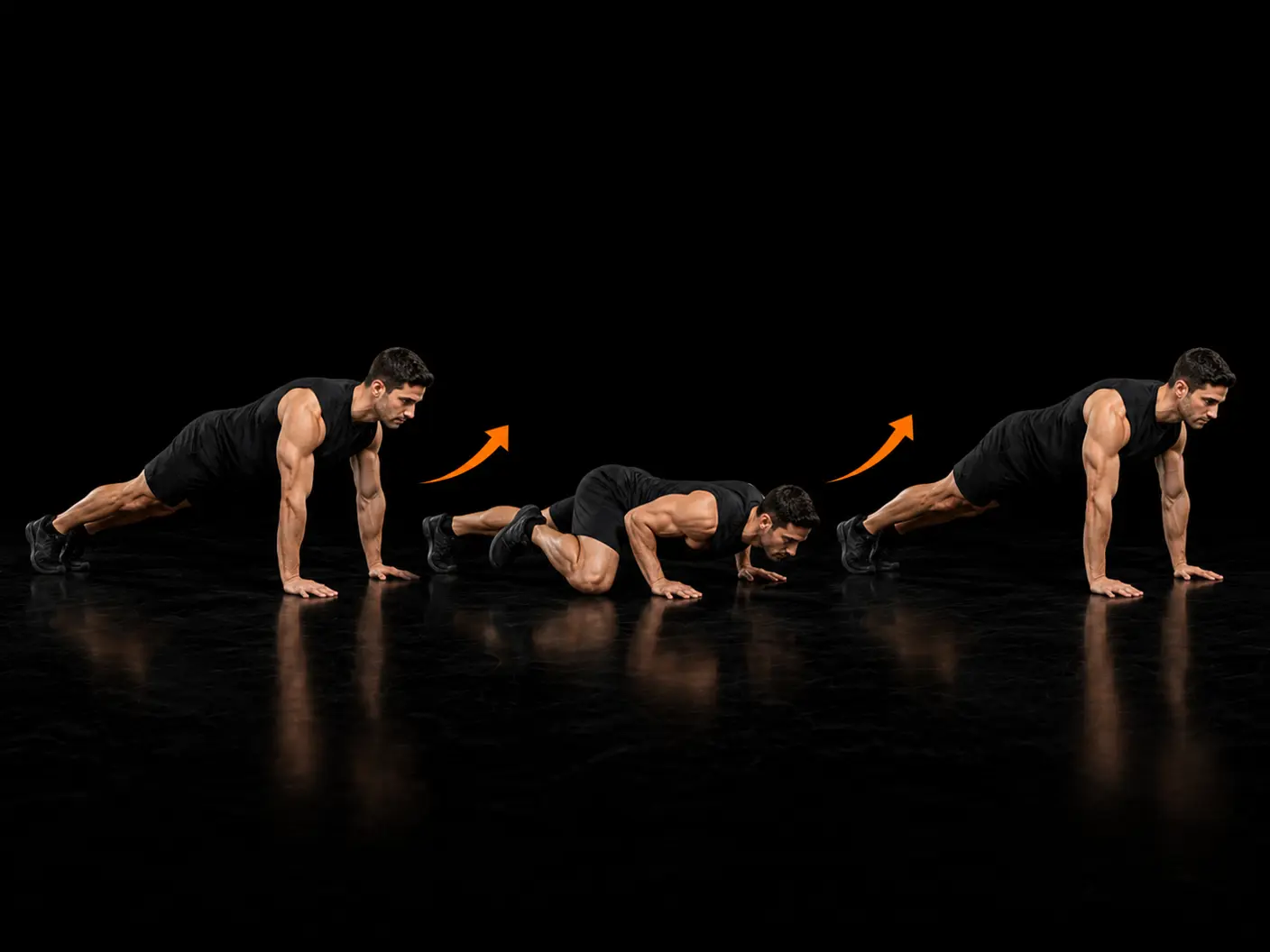
The Spiderman push-up is a bodyweight compound movement that pairs a standard horizontal push with a simultaneous hip flexion and spinal rotation, demanding co-ordination across the upper body and core in a single rep. It trains the pectorals and anterior deltoids as the primary movers while recruiting the obliques and hip flexors to control the travelling leg. It suits intermediate trainees who have a solid foundation in conventional push-ups and want to add an athletic, multi-planar demand without any equipment.
How to do it
Assume a standard push-up position. As you lower the chest, simultaneously bring one knee toward the outside of the same-side elbow. As you press back up, return the leg to the start position. Alternate sides each rep.
Coaching cues
- Knee meets elbow at the bottom
- Full push-up depth
- Core stays long
- Alternate sides
Why train it
- The simultaneous knee-to-elbow drive engages the obliques and hip flexors under load, developing rotational core stability that transfers to sport and functional movement.
- Targeting the pectorals and anterior deltoids through a full range of motion makes this an effective hypertrophy stimulus for the chest and shoulder without requiring any kit.
- Alternating sides each rep introduces a mild anti-rotation challenge, training the core to resist unwanted movement through the hips and lumbar spine.
- Because the movement is entirely bodyweight-based, it can be programmed anywhere and scaled in volume quickly, making it a practical choice for general fitness and athletic conditioning work.
Common mistakes
- Raising the hips as the knee travels forward — keep the pelvis level and the torso long so the hip flexor does the work rather than the lower back compensating.
- Failing to reach full push-up depth before the knee arrives at the elbow — lower the chest to within a fist's width of the floor on every rep before returning to the top.
- Letting the knee tap the ground mid-rep — the leg should travel through the air in a controlled arc, with the foot clearing the floor throughout the movement.
- Rushing the tempo to maintain rep count — slow the descent to ensure the knee and elbow meet at the same moment, which is where the co-ordination demand and core engagement are greatest.
Primary: Pectoralis Major, Anterior Deltoid.
Secondary: Triceps Brachii, Hip Flexors, Obliques.
Equipment
Good for
Easier variation
Standard push-up — add the leg movement only once upper-body strength is established.
Similar movements
Frequently asked
- What muscles does the Spiderman push-up work?
- The primary muscles are the pectorals and anterior deltoids, which drive the push-up portion of the movement. The triceps assist in the press, while the hip flexors and obliques are recruited to control the knee drive and resist rotation through the trunk.
- How many sets and reps should I do?
- For hypertrophy or general fitness, three to four sets of eight to twelve reps per side is a practical starting point. For athletic performance or conditioning, you can work in higher-rep sets of fifteen to twenty, keeping rest periods shorter to maintain the co-ordination demand.
- Is the Spiderman push-up suitable for beginners?
- It is classified as an intermediate movement because it requires both solid push-up mechanics and the ability to stabilise the pelvis under load. Beginners would benefit from building a base of standard push-ups and plank holds first before adding the rotational element.
- What is a good alternative if I find the Spiderman push-up too demanding?
- A standard push-up combined with a separate mountain climber drill allows you to train the same muscles in isolation before combining them. Once you can perform both movements cleanly, reintroducing the Spiderman variation becomes more manageable.
- Can I use the Spiderman push-up to build chest size?
- Yes — it is listed under hypertrophy as a primary goal because the pectorals work through a full range of motion on every rep. Volume and progressive overload through added sets or reduced rest periods will be the main drivers of muscle development when equipment is unavailable.
Want this movement in a plan built for you?
Adaptiv programmes the right exercises for your goal, equipment and experience — then adapts them as you train.
Build my programme