Decline Push-Up
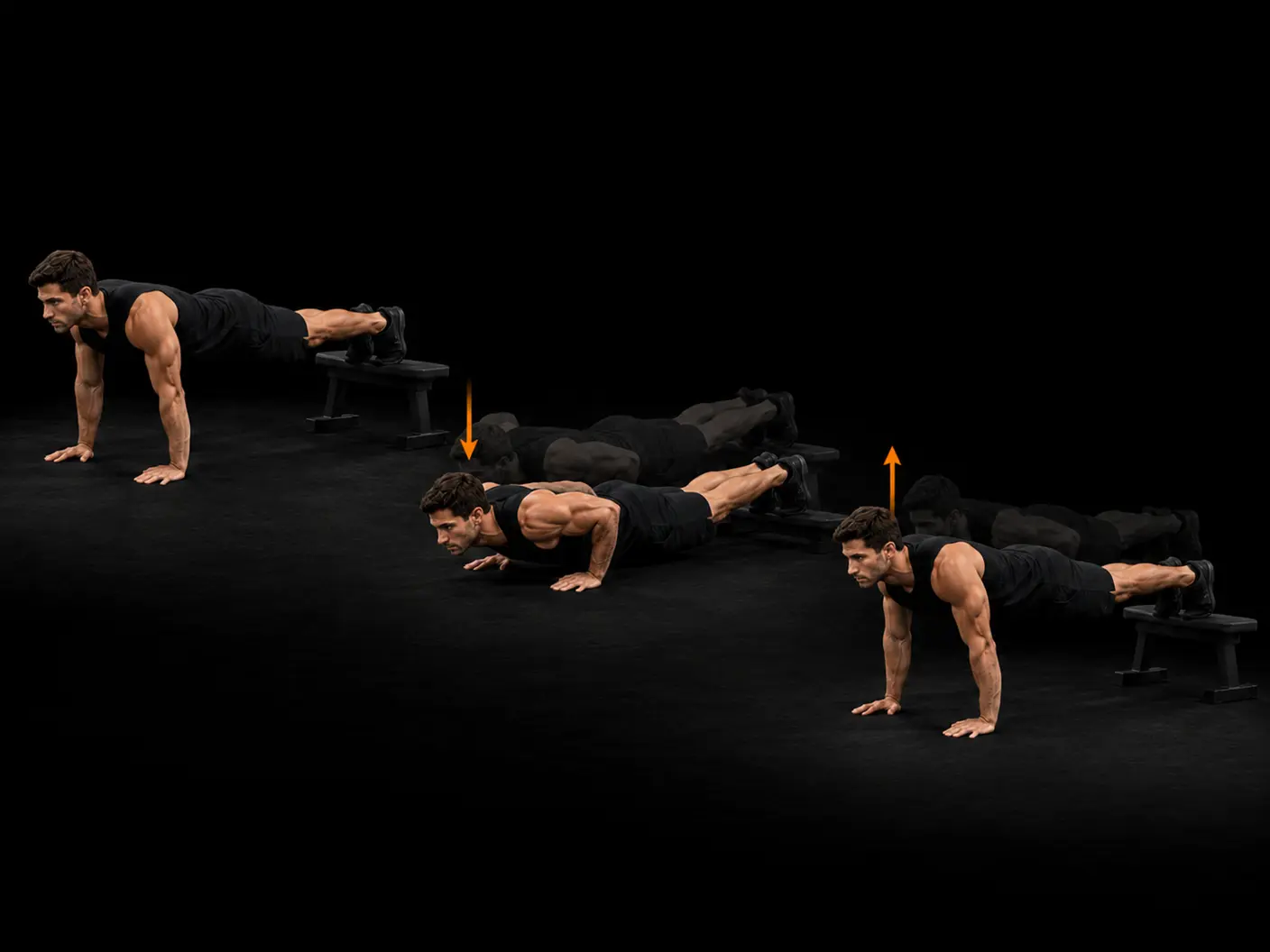
The decline push-up is a bodyweight horizontal pushing exercise performed with the feet elevated on a bench or box, which shifts the line of force to emphasise the upper portion of the pectoralis major and the anterior deltoid more than a flat push-up does. It follows the same fundamental pressing pattern as a bench press — lowering the chest under control and driving away from the surface — making it a useful compound movement for developing upper-body pushing strength and muscle. It suits intermediate trainees who have a solid flat push-up foundation and are looking to progress the movement without adding external load.
How to do it
Feet elevated on a bench, hands on the floor slightly wider than shoulder-width. Plank from head to heels. Lower the chest to the floor, elbows ~45°. Press the floor away; protract at the top.
Coaching cues
- Plank from head to heels
- Chest to the floor
- Elbows 45°
- Protract at the top
Why train it
- Elevating the feet increases demand on the upper pectoralis major and anterior deltoid, providing a distinct stimulus that the flat push-up does not replicate as effectively.
- As a compound movement, it coordinates the chest, shoulders, triceps, and core simultaneously, making it efficient for general fitness programming.
- No barbell or dumbbell is required — only a bench or box — so it integrates well into home training environments or sessions where equipment access is limited.
- The scapular protraction cue at the top of each rep actively trains serratus anterior function, reinforcing healthy shoulder mechanics under load.
Common mistakes
- Sagging through the hips — maintain a rigid plank from head to heels throughout every rep, not just at the start of the set.
- Flaring the elbows to 90° — keep them at approximately 45° to the torso to reduce shoulder joint stress and keep force directed through the target muscles.
- Failing to reach full depth — lower the chest all the way to the floor on every rep, as cutting the range of motion short reduces stimulus to the pectoralis major.
- Skipping the protraction at the top — actively push the floor away and spread the shoulder blades at the end of each press to complete the movement and engage the supporting musculature properly.
Primary: Pectoralis Major, Anterior Deltoid.
Secondary: Triceps Brachii, Rectus Abdominis.
Equipment
Good for
Easier variation
Standard push-up — reduces upper-pec and shoulder demand.
Similar movements
Frequently asked
- What muscles does the decline push-up work?
- The primary muscles are the upper pectoralis major and the anterior deltoid. The triceps and core work as secondary contributors, with the core maintaining the plank position throughout.
- How is the decline push-up different from a regular push-up?
- Elevating the feet changes the angle of your torso relative to the floor, which shifts more of the load onto the upper chest and front of the shoulder compared with a standard flat push-up. The movement pattern and technique cues are otherwise the same.
- How many sets and reps should I do?
- For hypertrophy, 3–4 sets of 8–15 controlled reps works well. For general fitness, 2–3 sets of 10–12 reps is a practical starting point. Rest 60–90 seconds between sets and prioritise consistent depth over hitting a specific rep target.
- What can I use instead of a bench?
- Any stable, elevated surface at roughly knee to hip height will work — a sturdy box, a low step, or a plyo box are all suitable alternatives, provided the surface does not move under load.
- Is the decline push-up suitable for building a bigger chest?
- Yes, it is a legitimate hypertrophy exercise for the upper chest when programmed with sufficient volume and progressive overload — for example, by gradually increasing reps, reducing rest, or moving to a higher elevation over time. Those with existing shoulder concerns should check with a qualified professional before adding it to their programme.
Want this movement in a plan built for you?
Adaptiv programmes the right exercises for your goal, equipment and experience — then adapts them as you train.
Build my programme