Archer Push-Up
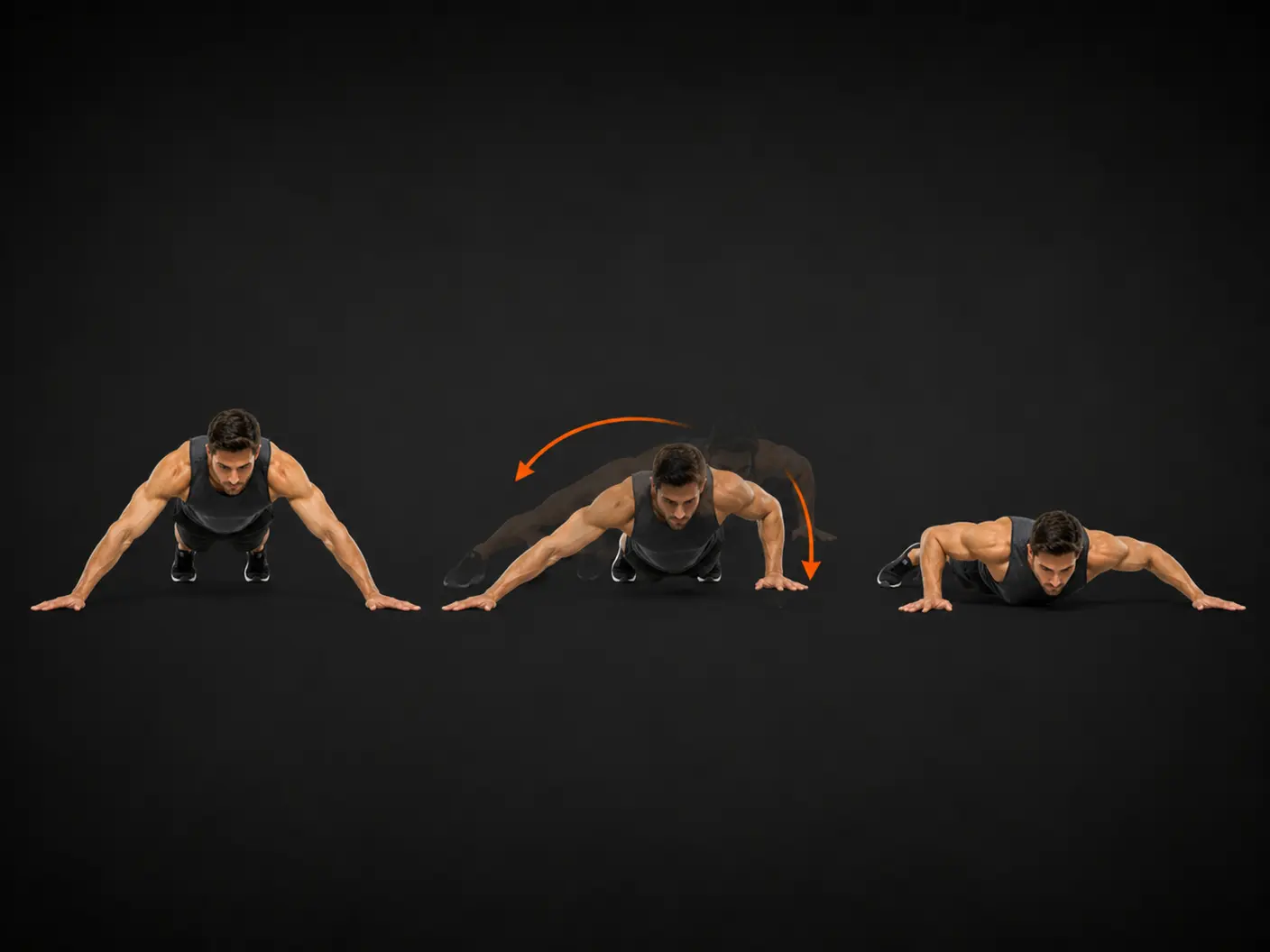
The archer push-up is an advanced bodyweight pressing variation that loads one side of the chest and shoulder at a time, with the opposite arm extended straight to reduce its contribution to the movement. Performed from a wide hand position, it trains the horizontal push pattern with a pronounced unilateral demand, making it a direct bridge between the standard push-up and the single-arm push-up. It suits lifters who have built a solid foundation of pressing strength and are looking to address side-to-side imbalances or progress toward more demanding bodyweight skills.
How to do it
Start in a wide push-up position. Shift your bodyweight toward one hand and bend that elbow as the other arm extends straight. Lower until the working elbow reaches approximately 90°, then press back up to the wide starting position. Each side counts as one rep; alternate or complete all reps on one side.
Coaching cues
- Shift the weight fully
- Straight arm stays extended
- Full depth on the working side
- Control the transition
Why train it
- The unilateral loading places significantly greater demand on the working pectorals and anterior deltoid than a standard push-up, building meaningful pressing strength without external load.
- Because each side must be trained independently, the archer push-up exposes and helps correct strength asymmetries between the left and right sides of the upper body.
- Keeping the extended arm straight throughout each rep requires continuous engagement of the serratus anterior and core, developing full-body tension and shoulder stability simultaneously.
- The movement requires no equipment and minimal space, making it a practical option for strength maintenance when access to a gym or weights is limited.
Common mistakes
- Allowing the extended arm to bend — keep it fully straight and actively press it into the floor throughout the entire rep to maintain the intended loading on the working side.
- Shifting the hips rather than the upper body — move your centre of mass laterally by driving through the shoulders, keeping the hips level and the body in a straight line from head to heel.
- Stopping short of full depth on the working side — lower until the working elbow reaches approximately 90° so the pectorals go through their full range of motion on each rep.
- Rushing the transition between sides — control the shift of bodyweight deliberately so each rep begins from a stable, fully loaded position rather than using momentum to carry you through.
Primary: Pectoralis Major, Anterior Deltoid.
Secondary: Triceps Brachii, Serratus Anterior, Rectus Abdominis.
Equipment
Good for
Easier variation
Wide push-up — build chest and tricep strength before attempting the archer variation.
Similar movements
Frequently asked
- What muscles does the archer push-up work?
- The primary muscles are the pectorals and anterior deltoid of the working arm. The triceps, serratus anterior, and core function as secondary contributors, with the serratus anterior particularly active in the extended arm to keep it pressed into the floor.
- How many sets and reps should I do for archer push-ups?
- For strength development, three to four sets of four to six reps per side works well, with full recovery between sets. If your goal is muscular endurance or building volume before progressing to single-arm work, three sets of eight to ten reps per side at a controlled tempo is a reasonable starting point.
- What is a good progression from the archer push-up?
- The archer push-up is commonly used as a stepping stone toward the single-arm push-up, where all load is taken through one arm with no assistance from the other. You can progress by gradually reducing the contact pressure of the extended arm over time — for example, resting the back of the extended hand on the floor rather than the palm.
- Is the archer push-up suitable for beginners?
- This movement is rated advanced and assumes you can already perform multiple sets of full-range standard push-ups with solid form. If you cannot yet do fifteen or more controlled push-ups, building that base first will make the transition to archer push-ups considerably safer and more productive.
- Can the archer push-up replace barbell or dumbbell pressing?
- It trains a similar horizontal push pattern and can build genuine pressing strength, but it is not a direct replacement for loaded barbell or dumbbell work when the primary goal is maximal strength or hypertrophy at higher loads. It is best viewed as a complementary movement or a primary option when equipment is unavailable.
Want this movement in a plan built for you?
Adaptiv programmes the right exercises for your goal, equipment and experience — then adapts them as you train.
Build my programme