Pseudo Planche Push-Up
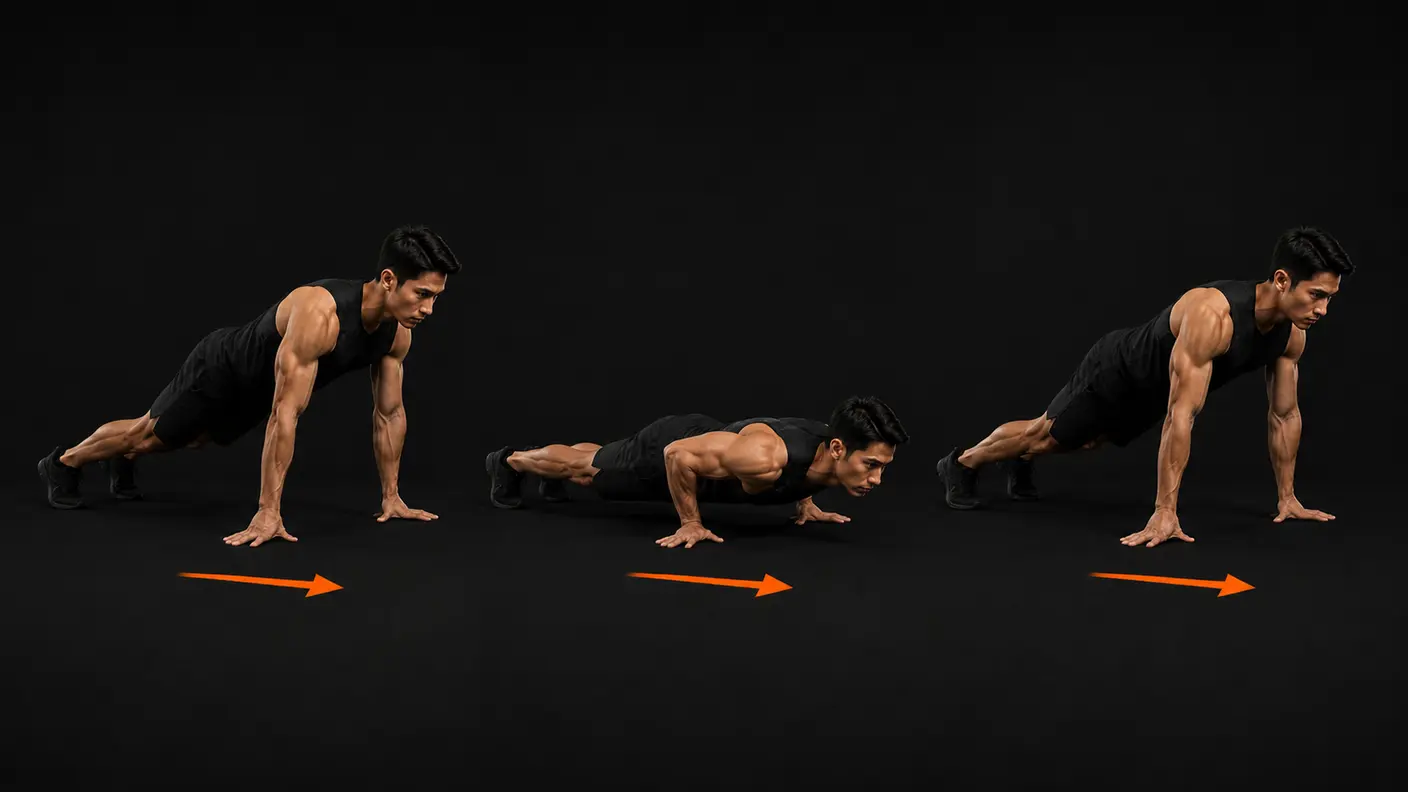
The pseudo planche push-up is an advanced bodyweight pressing movement that bridges the gap between a standard push-up and a full planche. By rotating the hands backward and shifting the shoulders forward over or beyond the wrists, the lever is lengthened considerably, placing far greater demand on the anterior deltoid, pectoralis major, and triceps than a conventional push-up. It suits intermediate to advanced trainees who are building towards planche progressions or want to develop serious upper-body pressing strength without external load.
How to do it
Set up in a push-up position. Rotate the hands 90–180° so the fingers point sideways or backward. Shift the shoulders forward over or beyond the wrists — the further forward, the harder. Lean into this position (the 'planche lean'), then perform a push-up from this forward position. The wrists and shoulders must be adequately mobile and conditioned.
Coaching cues
- Lean forward
- Hands angled back
- Elbows tucked
- Build the lean progressively
Why train it
- The forward lean dramatically increases the mechanical demand on the anterior deltoid and pectoralis major, developing pressing strength that transfers directly to gymnastics-based skill work.
- Because the movement requires no equipment beyond bodyweight, it can be trained anywhere and scaled incrementally by adjusting how far the shoulders sit forward of the wrists.
- The position heavily recruits the serratus anterior and core to stabilise the torso, building the shoulder girdle and trunk integrity that underpins most advanced calisthenics movements.
- Progressive overload is built into the mechanics — shifting the lean even a few centimetres further forward meaningfully increases the difficulty, allowing precise, long-term progression.
Common mistakes
- Placing the hands too far back without building wrist conditioning first — introduce the rotated hand position gradually and ensure wrist flexor strength is adequate before adding significant lean.
- Allowing the hips to pike upward during the push-up — maintain a rigid plank line from heels to crown so the full lever is loaded throughout the movement.
- Flaring the elbows wide — keep the elbows tucked close to the torso to protect the shoulder joint and correctly load the target musculature.
- Rushing the forward lean before the shoulders are ready — build the lean progressively over weeks rather than forcing maximal shoulder-forward position from the outset.
Primary: Anterior Deltoid, Pectoralis Major, Triceps Brachii.
Secondary: Rectus Abdominis, Serratus Anterior, Forearm Flexors.
Equipment
Good for
Easier variation
Standard push-up or pike push-up — build shoulder strength before adding the forward lean.
Similar movements
Frequently asked
- What muscles does the pseudo planche push-up work?
- The primary muscles are the anterior deltoid, pectoralis major, and triceps. The core, serratus anterior, and wrist flexors provide secondary stabilisation throughout the movement.
- How many sets and reps should I do for the pseudo planche push-up?
- Because of the high difficulty and positional demands, lower rep ranges of 3–6 reps per set tend to work well, with 3–4 sets and full recovery between efforts. Quality of position matters far more than volume here.
- What are good progressions or alternatives if I cannot yet do a pseudo planche push-up?
- A regular push-up with hands rotated slightly outward is a sensible starting point for building wrist tolerance. From there, practise the planche lean hold — shoulders forward over the wrists, arms straight — before adding the pressing component.
- Is this exercise suitable for building general pushing strength, or is it only useful for gymnastics?
- While it is most directly relevant to gymnastics and calisthenics progressions, the anterior deltoid and serratus anterior demands make it a useful complement to any programme that prioritises upper-body pressing strength and shoulder girdle control.
- Do I need any special equipment for the pseudo planche push-up?
- No equipment is required beyond a firm, flat surface. Some trainees use parallettes to reduce wrist extension stress, which can be helpful when first conditioning the wrists to the rotated hand position.
Want this movement in a plan built for you?
Adaptiv programmes the right exercises for your goal, equipment and experience — then adapts them as you train.
Build my programme