Snatch Balance
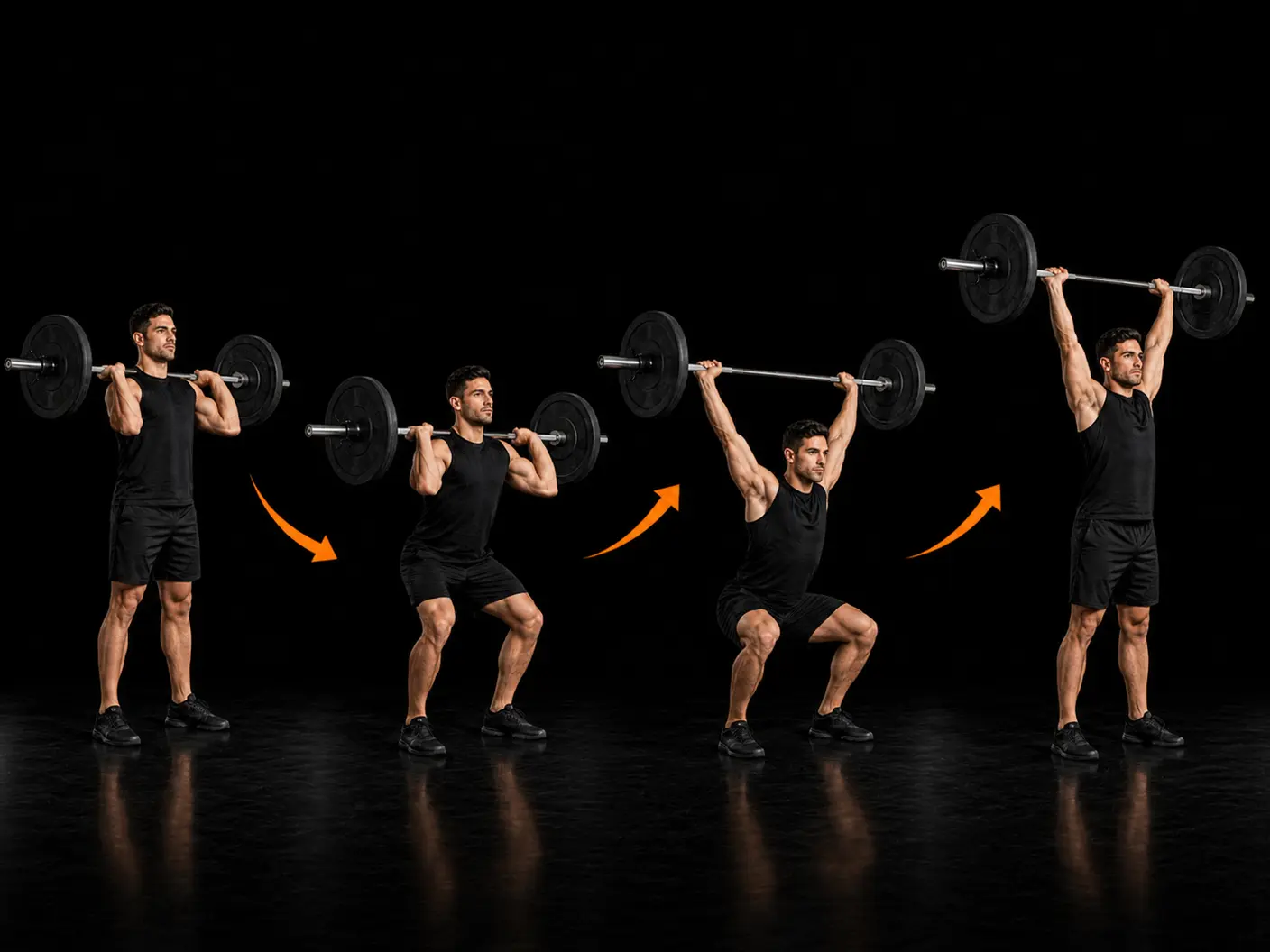
The snatch balance is an Olympic weightlifting derivative that trains the overhead squat catch position by requiring the lifter to drive a barbell from behind the neck into a locked-out overhead squat in a single explosive movement. It develops the speed, coordination, and positional strength needed to receive a snatch at depth, making it a direct technical supplement to the full lift. It suits experienced barbell athletes who already have a solid overhead squat and are refining their snatch mechanics.
How to do it
Bar behind the neck in a snatch-width grip. Feet shoulder-width. Dip slightly and drive the bar overhead while simultaneously dropping into a full overhead squat. Receive the bar at full lockout in the bottom of an OHS. Stand up.
Coaching cues
- Drive the bar
- Drop under fast
- Overhead squat catch
- Strong lockout
Why train it
- Builds the speed and confidence to drop under a barbell quickly, directly improving snatch receiving position.
- Develops overhead squat strength through a dynamic loading pattern that better replicates competition demands than static overhead work.
- Reinforces the precise timing between the upward drive and the downward pull under the bar, a coordination quality that transfers directly to the full snatch.
- Strengthens the shoulders and triceps under load at full lockout in a mechanically demanding position, supporting long-term overhead stability.
Common mistakes
- Pressing the bar up rather than driving it — the upward force should come from a sharp leg drive, with the arms locking out as you drop, not pressing the bar into position.
- Hesitating before dropping — commit to moving under the bar immediately after the drive; any pause allows the bar to travel too high and shifts the movement away from its intended stimulus.
- Receiving with soft elbows — the lockout must be active and fully extended at the moment of catch; practise overhead squat holds to reinforce the position before adding speed.
- Setting the feet too narrow on the catch — your receiving stance should match your overhead squat stance, so rehearse that foot transition deliberately until it becomes automatic.
Primary: Quadriceps, Gluteus Maximus, Anterior Deltoid, Trapezius.
Secondary: Hamstrings, Rectus Abdominis, Rhomboids, Triceps Brachii.
Equipment
Good for
Easier variation
Drop snatch — no driving phase, just drop under.
Similar movements
Frequently asked
- What muscles does the snatch balance work?
- The primary muscles loaded are the shoulders, quads, glutes, and triceps, which absorb and stabilise the barbell at the bottom of the overhead squat. The core and upper back work as secondary stabilisers to maintain a rigid torso throughout the catch and the stand.
- How many sets and reps should I do for the snatch balance?
- Most coaches programme it in the range of 3–5 sets of 2–3 repetitions, keeping the quality of each rep high. Because technique and speed are the priority, it is typically placed early in a session before fatigue accumulates, and loads are kept moderate relative to your overhead squat maximum.
- What is the difference between a snatch balance and a drop snatch?
- The snatch balance uses a dip-and-drive to generate upward momentum on the bar before you drop under it, meaning there is a brief moment where the bar moves upward independently. A drop snatch omits that drive entirely — you simply push yourself under a stationary bar — making it a purer test of speed and overhead squat mobility without any upward impulse.
- Is the snatch balance suitable for beginners?
- It is classified as an expert-level movement and requires a well-established overhead squat, familiarity with a snatch-width grip, and the ability to coordinate a fast transition under load. Beginners should develop overhead squat competency and basic barbell mechanics before approaching this exercise.
- What are good alternatives to the snatch balance?
- The overhead squat is the closest structural alternative and builds the same positional strength at a lower technical demand. The drop snatch removes the drive component and can serve as a stepping stone, while pressing snatch balance variations performed without the dip-and-drive allow lifters to rehearse the catch mechanics at reduced speed.
Want this movement in a plan built for you?
Adaptiv programmes the right exercises for your goal, equipment and experience — then adapts them as you train.
Build my programme