Overhead Squat
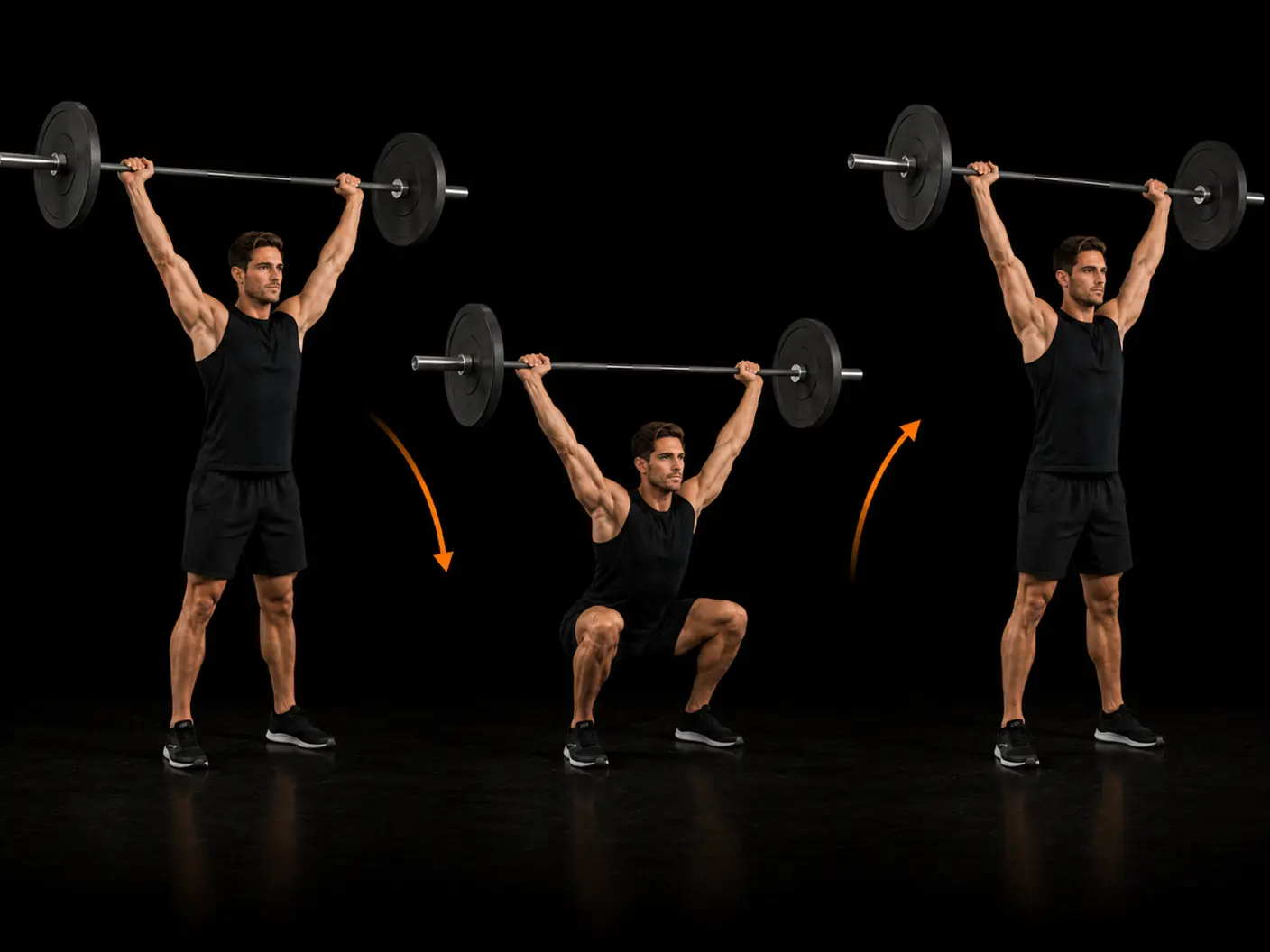
The overhead squat is a barbell compound movement in which the lifter descends to full depth whilst supporting a snatch-width load locked out overhead. It trains the squat pattern under the most demanding stability challenge available with a barbell, requiring simultaneous control of the lower body, thoracic spine, and shoulder girdle. It suits experienced lifters with a solid foundation in the squat and overhead press, and is particularly relevant to those pursuing athletic performance or maximal strength.
How to do it
Press the bar overhead with a snatch-width grip, arms fully locked, shoulders active. Feet shoulder-width, toes slightly out. Brace hard. Descend into a full squat — hips below knees — maintaining the bar directly over the mid-foot and the overhead position. Stand up.
Coaching cues
- Bar over mid-foot
- Active shoulders
- Full depth
- Brace hard
Why train it
- Develops full-body structural strength by demanding that the quads, glutes, and upper back work in concert to maintain position under a load that punishes any postural breakdown.
- Builds active shoulder stability through the requirement to press the bar into the overhead position throughout the entire range of motion, not merely hold it passively.
- Reinforces upright torso mechanics and ankle, hip, and thoracic mobility simultaneously, transferring directly to weightlifting derivatives and other athletic movements.
- Exposes asymmetries and mobility restrictions that other squat variations can mask, making it a reliable diagnostic tool for experienced coaches programming around technical weaknesses.
Common mistakes
- Allowing the bar to drift forward of the mid-foot — actively press up into the bar and retract the shoulder blades to anchor the load over the correct line throughout the descent.
- Losing depth by stopping above parallel — commit to hips below knees as required by the movement standard, using mobility work beforehand if range is the limiting factor.
- Relaxing the shoulder girdle at the bottom position — maintain active, elevated shoulders throughout; passive shoulders at depth compromise both control and safe loading.
- Allowing the knees to track inward during the ascent — drive them out in line with the toes from the moment you initiate the stand, maintaining that alignment all the way to lockout.
Primary: Quadriceps, Gluteus Maximus.
Secondary: Anterior Deltoid, Trapezius, Rectus Abdominis, Rhomboids, Hamstrings.
Equipment
Good for
Easier variation
Barbell back squat — removes the overhead demand.
Similar movements
Frequently asked
- What muscles does the overhead squat work?
- The primary muscles are the quads, glutes, shoulders, and upper back. The core, hamstrings, and traps contribute as secondary stabilisers, making this one of the most systemically demanding barbell movements available.
- How many sets and reps should I do for the overhead squat?
- For strength and athletic performance, three to five sets of two to five reps at a challenging but technically sound load is a common approach. Because the movement is expert-level and highly technical, quality of each rep takes priority over volume accumulation.
- What are good alternatives if I cannot perform the overhead squat yet?
- The front squat and goblet squat both build the upright torso mechanics the overhead squat demands, while pressing variations and thoracic mobility work address the overhead stability requirements. Developing competence in those movements first is a sensible progression.
- Is the overhead squat suitable for building general lower body size?
- It is primarily programmed for athletic performance and strength rather than hypertrophy. Exercises that allow greater loading with less technical demand, such as the back squat, are typically more efficient for adding muscle mass to the quads and glutes.
- Why is the overhead squat classified as expert difficulty?
- The movement requires the simultaneous expression of ankle, hip, and thoracic mobility, active shoulder stability under load, and precise barbell path control across a full range of motion. A breakdown in any one of these areas compromises the entire lift, which is why it is reserved for lifters with a well-established technical base.
Want this movement in a plan built for you?
Adaptiv programmes the right exercises for your goal, equipment and experience — then adapts them as you train.
Build my programme