Smith Machine Squat
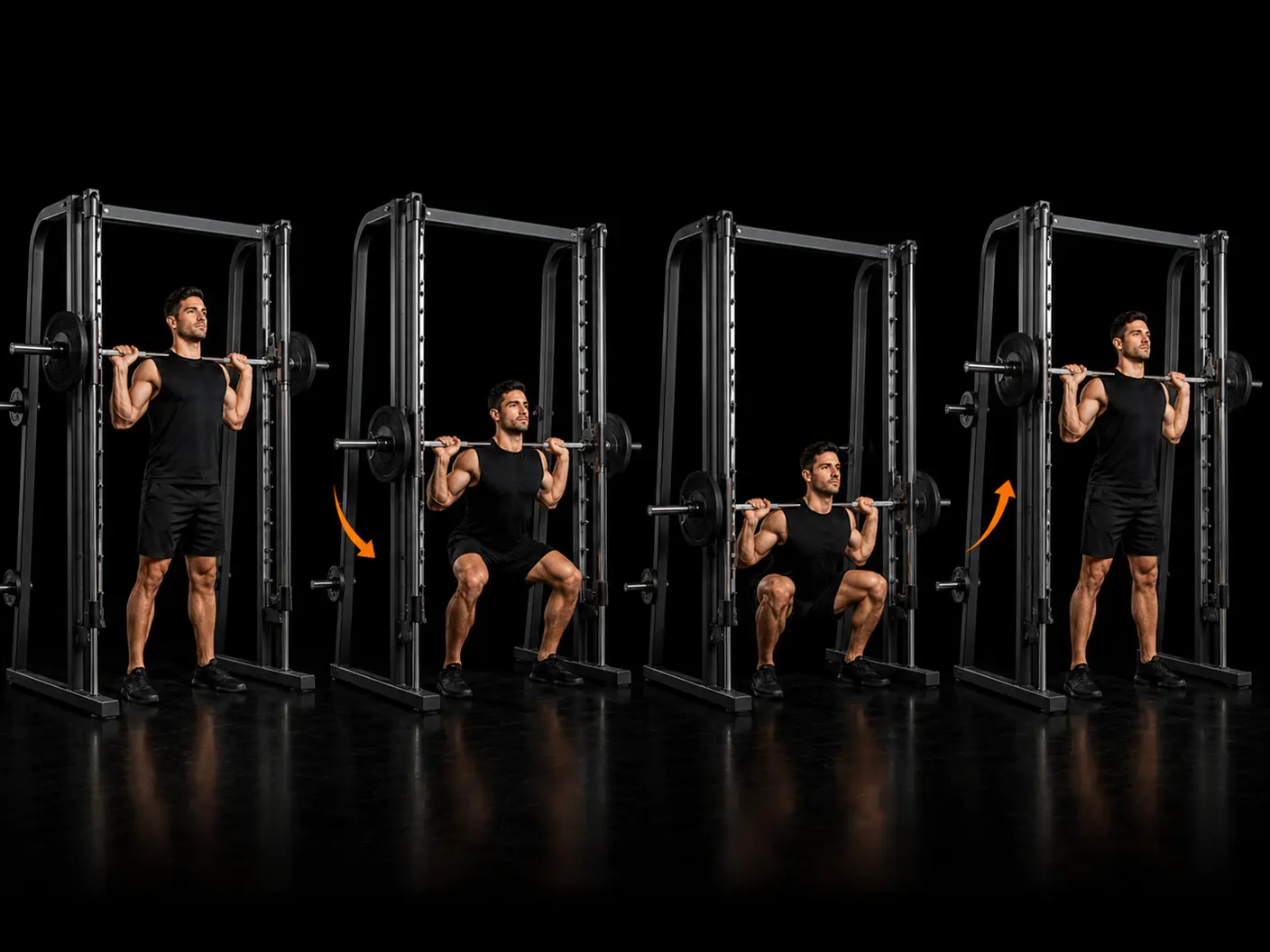
The Smith machine squat is a barbell back squat variation performed within a guided vertical track, removing the balance demand of a free bar and allowing the lifter to focus on depth, positioning, and load management. It trains the fundamental squat pattern, loading the quadriceps and glutes as primary movers with supporting work from the hamstrings, adductors, and core. It suits intermediate lifters working on hypertrophy or general fitness who want structured loading without the stabilisation demands of a free barbell.
How to do it
Set the bar on the upper traps as in a back squat. Feet slightly forward of the hips to allow vertical bar travel into the heels. Unhook the bar. Descend under control until hip crease drops below the knee. Drive up through mid-foot without letting the knees shoot forward. Re-hook at the top.
Coaching cues
- Feet slightly forward
- Chest tall
- Heels drive
- Full depth
Why train it
- The fixed bar path reduces the need for whole-body balance, letting you direct attention to depth and muscle activation rather than managing the bar in space.
- Placing the feet slightly forward of the hips shifts the torso into a more upright position, increasing quadriceps involvement and making full depth more accessible for many lifters.
- The guided track allows precise load progression for hypertrophy work, making it straightforward to add small increments across training cycles without technique breaking down.
- The safety hooks mean you can train close to failure without a spotter, making it a practical option for solo training sessions.
Common mistakes
- Placing the feet directly beneath the bar rather than slightly forward — position the feet ahead of the hips so the bar can travel vertically into the heels and your torso stays upright throughout the descent.
- Allowing the knees to drift forward excessively at the bottom — keep the drive through the mid-foot and heels rather than the toes, which keeps the shins from becoming excessively angled.
- Cutting the depth short before the hip crease drops below the knee — control the descent and allow the hips to descend fully before initiating the drive upward.
- Failing to re-hook the bar at the top of each set — always rotate the bar into the safety hooks at lockout, particularly when training near failure or without a spotter present.
Primary: Quadriceps, Gluteus Maximus.
Secondary: Hamstrings, Adductors, Rectus Abdominis.
Equipment
Good for
Easier variation
Bodyweight squat to box — same pattern without fixed bar path constraints.
Similar movements
Frequently asked
- What muscles does the Smith machine squat work?
- The primary movers are the quadriceps and glutes, with secondary contributions from the hamstrings, adductors, and core. The slightly forward foot position typical of this variation tends to emphasise the quadriceps more than a conventional back squat stance would.
- How many sets and reps should I do for the Smith machine squat?
- For hypertrophy, three to four sets of eight to twelve repetitions with a load that leaves two to three reps in reserve works well. For general fitness and movement quality, three sets of ten to fifteen at a moderate load is a sensible starting point.
- Is the Smith machine squat a good alternative to the barbell back squat?
- It trains the same fundamental pattern and primary muscles, so it serves as a practical substitute when a power rack is unavailable or when you are training without a spotter. The key difference is that the guided track removes the stabilisation requirement of the free bar, so it should not be treated as a direct equivalent for developing full barbell squat competency.
- How far forward should my feet be in a Smith machine squat?
- Position the feet slightly forward of where you would place them in a free barbell squat — roughly so that your shins are close to vertical when viewed from the side at the bottom of the movement. This accounts for the fixed vertical bar path and allows the load to travel through the heels rather than the forefoot.
- Can beginners use the Smith machine squat?
- The movement is classified as intermediate because it still requires sound squat mechanics and an understanding of foot positioning specific to the fixed bar path. Beginners would benefit from first developing a bodyweight squat pattern before progressing to loaded Smith machine work, and any lifter unsure about pre-existing joint concerns should consult a qualified professional before loading this pattern.
Want this movement in a plan built for you?
Adaptiv programmes the right exercises for your goal, equipment and experience — then adapts them as you train.
Build my programme