Ski Erg
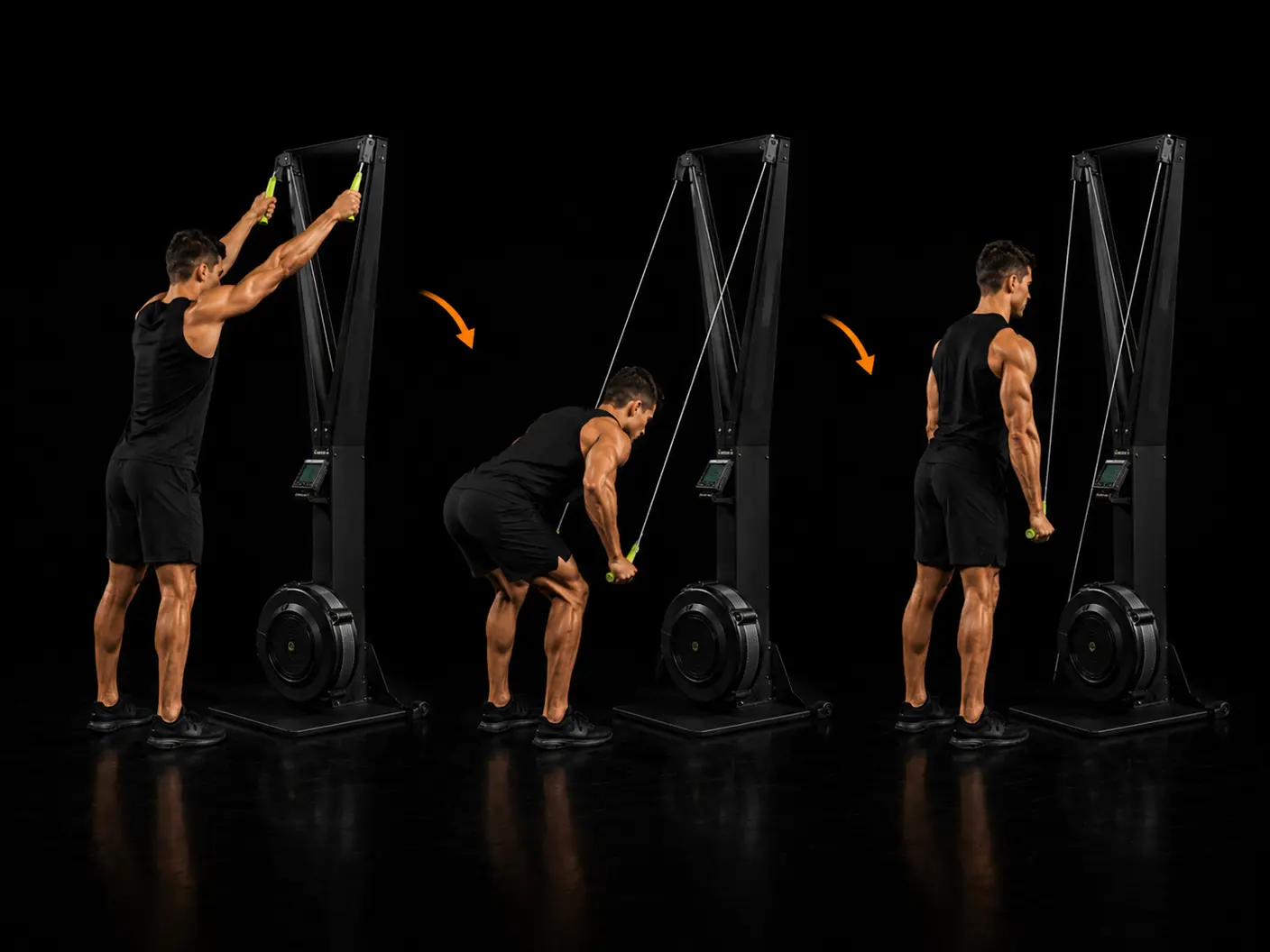
The Ski Erg is a cable-resistance conditioning machine that replicates the double-pole action of cross-country skiing, training a powerful hip hinge and simultaneous lat and triceps pull through a full range of motion. It demands co-ordination between the upper body and core while placing a significant cardiovascular demand on the system, making it a genuinely whole-body conditioning tool. It suits intermediate trainees looking to develop aerobic capacity, power endurance, or complement a strength programme with low-impact cardiovascular work.
How to do it
Stand facing the machine, feet shoulder-width. Grip the handles high. Drive down through the handles by hinging at the hips and pulling the arms past the hips. Stand tall; reach up to the start. Repeat at rhythm.
Coaching cues
- Hinge and pull
- Full extension
- Tall recovery
- Rhythm
Why train it
- The combination of lat, triceps, and core engagement across every stroke builds upper-body pulling endurance that transfers to athletic and functional demands.
- Because the feet remain in contact with the floor throughout, the Ski Erg is a lower-impact conditioning option than running, making it a practical alternative for those managing lower-limb fatigue.
- The rhythmic hinge-and-pull pattern reinforces hip hinge mechanics under a light but consistent load, which can support movement quality over longer training blocks.
- Its scalability — adjusting pace, stroke rate, and interval length — means it can be programmed for fat-loss intervals, aerobic base work, or sport-specific conditioning within the same machine.
Common mistakes
- Pulling only with the arms and skipping the hip hinge — initiate each stroke by driving the hips back first, then let the arms follow through past the hips.
- Collapsing forward at the bottom of the stroke — brace the core throughout so the spine stays neutral rather than rounding under load.
- Rushing the recovery phase — stand fully tall and reach the handles back to their highest point before beginning the next stroke, which protects rhythm and range.
- Gripping the handles too tightly throughout the set — maintain a firm but relaxed grip to reduce forearm fatigue and allow the lats and triceps to do the primary work.
Primary: Latissimus Dorsi, Triceps Brachii, Rectus Abdominis.
Secondary: Anterior Deltoid, Cardiovascular System.
Equipment
Good for
Easier variation
Rower — bilateral pull with legs integrated.
Similar movements
Frequently asked
- What muscles does the Ski Erg work?
- The primary muscles trained are the lats, triceps, and core, which drive and stabilise each downward stroke. The shoulders, legs, and cardiovascular system also contribute as secondary movers and support structures throughout the movement.
- Is the Ski Erg good for fat loss?
- It is listed as a primary goal for this machine because the full-body nature of the stroke and its cardiovascular demand make it effective for high-calorie-expenditure interval work. Short, high-effort intervals interspersed with active recovery periods are a common programming approach for this goal.
- What sets and reps — or intervals — should I use on the Ski Erg?
- For conditioning and fat loss, intervals of 20–40 seconds at high effort with equal or double rest periods work well repeated for 6–10 rounds. For aerobic base development, steady efforts of 10–20 minutes at a controlled, sustainable stroke rate are more appropriate.
- What is a good alternative to the Ski Erg if I do not have access to one?
- Movements that share the hip-hinge-and-pull pattern include cable pull-downs, battle rope double slams, or band pull-downs paired with cardiovascular work. No single alternative replicates the machine exactly, but these options address the same primary muscles.
- How difficult is the Ski Erg to learn?
- It is rated as an intermediate movement, primarily because co-ordinating the hip hinge with the arm drive and maintaining rhythm across a set takes some practice. Most people develop a workable pattern within one or two sessions by focusing on the cue sequence: hinge and pull, full extension, tall recovery, rhythm.
Want this movement in a plan built for you?
Adaptiv programmes the right exercises for your goal, equipment and experience — then adapts them as you train.
Build my programme