Assault Bike (Max Effort)
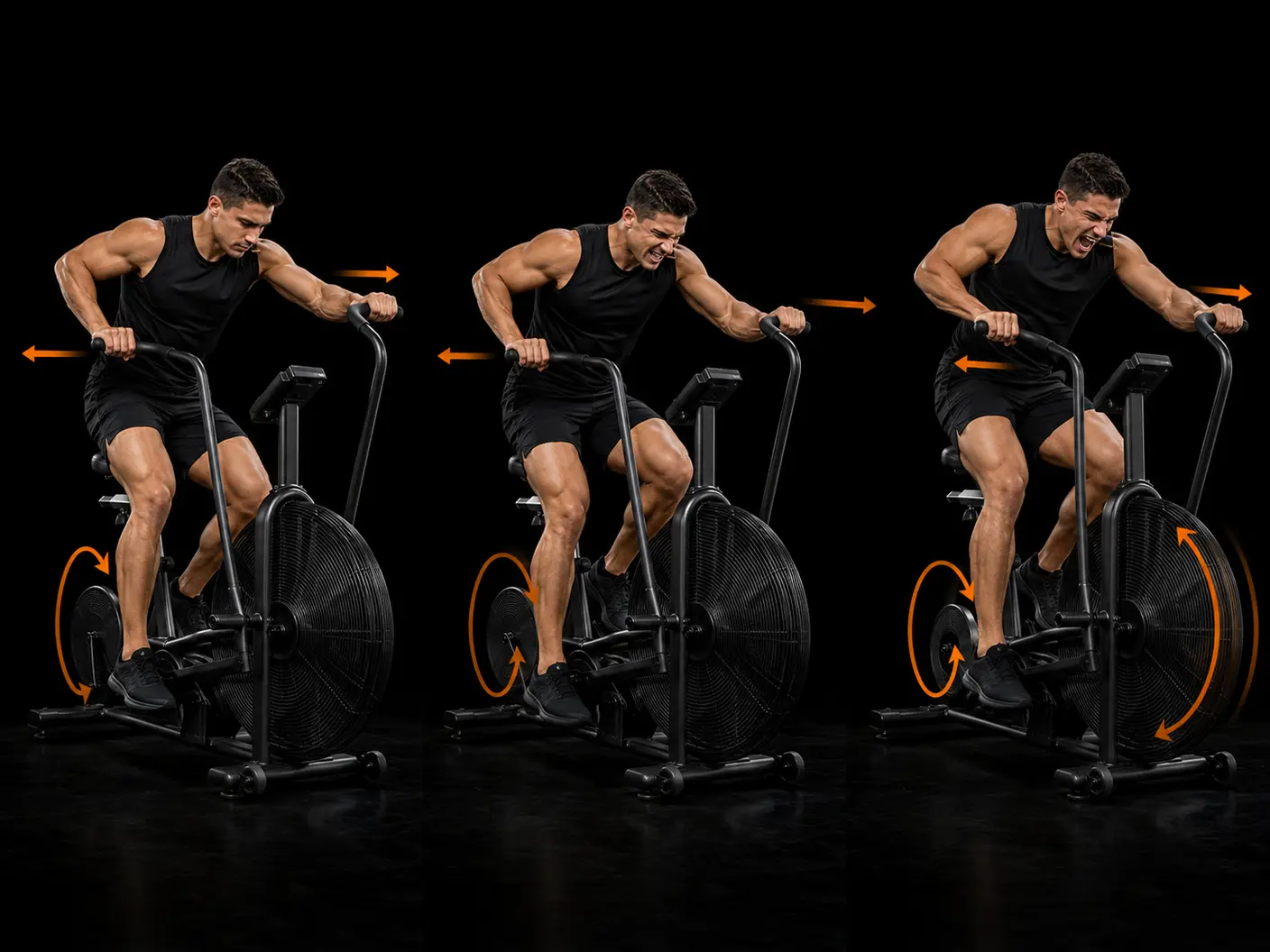
The assault bike max effort is a total-body conditioning protocol performed on an air-resistance bike, where output is limited only by the force applied — the harder you work, the greater the resistance. It trains the conditioning pattern by demanding simultaneous leg drive and upper-body push-pull under high metabolic stress. It suits intermediate trainees who have a base level of aerobic fitness and are looking to develop power output, work capacity, or body composition.
How to do it
Mount the bike. Adjust the seat so the knee has ~20° bend at full extension. Drive with legs and arms simultaneously at maximum effort. Use for intervals (e.g. 10s on / 20s off) or fixed calories / distance.
Coaching cues
- Drive with everything
- Tall posture
- Breathe through it
- Steady stroke
Why train it
- Air resistance scales automatically with effort, meaning the protocol is self-regulating and appropriate across a wide range of fitness levels within the intermediate bracket.
- The simultaneous arm and leg drive recruits the full body, producing a high caloric demand that supports fat loss goals when programmed alongside appropriate nutrition.
- Short, high-intensity intervals on the assault bike develop anaerobic capacity and cardiovascular efficiency, both of which transfer directly to athletic performance.
- Its low-impact nature relative to running makes it a practical conditioning tool for sustaining training frequency without excessive mechanical load on the joints.
Common mistakes
- Rounding the lower back under fatigue — maintain tall posture throughout the interval by keeping the chest up and the spine neutral.
- Setting the seat too low or too high — adjust so the knee retains approximately 20 degrees of bend at full pedal extension to allow efficient force transfer.
- Relying predominantly on the arms — the legs are the larger, more powerful driver; ensure leg drive is leading the effort rather than the arms compensating.
- Holding the breath during hard efforts — establish a rhythmic breathing pattern from the first stroke and maintain it, even when output is at its peak.
Secondary: Cardiovascular System.
Equipment
Good for
Easier variation
Lower-intensity air bike or stationary bike steady-state.
Similar movements
Frequently asked
- What muscles does the assault bike work?
- The assault bike engages the full body, with the quadriceps, hamstrings, and glutes driving the pedals while the chest, back, and shoulders push and pull the handlebars. The cardiovascular system is the principal secondary system under load. No single muscle group dominates — total systemic demand is the defining characteristic of this movement.
- How should I structure assault bike intervals for fat loss?
- A common starting point is 10 seconds of maximum effort followed by 20 seconds of complete rest, repeated for six to ten rounds. Longer protocols such as fixed-calorie efforts (e.g. 10 calories as fast as possible) with a 2:1 rest-to-work ratio are also effective. Total session volume should be built gradually to manage fatigue and maintain output quality across all intervals.
- How many sets and reps should I do on the assault bike?
- Because this is a conditioning movement, it is typically programmed by time, calorie target, or distance rather than traditional sets and reps. For high-intensity work, three to six intervals per session is a reasonable range, with rest periods at least twice the work duration to preserve effort quality.
- Is the assault bike suitable for beginners?
- This movement is classified as intermediate due to the coordination demands of simultaneous arm and leg drive and the intensity required to make the protocol effective. Beginners would benefit from developing a base of aerobic fitness on lower-intensity steady-state work before progressing to max-effort intervals.
- What are good alternatives if I do not have access to an assault bike?
- The assault bike's defining feature is its total-body air-resistance mechanism, which is specific to air bike variants such as the Echo or Rogue equivalent. Rowing ergometers offer a comparable total-body conditioning stimulus, while sprint intervals on a stationary bike can replicate the cardiovascular demand if the upper-body component is not a priority.
Want this movement in a plan built for you?
Adaptiv programmes the right exercises for your goal, equipment and experience — then adapts them as you train.
Build my programme