Battle Ropes
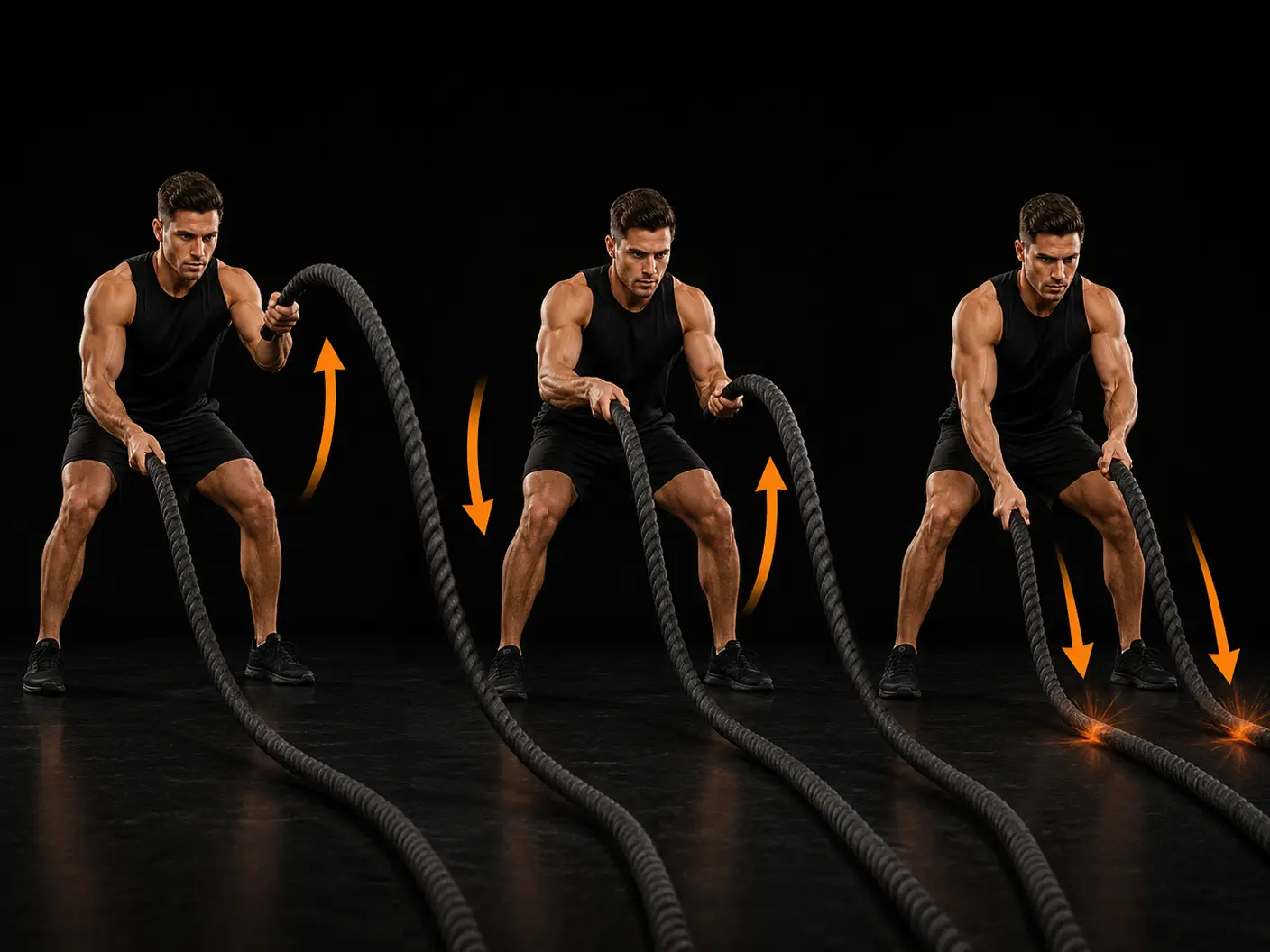
Battle ropes are a rope-based conditioning tool that trains rhythmic, repeated upper-body power output while demanding continuous core bracing and cardiovascular effort. The movement sits within the conditioning category, using alternating or simultaneous arm waves to drive force from the hands through the shoulders and lats into the anchor point. It suits intermediate trainees looking to improve general fitness or support fat loss through high-intensity interval work.
How to do it
Anchor the ropes. Grip one end in each hand. Drop into a quarter-squat. Create waves with the arms — alternating or simultaneous. Keep the core braced. Work in intervals (20s–40s on, short rest).
Coaching cues
- Quarter-squat base
- Arms generate the waves
- Brace the core
- Steady rhythm
Why train it
- The sustained wave pattern places significant demand on the shoulders, lats, and forearms simultaneously, making it an efficient upper-body conditioning stimulus.
- Working in short, intense intervals elevates heart rate rapidly, supporting cardiovascular adaptation and calorie expenditure within a short session window.
- The quarter-squat base requires the core to remain braced throughout each interval, reinforcing midline stability under fatigue.
- Because the movement is low-impact and load is self-regulated by effort, it is accessible for trainees who need to limit joint stress during conditioning work.
Common mistakes
- Letting the core go slack mid-interval — brace the abdomen as you would before a heavy lift and maintain that tension for the full working period.
- Standing fully upright rather than holding a quarter-squat — drop the hips slightly to create a stable base that allows the arms to drive freely without the torso rocking.
- Focusing on speed at the expense of amplitude — prioritise full, clear waves that travel the length of the rope rather than small, rapid flicks that reduce effective muscle involvement.
- Gripping the handles too tightly from the outset — use a firm but controlled grip to delay forearm fatigue and sustain output across the full interval.
Primary: Anterior Deltoid, Posterior Deltoid, Latissimus Dorsi, Rectus Abdominis.
Secondary: Cardiovascular System, Forearm Flexors.
Equipment
Good for
Easier variation
Shorter work intervals or single-arm waves.
Similar movements
Frequently asked
- What muscles do battle ropes work?
- The primary muscles targeted are the shoulders, lats, and core, with secondary demand placed on the forearms and cardiovascular system. The continuous wave motion keeps all of these structures under load for the duration of each interval.
- How long should I work with battle ropes?
- A standard protocol is 20–40 seconds of work followed by a short rest period, repeated for multiple rounds. Beginners to the movement should start at the lower end of that range and build duration as technique and work capacity improve.
- Are battle ropes good for fat loss?
- Battle ropes are listed with fat loss as a primary goal because interval-based conditioning elevates heart rate and energy expenditure effectively. They are best used as part of a structured programme that also addresses nutrition and recovery.
- Do I need a lot of space or special equipment?
- You need a set of battle ropes and a secure anchor point — a wall mount, a heavy rack, or a dedicated anchor strap will all work. A clear floor area of roughly four to six metres from the anchor is sufficient for most rope lengths.
- Can battle ropes replace traditional cardio?
- They can serve as an effective alternative to steady-state cardio for general fitness, particularly for those who find repetitive low-intensity work less engaging. However, they train a different energy system emphasis and upper-body pattern, so how they fit into a programme depends on your specific goals — a qualified coach can help you decide.
Want this movement in a plan built for you?
Adaptiv programmes the right exercises for your goal, equipment and experience — then adapts them as you train.
Build my programme