Medicine Ball Slam
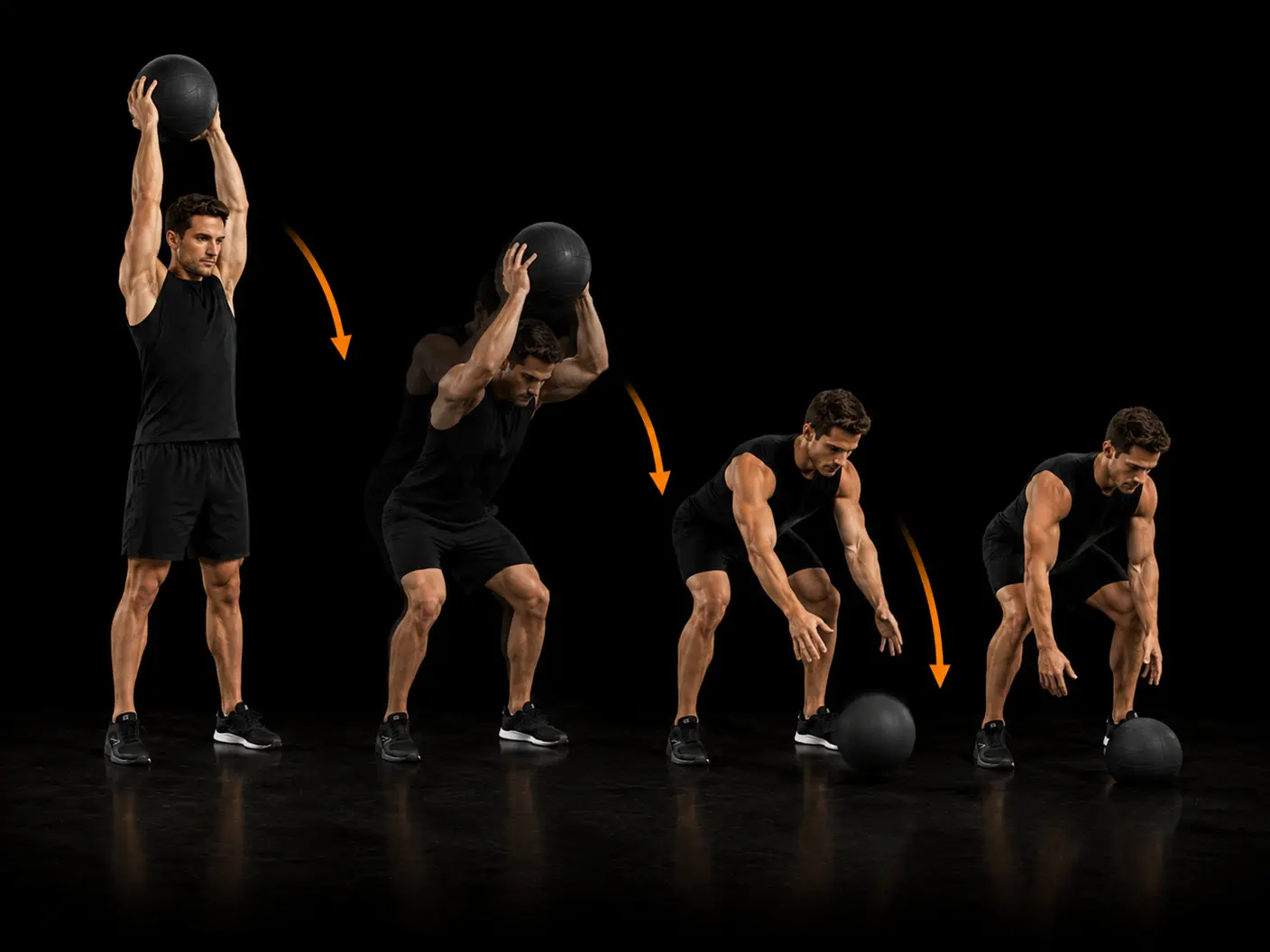
The medicine ball slam is a full-body power exercise that trains the ability to generate and express force rapidly from the overhead position down through the floor. It works through a hip-hinge pattern combined with a powerful shoulder and lat drive, making it genuinely compound in nature. It suits intermediate trainees looking to develop athletic power output or add high-intensity work to a fat-loss programme.
How to do it
Hold a non-bouncing med ball overhead with both hands. Extend up onto the toes. Drive the ball down to the floor in front of you with maximum force, folding through the hips. Pick up and repeat.
Coaching cues
- Reach up tall
- Slam with intent
- Hips fold through
- Full-body drive
Why train it
- Develops explosive power by training the entire posterior chain and upper body to work in co-ordination under maximal intent.
- The combination of lats, core, shoulders, glutes, and hamstrings working simultaneously makes it one of the more time-efficient conditioning tools available.
- Because the load is a ball rather than a barbell, the movement is accessible to athletes who lack the technical foundation for Olympic lifting but still need power development work.
- The high-force output required elevates heart rate quickly, making it an effective tool within a fat-loss programme where metabolic demand is a priority.
Common mistakes
- Using only the arms to throw the ball down — initiate the movement by driving the hips forward and folding at the waist so the whole body contributes to the slam.
- Failing to reach full overhead extension before the throw — rise up onto the toes and extend completely through the torso first, as this sets the range of motion that generates maximum force on the way down.
- Letting the lower back round excessively during the hip fold — brace the core before the downward drive and hinge at the hips rather than collapsing through the spine.
- Choosing a bouncing medicine ball rather than a non-bouncing one — a ball that returns to the thrower unpredictably creates a control hazard and reduces the quality of each repetition.
Primary: Latissimus Dorsi, Rectus Abdominis, Anterior Deltoid.
Secondary: Gluteus Maximus, Hamstrings, Triceps Brachii, Trapezius.
Equipment
Good for
Easier variation
Lighter ball with shorter ROM — groove the pattern.
Similar movements
Frequently asked
- What muscles does the medicine ball slam work?
- The primary muscles trained are the lats, core, and shoulders, with meaningful contribution from the glutes, hamstrings, and triceps as secondary movers. The movement is genuinely full-body, requiring co-ordinated force production from the lower body through to the hands.
- How many sets and reps should I do for medicine ball slams?
- For power development, three to five sets of four to eight reps with full recovery between sets is a well-established approach, as quality of effort matters more than accumulating volume. For conditioning or fat-loss circuits, shorter rest periods or timed rounds of fifteen to twenty seconds can be used, though you should maintain intent on each slam rather than simply going through the motions.
- What weight medicine ball should I use?
- Most intermediate trainees find a ball between four and eight kilograms appropriate — light enough to allow full overhead extension and maximum velocity on every rep, but heavy enough that each slam requires genuine effort. Prioritise speed and full-body co-ordination over loading; if your range of motion shortens or the hip fold disappears, the ball is too heavy.
- Are medicine ball slams suitable for fat loss?
- They are well-suited to fat-loss programming because the high-force, full-body nature of the movement creates significant metabolic demand in a short period. They work particularly well within interval-based sessions or as a conditioning finisher alongside more traditional resistance work.
- What exercises can I do instead of medicine ball slams?
- If a medicine ball is unavailable, kettlebell swings train a similar hip-hinge power pattern with comparable lower-body and lat involvement. Trap bar jumps or broad jumps can also develop explosive power, though they shift emphasis toward the lower body and reduce the overhead shoulder and lat contribution that makes the slam distinctive.
Want this movement in a plan built for you?
Adaptiv programmes the right exercises for your goal, equipment and experience — then adapts them as you train.
Build my programme