Overhead Medicine Ball Throw
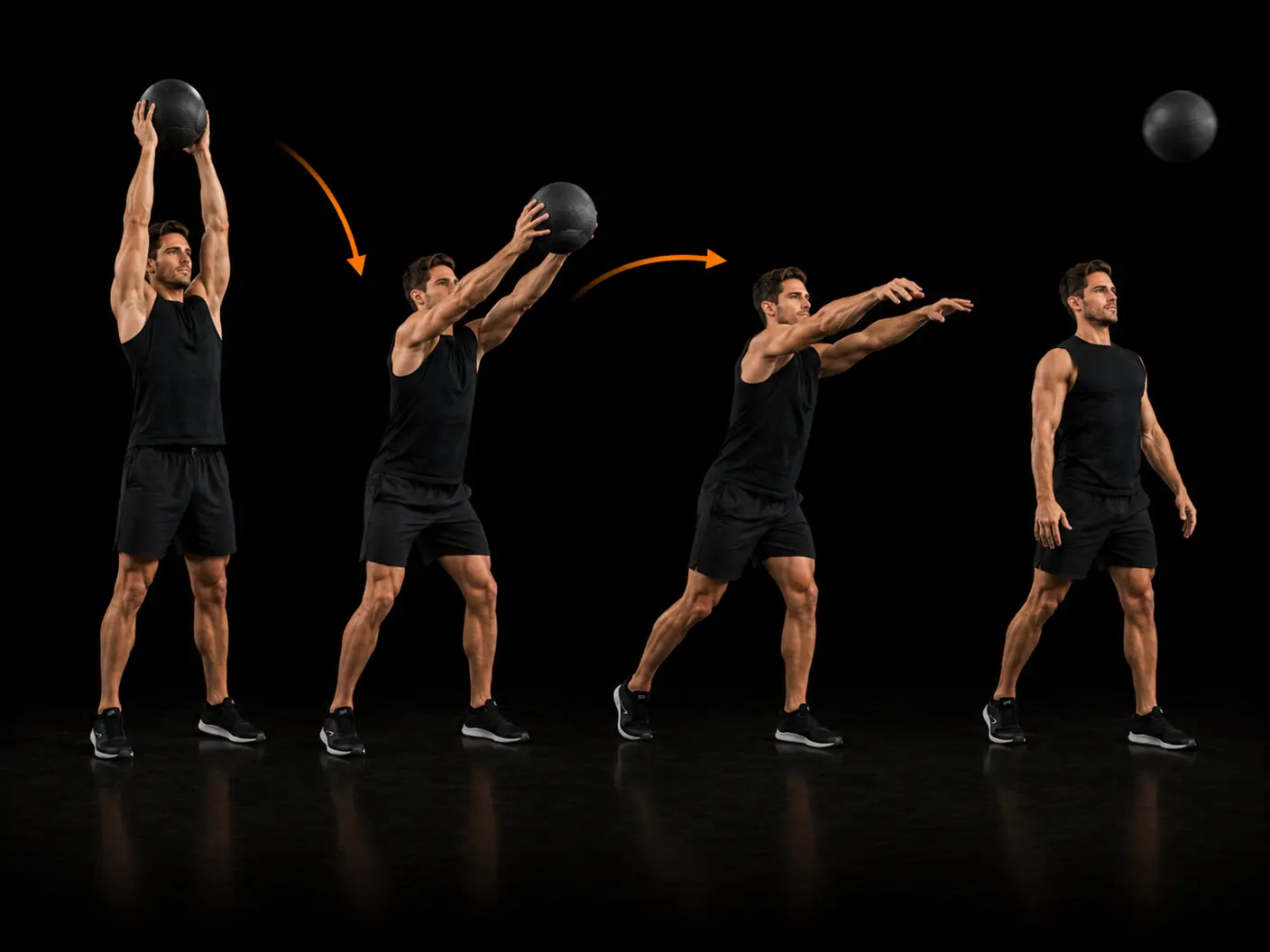
The overhead medicine ball throw is an explosive compound movement that trains the power pattern through rapid trunk flexion, driving force from the core and shoulders into a maximal release of the ball against a wall or the ground. It develops the ability to produce force quickly — a quality distinct from strength alone — making it well suited to athletes and intermediates who want to bridge the gap between the gym and sport. The movement is accessible to anyone who has a solid base of core control and can perform explosive efforts with sound mechanics.
How to do it
Stand facing a wall or open space. Hold a medicine ball with both hands overhead. Rapidly flex the trunk and throw the ball against the wall or into the ground in front of you as hard as possible. The power comes from the trunk and arms, not just the arms. Catch the rebound or pick up and reset.
Coaching cues
- Explosive trunk flexion
- Full range of motion
- Maximum intent
- Catch or reset safely
Why train it
- Develops explosive trunk flexion power, which transfers directly to throwing, striking, and change-of-direction sports.
- Trains the rectus abdominis and obliques under high-velocity conditions, producing a stimulus that slower core exercises cannot replicate.
- The full-body recruitment of glutes, hamstrings, lats, and shoulders means a significant metabolic demand, supporting fat loss goals when programmed in circuits or intervals.
- Maximum-intent repetitions condition the neuromuscular system to recruit motor units rapidly, improving overall athletic output over time.
Common mistakes
- Using only the arms to throw — initiate the movement with explosive trunk flexion so the core drives the effort and the arms follow.
- Insufficient range of motion overhead — start with the ball fully extended above the head so the entire trunk flexion range contributes to force production.
- Resetting too quickly without composure — take a moment to pick up or catch the ball under control before the next rep to maintain quality and reduce error.
- Choosing a ball that is too light — select a weight that challenges maximum intent without compromising full range of motion or causing the throw to become uncontrolled.
Primary: Rectus Abdominis, Obliques, Anterior Deltoid, Latissimus Dorsi.
Secondary: Gluteus Maximus, Hamstrings, Triceps Brachii, Trapezius.
Equipment
Good for
Easier variation
Light medicine ball overhead slam at reduced velocity — build power output progressively.
Similar movements
Frequently asked
- What muscles does the overhead medicine ball throw work?
- The primary muscles are the core — specifically the rectus abdominis and obliques — along with the shoulders and lats. The glutes and hamstrings contribute as secondary movers, helping to generate and transfer force through the trunk.
- How many sets and reps should I do?
- For power development, 3–5 sets of 4–8 repetitions works well, with full recovery of 90–120 seconds between sets so each throw can be performed with maximum intent. Reducing rest and increasing volume shifts the emphasis towards conditioning and fat loss.
- Do I need a wall, or can I throw into the ground?
- Both options are effective. Throwing against a solid wall allows for a rebound catch and a faster reset, while a downward slam into the ground suits open spaces and removes the need for a rebound. Choose based on what your environment allows.
- Is this exercise suitable for beginners?
- This movement is rated intermediate because it requires both the core stability to control a load overhead and the body awareness to produce explosive effort safely. Beginners would benefit from building a foundation with slower trunk-flexion and core exercises before progressing to maximum-intent throws.
- What are good alternatives if I do not have a medicine ball?
- The overhead medicine ball throw is specific to the equipment listed, so a direct substitute requires a medicine ball. If one is unavailable, explosive movements that train trunk flexion power — such as a cable crunch with controlled speed or a hanging knee raise with intent — can partially address the pattern, though the ballistic quality will differ.
Want this movement in a plan built for you?
Adaptiv programmes the right exercises for your goal, equipment and experience — then adapts them as you train.
Build my programme