Medicine Ball Chest Pass
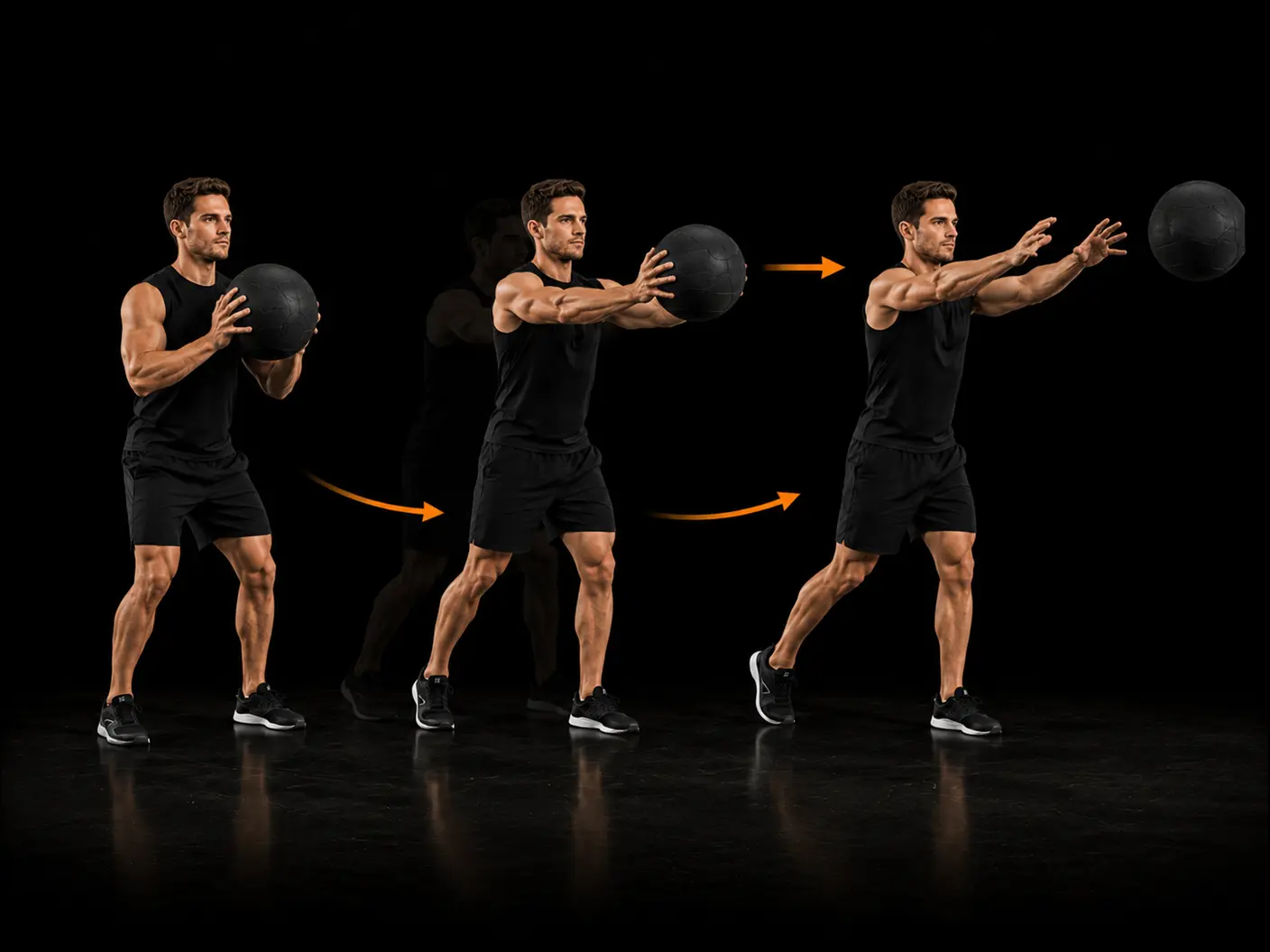
The medicine ball chest pass is an explosive pressing movement that trains horizontal power through the chest, triceps, and anterior deltoid. Performed against a wall at close range, it develops rate-of-force development in the upper body — the ability to generate and express force quickly rather than simply move heavy loads. It suits athletes and intermediates looking to build power qualities that translate to throwing, striking, and contact sport performance.
How to do it
Stand 6 feet from a wall, feet shoulder-width. Hold a med ball at the chest. Explosively press the ball forward into the wall — extend the elbows fully and protract the shoulders. Catch the ball on the rebound and immediately repeat.
Coaching cues
- Press with intent
- Full extension
- Catch and reset
- Minimal ground time
Why train it
- Developing upper-body rate-of-force development makes this a direct training tool for sports requiring explosive pressing or pushing actions.
- The cyclical catch-and-press structure trains the stretch-shortening cycle, conditioning the muscles and connective tissue to store and release elastic energy efficiently.
- As a compound movement involving the core and quads for stabilisation, it demands whole-body co-ordination rather than isolating a single muscle group.
- Its relatively low technical barrier compared to barbell power work makes it a practical option for introducing power training within a broader athletic performance programme.
Common mistakes
- Pushing rather than pressing explosively — focus on maximum intent from the first inch of movement, treating every rep as an attempt to drive the ball through the wall.
- Allowing the elbows to flare excessively wide — keep them at roughly 45 degrees to the torso to maintain force transfer through the primary movers and reduce shoulder strain.
- Failing to fully extend at the elbow and shoulder — incomplete extension shortens the working range and reduces the stimulus to the triceps and anterior deltoid.
- Absorbing the rebound passively — receive the ball with active hands and transition immediately into the next rep, minimising the time the ball spends at your chest.
Primary: Pectoralis Major, Triceps Brachii, Anterior Deltoid.
Secondary: Rectus Abdominis, Quadriceps.
Equipment
Good for
Easier variation
Lighter ball or shorter distance.
Similar movements
Frequently asked
- What muscles does the medicine ball chest pass work?
- The primary muscles are the pectoralis major, triceps, and anterior deltoid. The core and quads contribute as secondary stabilisers throughout the movement.
- How many sets and reps should I do for the medicine ball chest pass?
- For power development, lower rep ranges work best — typically 3 to 5 sets of 4 to 8 reps, with full recovery between sets of around 2 to 3 minutes. The priority is quality and speed of each rep, not volume or fatigue.
- How heavy should the medicine ball be?
- Choose a weight that allows fully explosive intent on every rep — if the ball slows your movement or you cannot fully extend, it is too heavy. For most intermediates, 4 to 6 kg is a reasonable starting point, adjusting based on how well you can maintain speed and control.
- Is the medicine ball chest pass suitable for improving sport performance?
- Yes, it is categorised specifically as an athletic performance exercise. The horizontal power pattern it trains is relevant to contact sports, racket sports, and any activity requiring rapid upper-body force expression.
- What are good alternatives to the medicine ball chest pass?
- If a wall is unavailable, a partner chest pass achieves the same movement pattern. For those looking to progress the stimulus, a rotational chest pass or overhead slam can complement upper-body power work within the same programme.
Want this movement in a plan built for you?
Adaptiv programmes the right exercises for your goal, equipment and experience — then adapts them as you train.
Build my programme