Plyo Push-Up
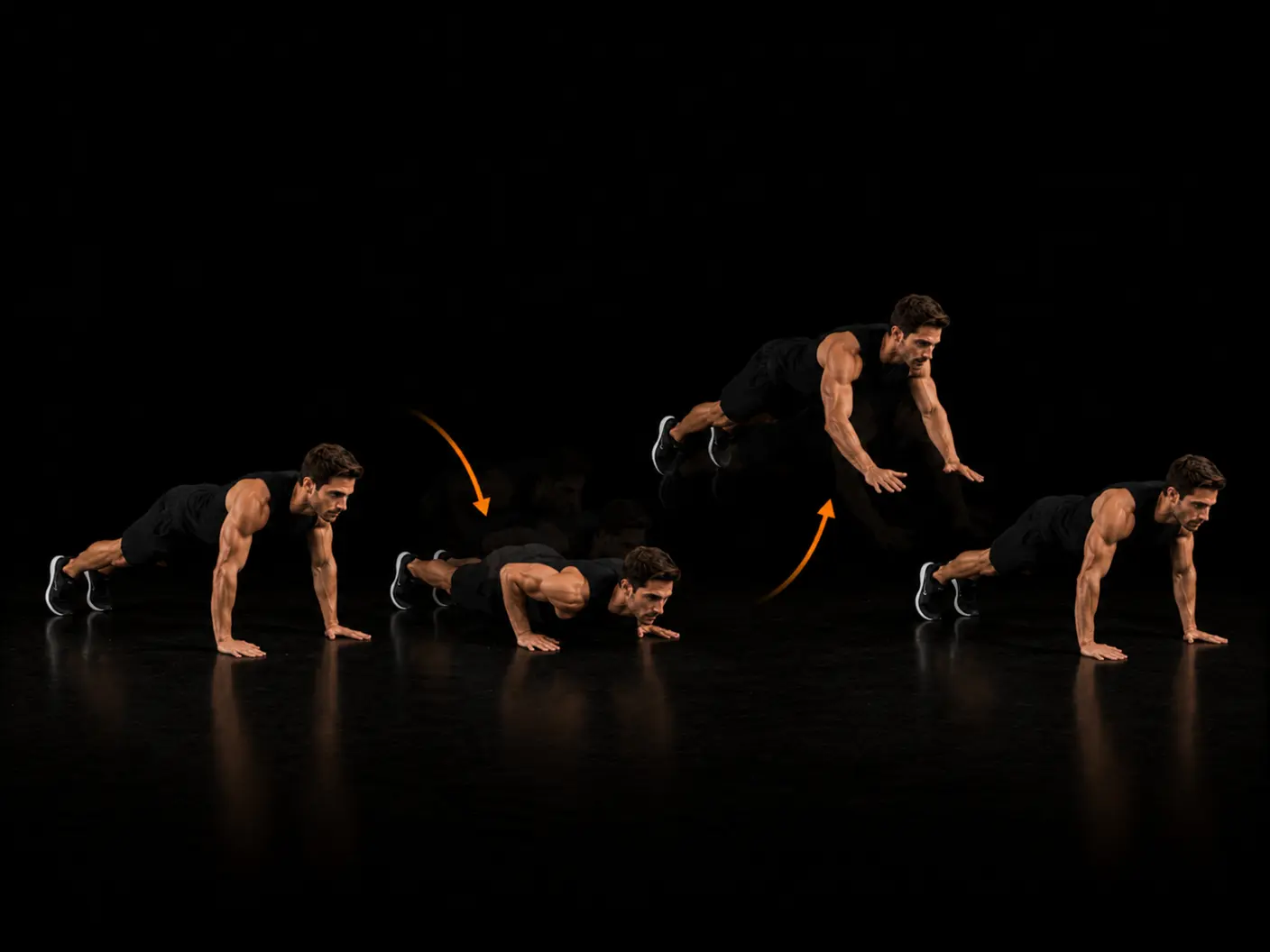
The plyo push-up is a bodyweight plyometric exercise built on the standard push-up pattern, distinguished by an explosive press that drives both hands clear of the floor at the top of each rep. It trains the pectoralis major, triceps, and anterior deltoid under power demands rather than pure strength, making it a meaningful step up from conventional push-up variations. It suits intermediate trainees looking to develop upper-body explosiveness, particularly those with athletic performance goals.
How to do it
Set up in a push-up position. Lower to the floor. Press the floor away explosively so both hands leave the floor. Land with soft elbows; immediately absorb and descend into the next rep.
Coaching cues
- Explosive press
- Hands off the floor
- Soft landing
- Reset quickly
Why train it
- Develops rate of force development in the push pattern, training the chest, triceps, and anterior deltoid to produce force rapidly rather than simply against load.
- Requires no equipment, making it a practical power-training option that can be programmed anywhere without access to specialist machinery.
- The landing and immediate descent phase trains the ability to absorb and redirect force quickly, a quality that carries over to contact and change-of-direction sports.
- Because the movement demands a solid base of push-up strength before the explosive element is added, it serves as a natural progression marker within a bodyweight training programme.
Common mistakes
- Failing to fully extend the elbows before leaving the floor — commit to a complete, powerful press so both hands genuinely clear the surface rather than producing a minimal hop.
- Landing with rigid, locked elbows — keep a soft bend at the elbows on contact and allow the body to descend fluidly into the next rep to absorb force safely.
- Sagging the hips during the movement — brace the core throughout so the body moves as a single unit, exactly as it would in a controlled standard push-up.
- Rushing the reset at the expense of position — take a brief moment after each landing to confirm hand placement and body alignment before initiating the next explosive press.
Primary: Pectoralis Major, Triceps Brachii, Anterior Deltoid.
Secondary: Rectus Abdominis.
Equipment
Good for
Easier variation
Clap push-up removed — just the hand leave.
Similar movements
Frequently asked
- What muscles do plyo push-ups work?
- The primary muscles are the pectoralis major, triceps, and anterior deltoid. The core and shoulders also work as secondary stabilisers to maintain a rigid body position throughout the movement.
- How many sets and reps should I do for plyo push-ups?
- Because this is a power exercise, lower rep ranges tend to be more appropriate than the higher volumes used for hypertrophy. Three to five sets of four to eight reps, with full recovery between sets, allows each rep to be performed with genuine intent and quality.
- What are good alternatives to the plyo push-up?
- If you need a less demanding option, a standard push-up with an accelerated top phase is a useful regression. For those seeking a similar plyometric stimulus with reduced load, an incline plyo push-up performed against a box or bench lowers the force requirements while preserving the movement pattern.
- Do I need to be able to do a certain number of push-ups before attempting plyo push-ups?
- A solid foundation of conventional push-up strength is advisable before adding the explosive element. If standard push-ups are not yet consistent and controlled through a full range of motion, address that first before progressing to the plyometric variation.
- Can plyo push-ups help with sport performance?
- Upper-body power and the ability to produce force quickly are relevant across a range of sports, from contact activities to throwing and striking disciplines. The plyo push-up directly targets these qualities in a horizontal push pattern, which is why athletic performance is the primary goal category for this movement.
Want this movement in a plan built for you?
Adaptiv programmes the right exercises for your goal, equipment and experience — then adapts them as you train.
Build my programme