Clapping Push-Up
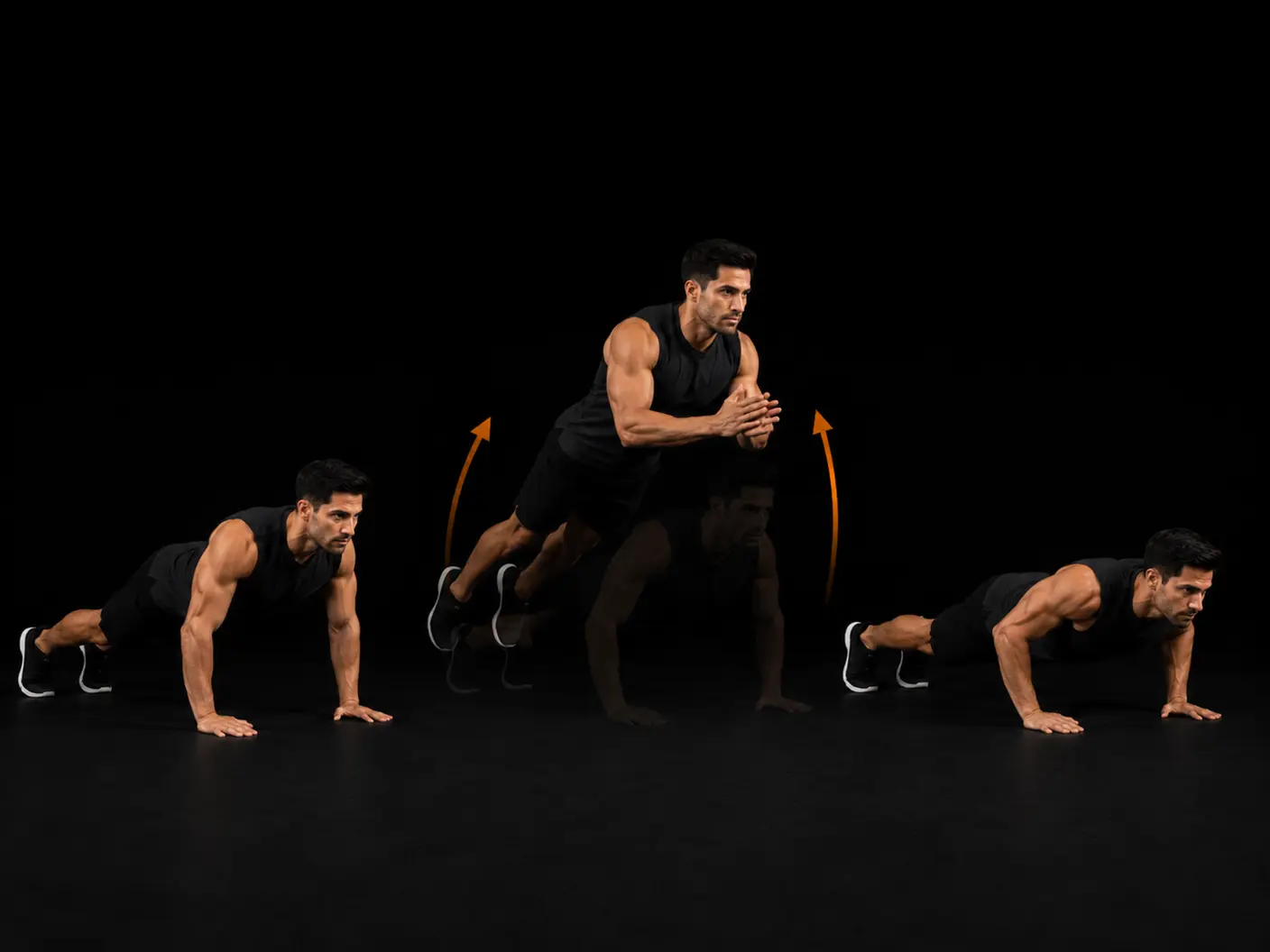
The clapping push-up is an advanced plyometric pressing movement that develops explosive upper-body power through a maximal-effort push-up that projects the hands clear of the floor. It trains the stretch-shortening cycle of the pectoralis major, triceps, and anterior deltoid under bodyweight load, demanding both peak force production and rapid absorption on landing. It suits experienced trainees with a solid foundation in conventional push-up volume who are looking to develop athletic pressing power.
How to do it
Set up in a push-up position. Lower to the floor. Press the floor away explosively enough that both hands leave the floor. Clap the hands together. Land with soft elbows and immediately lower into the next rep.
Coaching cues
- Explosive press
- Soft landing
- Minimise contact time
- Plank throughout
Why train it
- Develops rate of force development in the horizontal push pattern, a quality directly relevant to throwing, striking, and contact sport performance.
- The requirement to maintain a rigid plank throughout each rep builds anterior core stiffness under dynamic, high-demand conditions.
- Minimal contact time between repetitions trains the stretch-shortening cycle, improving the speed at which the upper body can transition from absorption to propulsion.
- As a bodyweight-only movement, it can be performed anywhere and integrated into power or conditioning blocks without specialist equipment.
Common mistakes
- Sagging at the hips during the explosive phase — brace the core and maintain a straight line from head to heel throughout the entire rep, not just the descent.
- Pressing with insufficient force and barely clearing the floor — commit to a maximal explosive press so there is genuine airtime to complete the clap cleanly.
- Landing with locked or rigid elbows — receive the floor with soft, slightly bent elbows and immediately absorb into the next lowering phase to protect the joints and maintain rhythm.
- Allowing the hips to pike upward on take-off — keep the glutes engaged so the body moves as a single unit rather than breaking at the waist.
Primary: Pectoralis Major, Triceps Brachii, Anterior Deltoid.
Secondary: Rectus Abdominis.
Equipment
Good for
Easier variation
Plyo push-up without the clap — hands leave the floor only.
Similar movements
Frequently asked
- What muscles do clapping push-ups work?
- The primary muscles are the pectoralis major, triceps, and anterior deltoid. The core and shoulders work as secondary stabilisers to maintain body position throughout the movement.
- How many sets and reps should I do for clapping push-ups?
- Because this is a power exercise, lower rep ranges typically produce the best quality of effort — three to five sets of four to eight reps is a sensible starting point. Rest fully between sets (90 seconds to three minutes) so each set can be performed with maximum intent.
- What should I be able to do before attempting clapping push-ups?
- You should be comfortable performing multiple sets of at least 20 strict conventional push-ups with full range of motion and no hip sag before introducing the plyometric variant. The explosive demand places considerably more stress on the wrists, elbows, and shoulders than a standard push-up.
- Are clapping push-ups good for building muscle?
- They are primarily a power development tool rather than a hypertrophy exercise. If your main goal is muscle size, higher-volume conventional push-up variations or weighted pressing movements will be more effective; clapping push-ups are best programmed as part of an athletic performance or power block.
- What are good alternatives to clapping push-ups?
- If you are working towards clapping push-ups, elevated explosive push-ups — where the hands land on a raised surface to reduce the force required on landing — are a useful progression step. Plyo push-ups without the clap, where the hands simply leave the floor, also train the same quality at a slightly lower technical demand.
Want this movement in a plan built for you?
Adaptiv programmes the right exercises for your goal, equipment and experience — then adapts them as you train.
Build my programme