Med Ball Rotational Slam
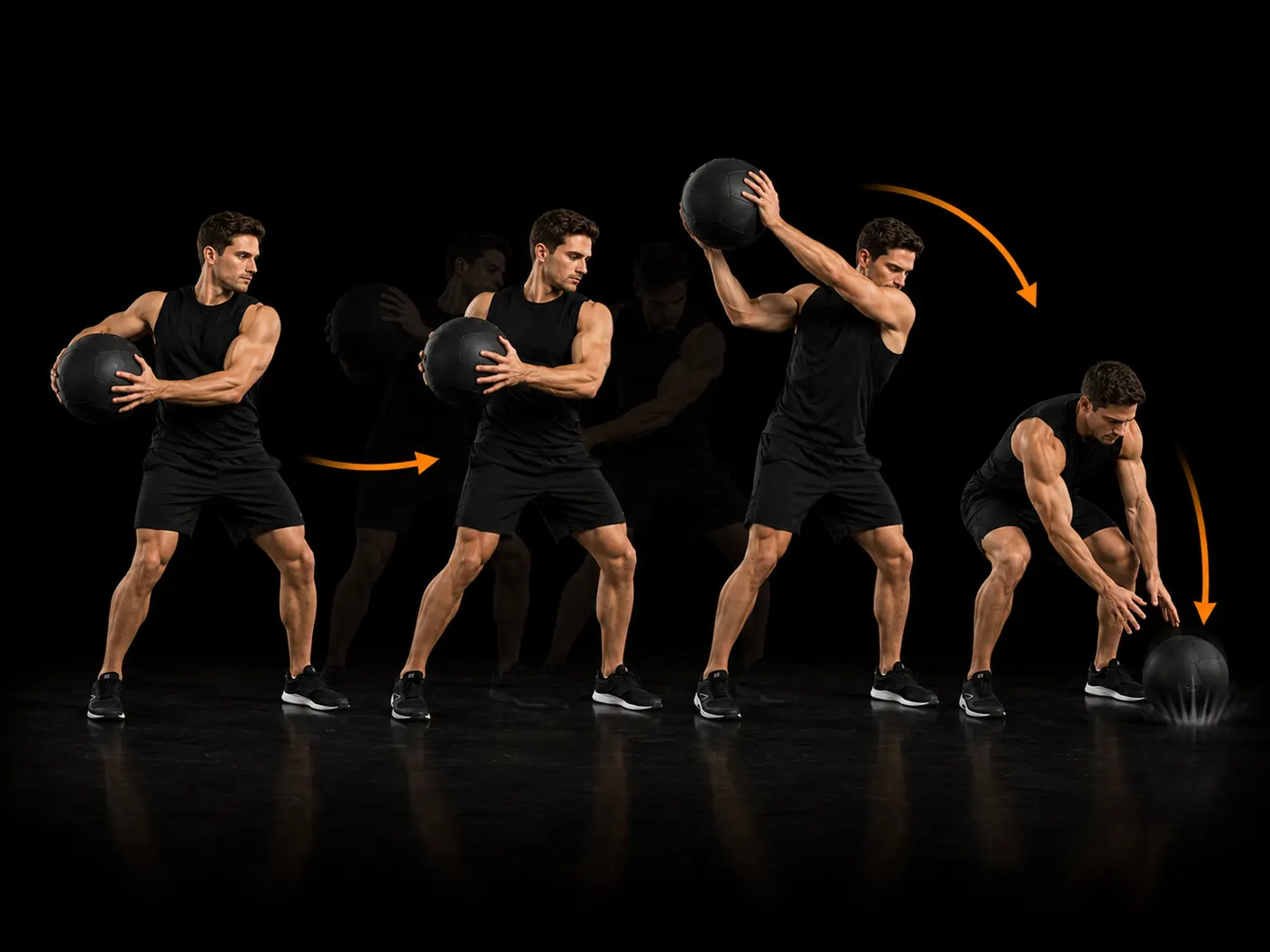
The med ball rotational slam is a compound power movement that trains the rotational force production running from the hips through the torso. Holding a medicine ball at one hip, you drive an explosive rotation to slam it into a wall or floor, developing the obliques and rectus abdominis as primary movers with supporting contribution from the shoulders, lats, and glutes. It suits intermediate trainees looking to build rotational athleticism or add high-intensity conditioning work to their programme.
How to do it
Stand side-on to a wall or open space, feet shoulder-width. Hold a medicine ball at one hip. Rotate explosively through the hips and torso; slam the ball into the wall or floor at the far side. Catch on the rebound or reset. Work both sides.
Coaching cues
- Rotate through the hips
- Explosive intent
- Whip the torso
- Catch or reset
Why train it
- Develops explosive rotational power that transfers directly to sport-specific movements such as throwing, striking, and swinging.
- The compound, full-body nature of the movement elevates heart rate efficiently, making it a productive tool within fat-loss or conditioning circuits.
- Training both sides of the rotation addresses asymmetries in lateral force production, which are common in athletes who favour a dominant side.
- The slam mechanic encourages genuine maximal intent on each repetition, making it easier to maintain power output across a set than with slower, resistance-based exercises.
Common mistakes
- Rotating from the shoulders only — initiate each rep by driving the hips first, letting the torso and arms follow as a whip.
- Using a medicine ball that is too heavy — this limits rotational speed and shifts the demand away from power, so choose a load you can accelerate maximally throughout the full arc.
- Keeping the feet fixed and rigid — allow the back heel to lift and pivot naturally with the rotation to avoid excessive strain through the knee and ankle.
- Rushing through the reset — take a moment to re-establish your hip position and grip before each slam, as poor starting position reduces force transfer and consistency across reps.
Primary: Obliques, Rectus Abdominis.
Secondary: Anterior Deltoid, Latissimus Dorsi, Gluteus Maximus.
Equipment
Good for
Easier variation
Slower rotation with a light ball — groove the pattern.
Similar movements
Frequently asked
- What muscles does the med ball rotational slam work?
- The primary muscles are the obliques and rectus abdominis. The shoulders, lats, and glutes contribute as secondary movers, making it a full-body rotational pattern rather than an isolated core exercise.
- How many sets and reps should I do for the med ball rotational slam?
- For power development, three to five sets of four to six reps per side with full recovery between sets works well, as fatigue degrades speed and intent. In a conditioning context, you can programme it in timed intervals of fifteen to twenty seconds per side.
- Do I need a wall, or can I slam the ball on the floor?
- Both options are valid. Slamming into a wall at approximately hip to chest height suits a rotational finish, whilst a floor slam works if you have a suitable surface and a heavy dead-ball that will not rebound unpredictably. Choose whichever your environment allows safely.
- Is this exercise suitable for beginners?
- It is classified as an intermediate movement because it requires sound hip mobility, core control, and an understanding of how to sequence a rotational pattern before adding explosive intent. Beginners would benefit from building foundational rotational strength through slower, controlled movements first.
- What are good alternatives to the med ball rotational slam?
- Cable woodchops and resistance band rotations train a similar pattern at lower intensity and are useful progressions into the slam. Pallof presses develop the anti-rotation stability that supports this movement, and landmine rotations offer a comparable rotational power stimulus with a slightly more guided path.
Want this movement in a plan built for you?
Adaptiv programmes the right exercises for your goal, equipment and experience — then adapts them as you train.
Build my programme