Scoop Toss (Med Ball)
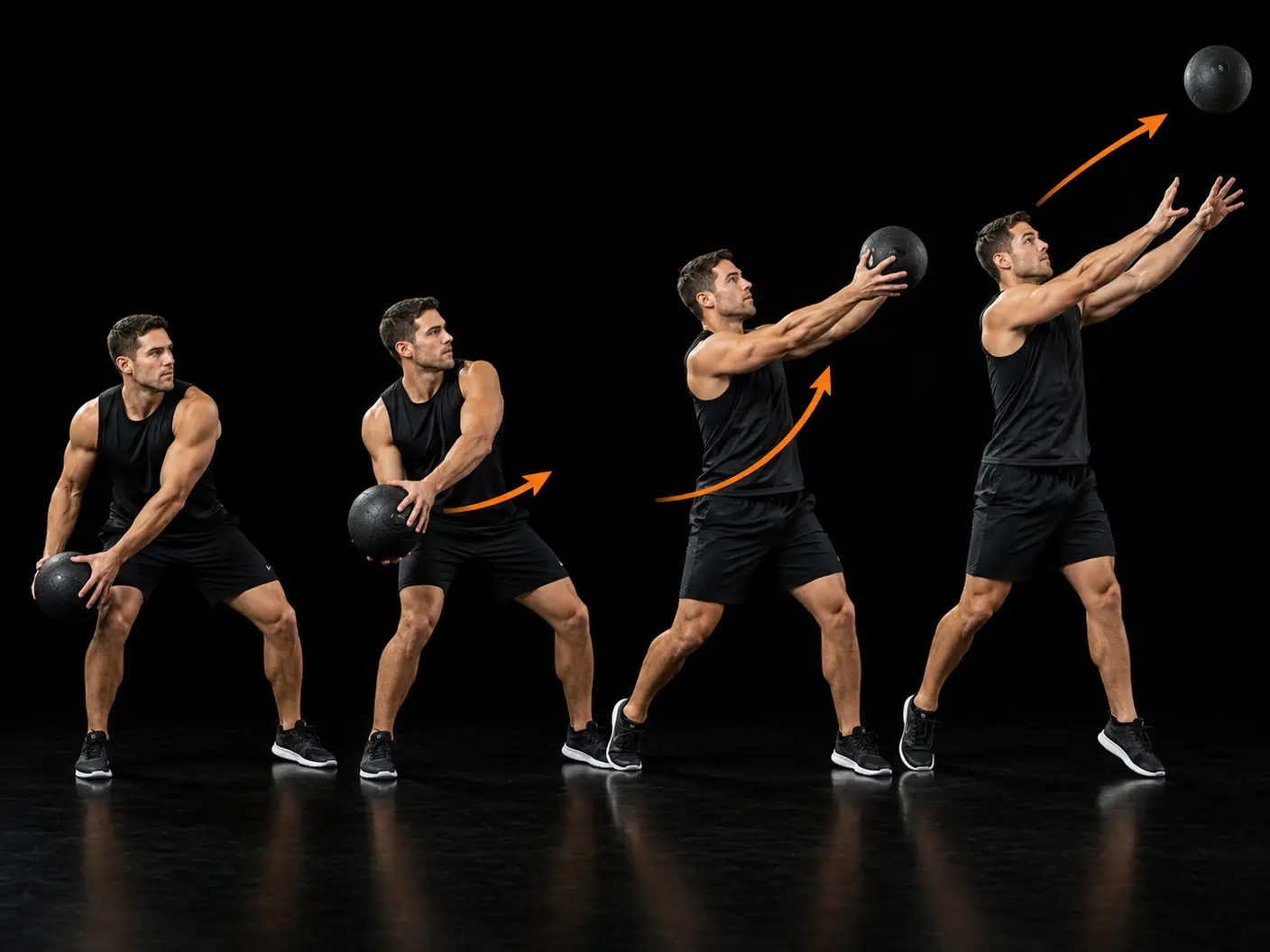
The scoop toss is an explosive medicine ball movement that trains the triple-extension power pattern — hips, knees, and ankles driving in sequence to project a load overhead and behind the body. It develops rate of force development through the posterior chain, making it a direct training stimulus for athletic qualities such as sprinting, jumping, and change of direction. It suits intermediate trainees who have established a sound hip hinge pattern and are ready to express that strength at speed.
How to do it
Hold a med ball at the hips with both hands. Hinge back into a loaded position. Drive the hips forward explosively and swing the ball up and overhead, releasing it behind you for maximum distance.
Coaching cues
- Loaded hinge
- Explosive hip drive
- Full extension
- Release overhead
Why train it
- Develops explosive hip extension power through the glutes and hamstrings, qualities that transfer directly to field and court sport performance.
- The overhead release demands full-body coordination, training the lats and shoulders to work in sequence with the lower body rather than in isolation.
- Because the load leaves the hands at peak velocity, there is no deceleration phase — the athlete must produce maximal force without the safety net of slowing the movement down.
- Regular use builds neuromuscular efficiency, teaching the body to recruit large muscle groups rapidly and in the correct order.
Common mistakes
- Using the arms to swing the ball rather than the hips — initiate the movement by driving the hips forward first and let the arms follow as a consequence of that hip extension.
- Failing to load the hinge sufficiently at the start — push the hips back until the hamstrings are under tension before you drive, rather than squatting straight down and losing the elastic energy in the posterior chain.
- Releasing the ball too early, in front of the body — hold on through the full extension so the ball travels upward and overhead rather than being thrown forward like a chest pass.
- Rounding the lower back during the hinge — brace the core before the movement begins and maintain a neutral spine throughout the load phase to transfer force efficiently into the drive.
Primary: Gluteus Maximus, Hamstrings, Latissimus Dorsi.
Secondary: Rectus Abdominis, Anterior Deltoid.
Equipment
Good for
Easier variation
Two-handed kettlebell swing — similar pattern without the release.
Similar movements
Frequently asked
- What muscles does the scoop toss work?
- The primary muscles are the glutes, hamstrings, and lats, which drive the explosive extension and guide the ball overhead. The core and shoulders act as secondary contributors, stabilising the trunk and controlling the release.
- How many sets and reps should I do for the scoop toss?
- Because this is a power movement, lower rep ranges are appropriate — typically 3 to 5 sets of 3 to 6 repetitions. Quality of each throw matters far more than accumulating volume; if speed or height drops noticeably, rest before continuing.
- What weight medicine ball should I use?
- A ball that is light enough to allow full, explosive extension is the correct choice — most intermediate trainees start effectively between 3 kg and 6 kg. If the movement looks slow and laboured, the ball is too heavy for the intended training effect.
- Is the scoop toss suitable for strength training or only for sport?
- Although it sits firmly within athletic performance programming, it is a valuable addition for any intermediate lifter who wants to develop power expression rather than purely maximal strength. It complements barbell lifting by training the speed end of the force-velocity curve.
- What are good alternatives if I do not have access to a medicine ball?
- The hip hinge power pattern can be trained with a kettlebell swing, which shares the loaded hinge and explosive hip drive mechanics. For overhead projection specifically, the scoop toss has few direct substitutes without a medicine ball, so check equipment availability before programming it.
Want this movement in a plan built for you?
Adaptiv programmes the right exercises for your goal, equipment and experience — then adapts them as you train.
Build my programme