Rotational Medicine Ball Throw
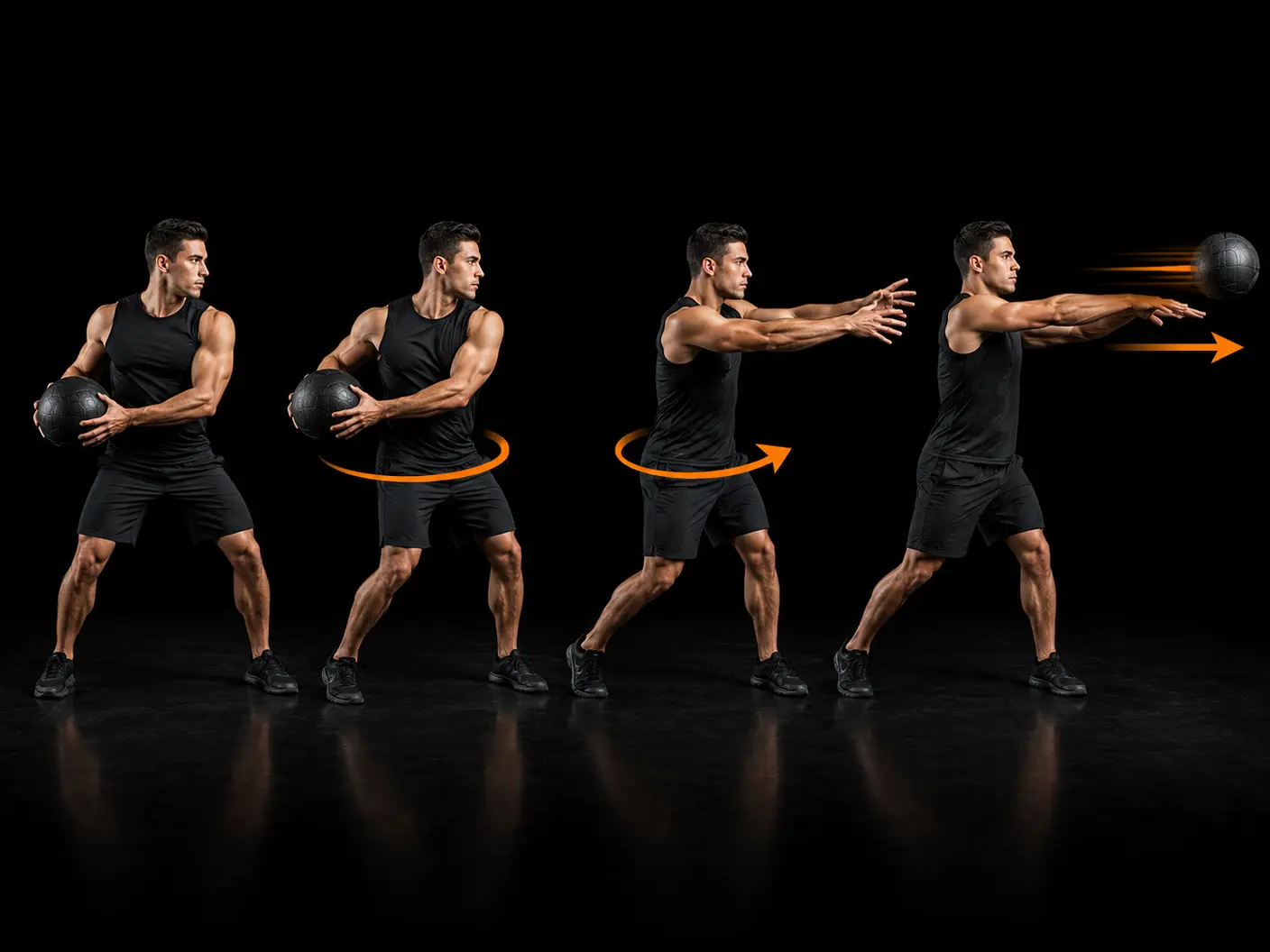
The rotational medicine ball throw is an explosive compound movement that trains rotational power through the hips, core, and torso. Standing side-on to a wall, the athlete drives force from the lower body through the obliques and into the throw — a pattern that closely mirrors the demands of striking, throwing, and change-of-direction sport skills. It suits intermediate trainees who have a solid foundation in core stability and are looking to develop athletic power rather than simply muscular endurance.
How to do it
Stand side-on to a wall, feet shoulder-width. Hold a med ball at the hip furthest from the wall. Rotate explosively through the hips and torso; throw the ball into the wall at chest height. Catch on the rebound and reset. Work both sides.
Coaching cues
- Rotate through the hips
- Throw with intent
- Use the legs
- Catch and reset
Why train it
- Develops rotational power by training the obliques, glutes, and core to generate and transfer force explosively across the body.
- Bridges the gap between gym strength and sport performance by replicating the rotational mechanics found in throwing, swinging, and cutting movements.
- Working both sides in every session helps address asymmetries in rotational strength that can limit athletic output.
- The catch-and-reset structure trains not just force production but also reactive control, demanding that the athlete decelerate and stabilise between repetitions.
Common mistakes
- Using only the arms to throw — drive the movement from the hips and legs first, letting the torso and arms follow as a consequence of that rotation.
- Standing too square to the wall — set up fully side-on so that the hips have the full range of motion required to generate rotational force.
- Throwing without intent at submaximal effort — each repetition should be executed with genuine force; half-hearted throws undermine the power adaptation the exercise is designed to produce.
- Neglecting the weaker side — always complete equal volume on both sides to develop balanced rotational capacity rather than reinforcing an existing asymmetry.
Primary: Obliques, Rectus Abdominis, Gluteus Maximus.
Secondary: Anterior Deltoid, Latissimus Dorsi.
Equipment
Good for
Easier variation
Slower rotation with lighter ball — groove the pattern.
Similar movements
Frequently asked
- What muscles does the rotational medicine ball throw work?
- The primary muscles trained are the obliques, broader core musculature, and glutes. The shoulders and lats contribute as secondary movers during the throw and catch phases.
- How many sets and reps should I do?
- For power development, keep repetitions low and intent high — typically 3 to 5 sets of 4 to 8 throws per side. Rest fully between sets, around 90 to 120 seconds, so that each effort is genuinely explosive rather than fatigued.
- What weight medicine ball should I use?
- Choose a weight that allows you to throw with full rotational intent and speed; most athletes find somewhere between 3 kg and 6 kg appropriate for this movement. If the ball slows your rotation noticeably, reduce the load — power output matters more than the number on the ball.
- Is this exercise suitable for beginners?
- The movement is rated intermediate because it requires the athlete to already have a working foundation of core stability and hip control. Beginners would benefit from developing those qualities through anti-rotation and hip-hinge work before progressing to this exercise.
- What are good alternatives to the rotational medicine ball throw?
- If you do not have access to a wall or medicine ball, cable rotational chops performed at speed offer a comparable rotational power stimulus. Landmine rotational presses are another structured alternative that trains a similar hip-to-shoulder power transfer pattern.
Want this movement in a plan built for you?
Adaptiv programmes the right exercises for your goal, equipment and experience — then adapts them as you train.
Build my programme