Single-Leg Standing Calf Raise
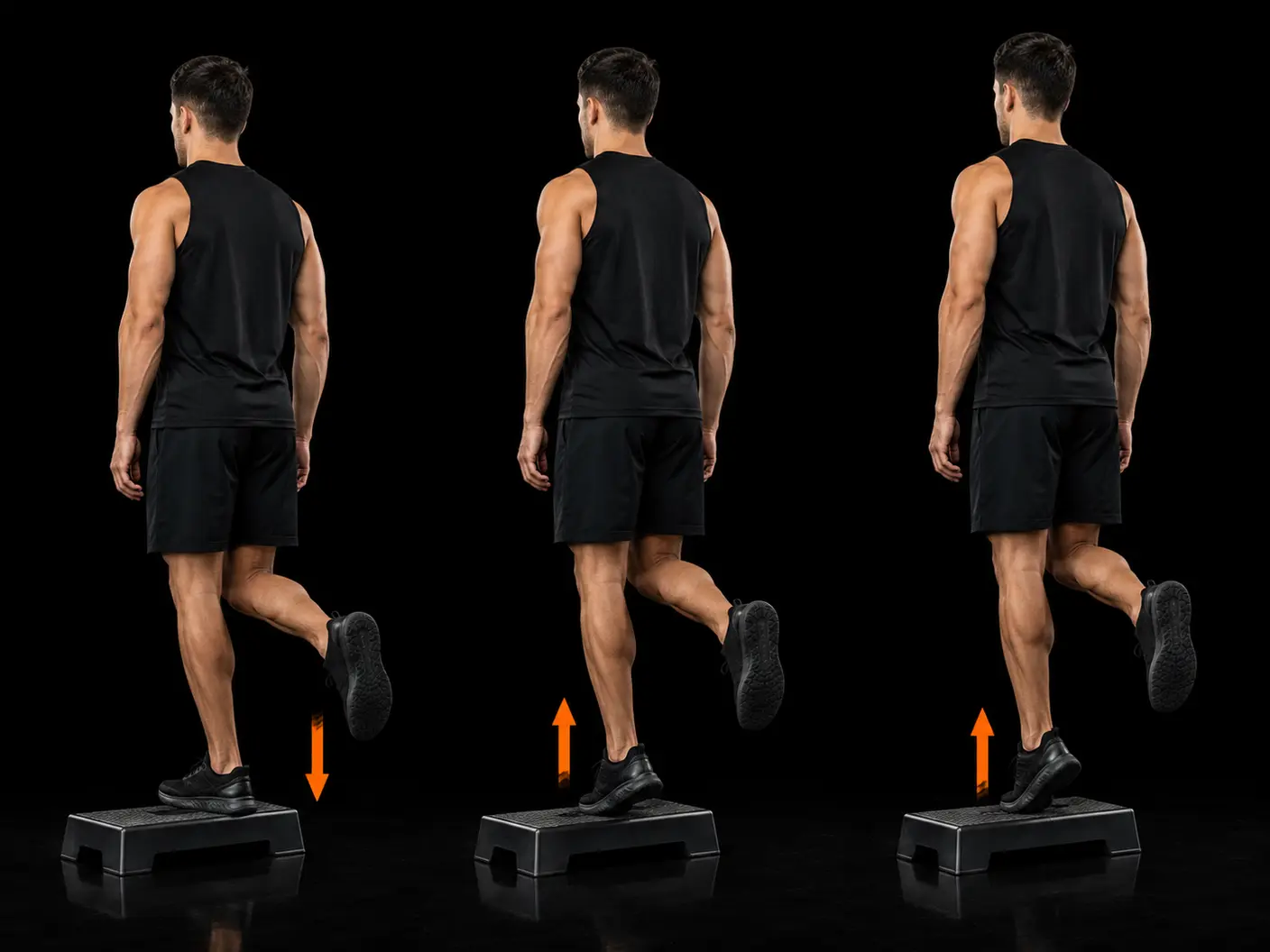
The single-leg standing calf raise is an isolation movement that trains the plantarflexors through a full range of motion, with one leg at a time to address side-to-side strength and size discrepancies. Performed on a step with the ball of the foot at the edge, it allows the heel to drop into a deep stretch before pressing to peak contraction — a range rarely achieved in bilateral or flat-floor variations. It suits beginners building foundational lower-leg strength through to athletes seeking unilateral calf development and improved ankle resilience.
How to do it
Stand on one foot on a step, ball of the foot on the edge, heel hanging off. Hold a support with one hand. Optionally hold a dumbbell in the other. Drop the heel into full stretch. Press up to peak contraction. Pause; lower under control.
Coaching cues
- Ball of the foot on the edge
- Full stretch
- Pause at top
- Slow descent
Why train it
- Training one leg at a time ensures each calf works independently, preventing the stronger side from compensating and helping to equalise left-to-right muscle development.
- The hanging-heel position on a step creates a full eccentric stretch of the gastrocnemius that flat-floor raises cannot replicate, driving greater hypertrophic stimulus across the full muscle belly.
- The single-leg stance demands continuous work from the ankle stabilisers, reinforcing the joint control that underpins running, jumping, and change-of-direction tasks.
- An optional dumbbell in the free hand provides straightforward progressive overload without specialist equipment, making the exercise accessible across most training environments.
Common mistakes
- Bouncing out of the bottom position — pause briefly in the stretched position and initiate each rep with a deliberate muscular contraction rather than elastic rebound.
- Rising onto the toes instead of pressing through the ball of the foot — keep the foot correctly positioned on the step edge throughout so force travels efficiently through the intended joint.
- Rushing the descent — lower the heel slowly and under control to maximise time under tension and protect the Achilles tendon from abrupt loading.
- Gripping the support for balance assistance rather than light stabilisation — use the hand contact only to prevent swaying, keeping the working leg responsible for all the effort.
Primary: Gastrocnemius.
Secondary: Soleus.
Equipment
Good for
Easier variation
Bilateral calf raise — easier balance and load.
Similar movements
Frequently asked
- What muscles does the single-leg standing calf raise work?
- The primary muscle is the gastrocnemius, the two-headed muscle that gives the calf its rounded appearance. The soleus and ankle stabilisers work as secondary contributors, supporting plantarflexion and controlling balance throughout the movement.
- How many sets and reps should I do for calf hypertrophy?
- The calves respond well to moderate-to-high rep ranges — 3 to 4 sets of 10 to 20 reps per leg is a practical starting point for hypertrophy. Prioritise a full range of motion and a controlled tempo over simply accumulating reps.
- Do I need a dumbbell, or is bodyweight sufficient?
- Bodyweight alone is sufficient when you are establishing technique and building baseline strength. Once you can complete 15 or more controlled reps per leg with ease, adding a dumbbell in the free hand provides the progressive overload needed to continue driving adaptation.
- How does this compare to the seated calf raise?
- The standing position keeps the knee extended, which places greater demand on the gastrocnemius. The seated calf raise flexes the knee, shifting emphasis toward the soleus. Combining both exercises in a programme trains the full calf complex more completely than either movement alone.
- Is this exercise suitable if I have a history of Achilles discomfort?
- The deep stretch involved in this movement places significant load through the Achilles tendon, so if you have any history of tendon issues you should consult a qualified professional before including it in your programme.
Want this movement in a plan built for you?
Adaptiv programmes the right exercises for your goal, equipment and experience — then adapts them as you train.
Build my programme