Leg Press Calf Raise
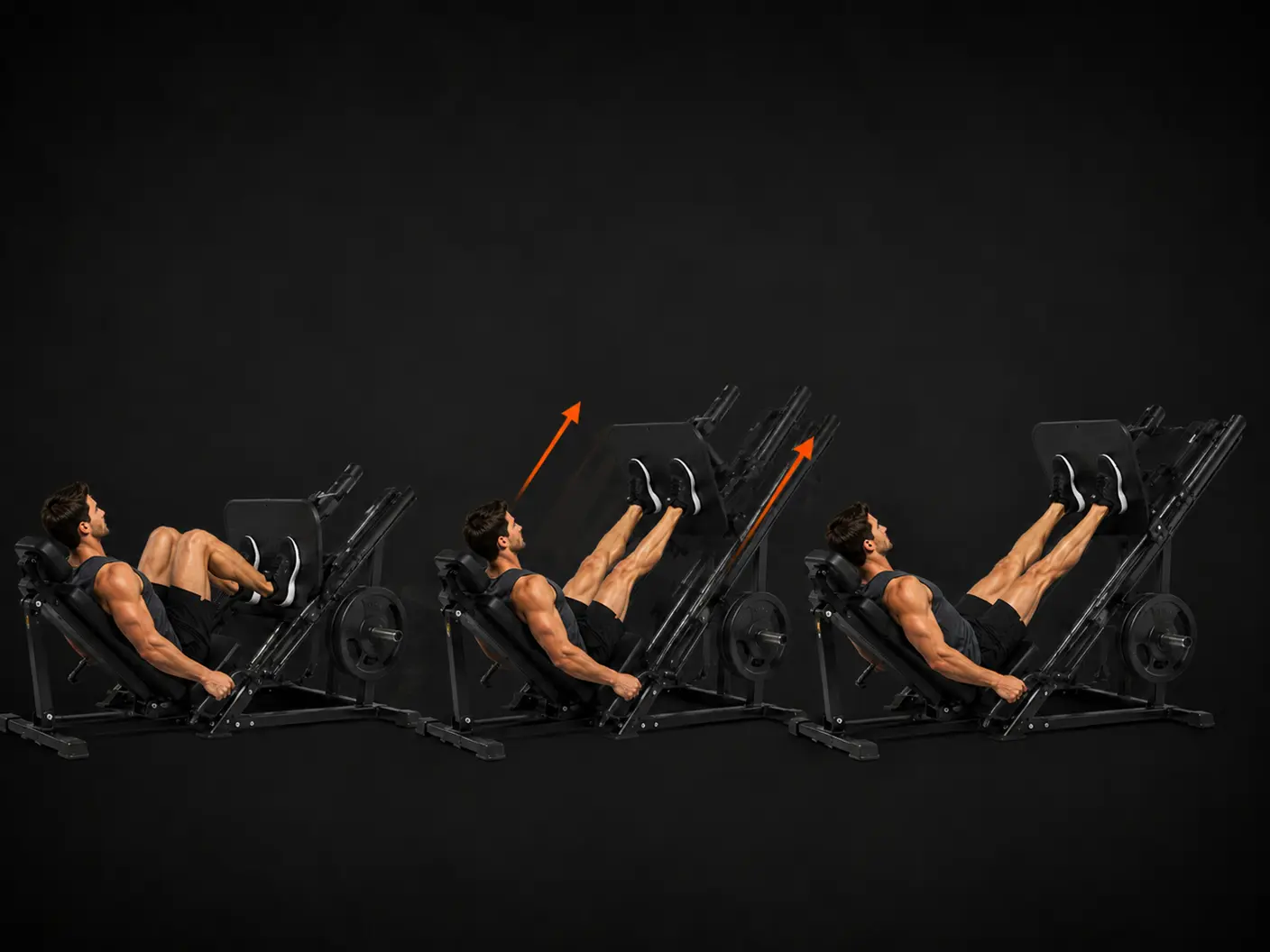
The leg press calf raise is an isolation exercise that targets the calf complex by driving the ankle through plantarflexion against a loaded sled on a 45-degree leg press machine. With the legs held near full extension, the movement removes the knee-flexion variable and places the gastrocnemius — the larger, two-headed calf muscle — under significant mechanical tension throughout the range of motion. It suits lifters of all experience levels looking to add isolated volume to the lower leg without the balance demands of standing calf raise variations.
How to do it
Sit in the leg press. Place the balls of the feet at the bottom of the platform, heels hanging off. Unrack the sled. Straighten the legs but do not fully lock out. Press the platform away by extending the ankles; hold briefly. Lower the heels as far as mobility allows.
Coaching cues
- Balls of the feet low on plate
- Full stretch
- Squeeze at the top
- Controlled eccentric
Why train it
- Training the gastrocnemius with the knee near full extension maximises its involvement, since the muscle crosses the knee joint and becomes slack when the knee is flexed.
- The machine provides a stable, controlled environment that allows you to focus entirely on ankle range of motion and muscular contraction rather than balance or spinal loading.
- Allowing the heels to drop below the plate on each repetition creates a deep stretch under load, which research associates with greater hypertrophic stimulus in the calf musculature.
- The leg press calf raise is straightforward to load progressively, making it a reliable tool for accumulating the higher training volumes the calves typically require to grow.
Common mistakes
- Placing the feet too high on the plate — position the balls of the feet at the lower edge of the platform so the heels hang completely clear and the ankle can move through its full range.
- Bouncing out of the bottom position — lower the heels under control and pause briefly in the stretched position before each concentric drive, removing momentum from the movement.
- Cutting the range of motion short at the top — press all the way through to full plantarflexion and hold for a brief squeeze before lowering, ensuring the gastrocnemius is fully contracted.
- Fully locking out the knees — keep a very slight bend in the joints throughout to protect them under load, without introducing enough flexion to reduce gastrocnemius tension.
Primary: Gastrocnemius.
Secondary: Soleus.
Equipment
Good for
Easier variation
Single-leg version — address asymmetry.
Similar movements
Frequently asked
- What muscles does the leg press calf raise work?
- The primary muscle trained is the gastrocnemius, the prominent two-headed muscle that gives the calf its visible shape. The soleus, which sits beneath the gastrocnemius, acts as a secondary contributor throughout the movement.
- How many sets and reps should I do for calf hypertrophy?
- The calves are accustomed to high volumes of low-level activity, so they often respond better to moderate-to-high rep ranges — typically 10 to 20 repetitions per set. Three to four sets per session, with genuine attention to the stretch and squeeze at each end of the range, is a practical starting point.
- Is the leg press calf raise better than the standing calf raise?
- The two exercises are complementary rather than interchangeable. The leg press version isolates the gastrocnemius with the knee extended and removes balance as a limiting factor, whereas standing calf raise variations may better replicate upright loading patterns. Including both in a programme provides well-rounded calf development.
- Why do my calves seem so hard to grow compared with other muscle groups?
- The calf musculature is composed of a high proportion of slow-twitch muscle fibres and is conditioned by continuous low-level use throughout the day, which means it adapts readily to low-intensity stimulus. Consistent progressive overload, full range of motion, and sufficient weekly volume are the primary levers to address this — if progress has stalled, review whether you are genuinely challenging the stretch and contraction on each repetition.
- Can I use this exercise if I have knee discomfort?
- Because the legs are held near full extension during the movement, any existing knee sensitivity could be relevant — check with a qualified professional before programming this exercise if you have a history of knee issues.
Want this movement in a plan built for you?
Adaptiv programmes the right exercises for your goal, equipment and experience — then adapts them as you train.
Build my programme