Seated Calf Raise
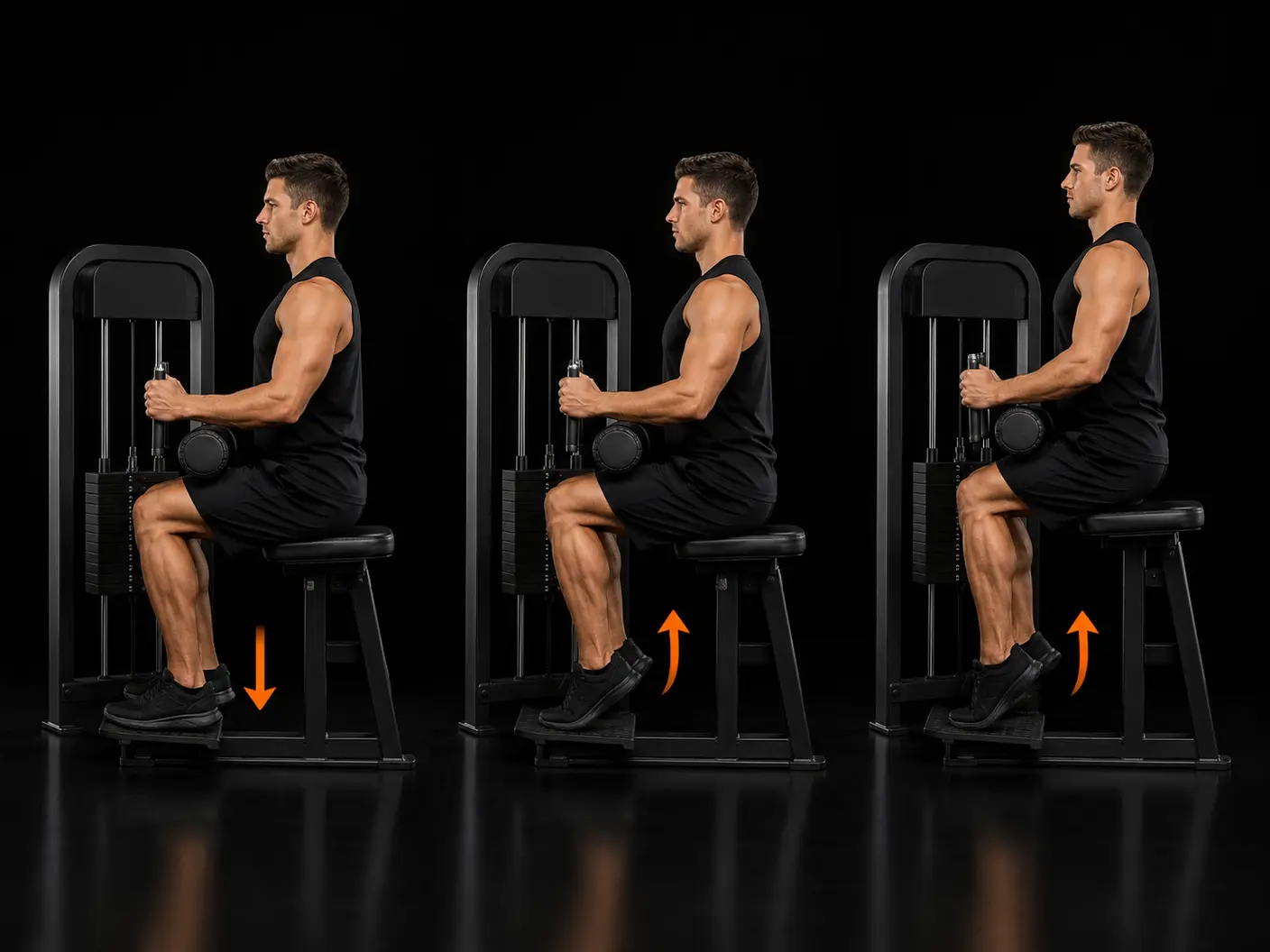
The seated calf raise is a machine-based isolation exercise that targets the soleus by training the plantarflexion movement pattern with the knee held at 90°. Because the gastrocnemius crosses the knee joint, bending the knee places it in a shortened position and effectively removes it from the movement, directing almost all mechanical demand onto the soleus beneath it. This makes the exercise well suited to anyone looking to develop the lower calf specifically, from beginners building foundational lower-leg strength to more advanced trainees filling a gap in their hypertrophy programme.
How to do it
Sit with the knees bent at 90° under the pad. Balls of the feet on the platform, heels hanging off. Lower the heels for a deep stretch. Press through the balls of the feet to peak contraction. Pause briefly. Lower slowly.
Coaching cues
- Deep stretch
- Squeeze at the top
- Knee bent at 90°
- Slow eccentric
Why train it
- The bent-knee position isolates the soleus with a precision that standing calf variations cannot replicate, making it the most direct tool available for developing this muscle.
- A full range of motion — from a deep heel drop to a peak contraction — places the soleus under load across its entire working length, which is a key driver of hypertrophic adaptation.
- The machine provides stable, controlled resistance, allowing the lifter to focus entirely on tempo and contraction quality rather than balance or stability demands.
- Because the exercise is low-impact and mechanically straightforward, it can be programmed as a finishing movement on lower-body days without significantly adding to systemic fatigue.
Common mistakes
- Cutting the range of motion short — allow the heels to drop fully below the platform level on each repetition to achieve the stretch the soleus requires for effective stimulus.
- Bouncing out of the bottom position — pause briefly in the stretched position and initiate the press under control rather than using momentum to drive the movement.
- Rushing the eccentric — lower the heels slowly over two to four seconds to keep tension on the soleus and avoid simply dropping the weight stack.
- Allowing the knees to drift away from 90° — keep them firmly under the pad throughout, as any significant change in knee angle begins to recruit the gastrocnemius and reduces the isolation effect.
Primary: Soleus.
Secondary: Gastrocnemius.
Equipment
Good for
Easier variation
Seated calf raise with dumbbell on the knees — same pattern without the machine.
Similar movements
Frequently asked
- What muscles does the seated calf raise work?
- The primary muscle trained is the soleus, which sits beneath the gastrocnemius in the lower leg. The gastrocnemius contributes minimally because the bent-knee position places it in a shortened, less effective position.
- How many sets and reps should I do for the seated calf raise?
- For hypertrophy, three to four sets of ten to twenty repetitions works well, with a slow eccentric and a brief pause at the top of each rep. The soleus responds favourably to moderate-to-high rep ranges, so there is rarely a strong case for going very heavy with low reps on this exercise.
- What is the difference between a seated and a standing calf raise?
- The key distinction is knee angle. Standing calf raises are performed with a straight knee, which keeps the gastrocnemius active and shares the load between both calf muscles. The seated variation bends the knee to 90°, effectively isolating the soleus and making it the only viable option for directly targeting that muscle.
- Can I do this exercise without a seated calf raise machine?
- The seated calf raise machine is the primary equipment listed for this movement. Without it, closely replicating the bent-knee loading position is difficult, though a barbell or dumbbell placed across the thighs while seated on a bench with the balls of the feet on a plate can serve as a substitute in a well-equipped setting.
- How does the seated calf raise fit into a general fitness programme?
- It is a foundational isolation movement that complements compound lower-body work such as squats and deadlifts, which do not place significant direct demand on the soleus. Adding two to three sets at the end of a leg session is a straightforward way to ensure the lower leg receives dedicated attention.
Want this movement in a plan built for you?
Adaptiv programmes the right exercises for your goal, equipment and experience — then adapts them as you train.
Build my programme