Donkey Calf Raise
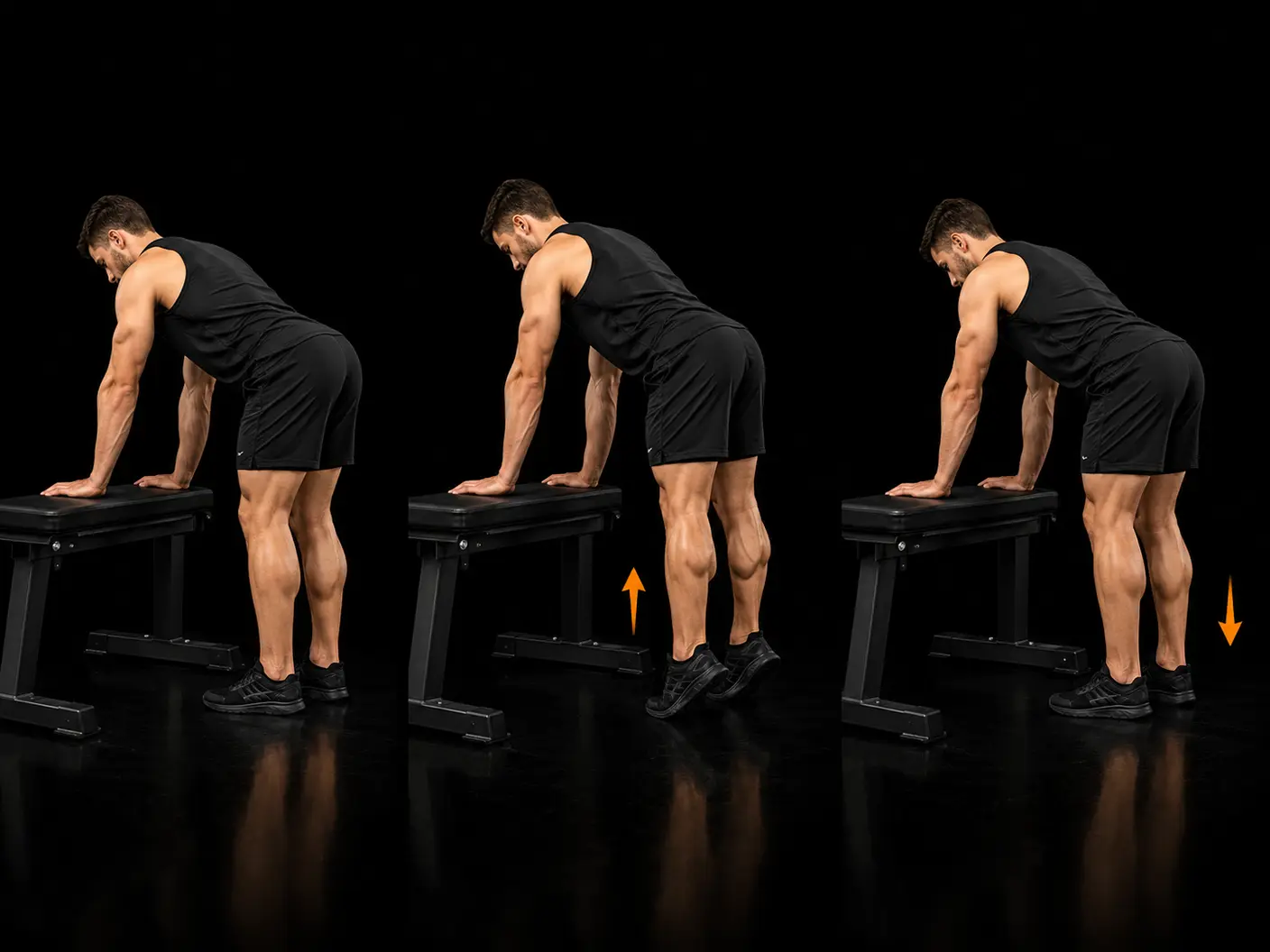
The donkey calf raise is a bent-over isolation movement that loads the gastrocnemius through a long range of motion, with the hips hinged to place the muscle under greater stretch than standing calf raise variations allow. It trains the push-off function of the posterior lower leg and is performed on a dedicated donkey calf machine or with a training partner seated across the hips. It suits anyone prioritising calf hypertrophy who wants to maximise the stretch position of the gastrocnemius.
How to do it
Bend forward at the hips, supporting the upper body on a bench or bar. Balls of the feet on a platform, heels hanging off. Load comes onto the lower back (machine pad or partner seated on hips). Stretch the heels down; press through the balls of the feet to peak contraction.
Coaching cues
- Hips hinged
- Full stretch
- Squeeze at the top
- Smooth tempo
Why train it
- The hinged hip position elongates the gastrocnemius more than an upright stance, creating a greater active stretch and potentially a stronger stimulus for muscle growth.
- Working through a full range of motion — from heels dropped below the platform to peak plantar flexion — ensures the gastrocnemius is loaded across its entire length.
- As an isolation exercise, it allows focused volume to be directed at the calves without fatiguing the quads, hamstrings, or glutes that compound movements demand.
- Its foundational difficulty rating makes it accessible to most trainees and straightforward to programme as supplementary work at the end of a lower-body session.
Common mistakes
- Cutting the range of motion short — allow the heels to drop into a full stretch before pressing to peak contraction on every repetition.
- Bouncing out of the bottom position — control the descent and pause briefly in the stretch rather than using momentum to initiate the press.
- Letting the tempo become erratic — use a smooth, consistent cadence throughout so the gastrocnemius remains under tension for the full set.
- Insufficient hip hinge — ensure the torso is genuinely bent forward and well supported so the load is positioned correctly across the hips, which is what distinguishes this variation from an upright calf raise.
Primary: Gastrocnemius.
Secondary: Soleus.
Equipment
Good for
Easier variation
Standing calf raise — more accessible setup.
Similar movements
Frequently asked
- What muscles does the donkey calf raise work?
- The primary muscle is the gastrocnemius, the two-headed calf muscle responsible for the bulk of lower-leg size. The soleus, which sits beneath the gastrocnemius, works as a secondary contributor throughout the movement.
- How many sets and reps should I do for calf hypertrophy?
- For hypertrophy, a common approach is 3–4 sets of 10–20 repetitions with a controlled tempo, prioritising a full stretch at the bottom of each rep. Calves respond well to higher rep ranges given their postural role, so erring toward the upper end of that bracket is reasonable.
- What is the difference between the donkey calf raise and the standing calf raise?
- The key difference is hip position. Hinging forward at the hips lengthens the gastrocnemius further than an upright stance does, because the muscle crosses both the knee and the ankle. This extended position may increase the growth stimulus by loading the muscle at a longer length.
- Can I do this exercise without a donkey calf machine?
- Yes — the traditional method involves bending over a bench or fixed bar for upper-body support while a training partner sits across the hips to provide resistance. It requires a co-operative training environment but produces the same mechanical position as the machine variation.
- Where does the donkey calf raise fit in a programme?
- It is best placed toward the end of a lower-body session once compound work is complete, as it is an isolation movement and does not require systemic energy. It pairs well with seated calf raises if you want to address both the gastrocnemius and soleus within the same session.
Want this movement in a plan built for you?
Adaptiv programmes the right exercises for your goal, equipment and experience — then adapts them as you train.
Build my programme