Single-Leg Box Jump
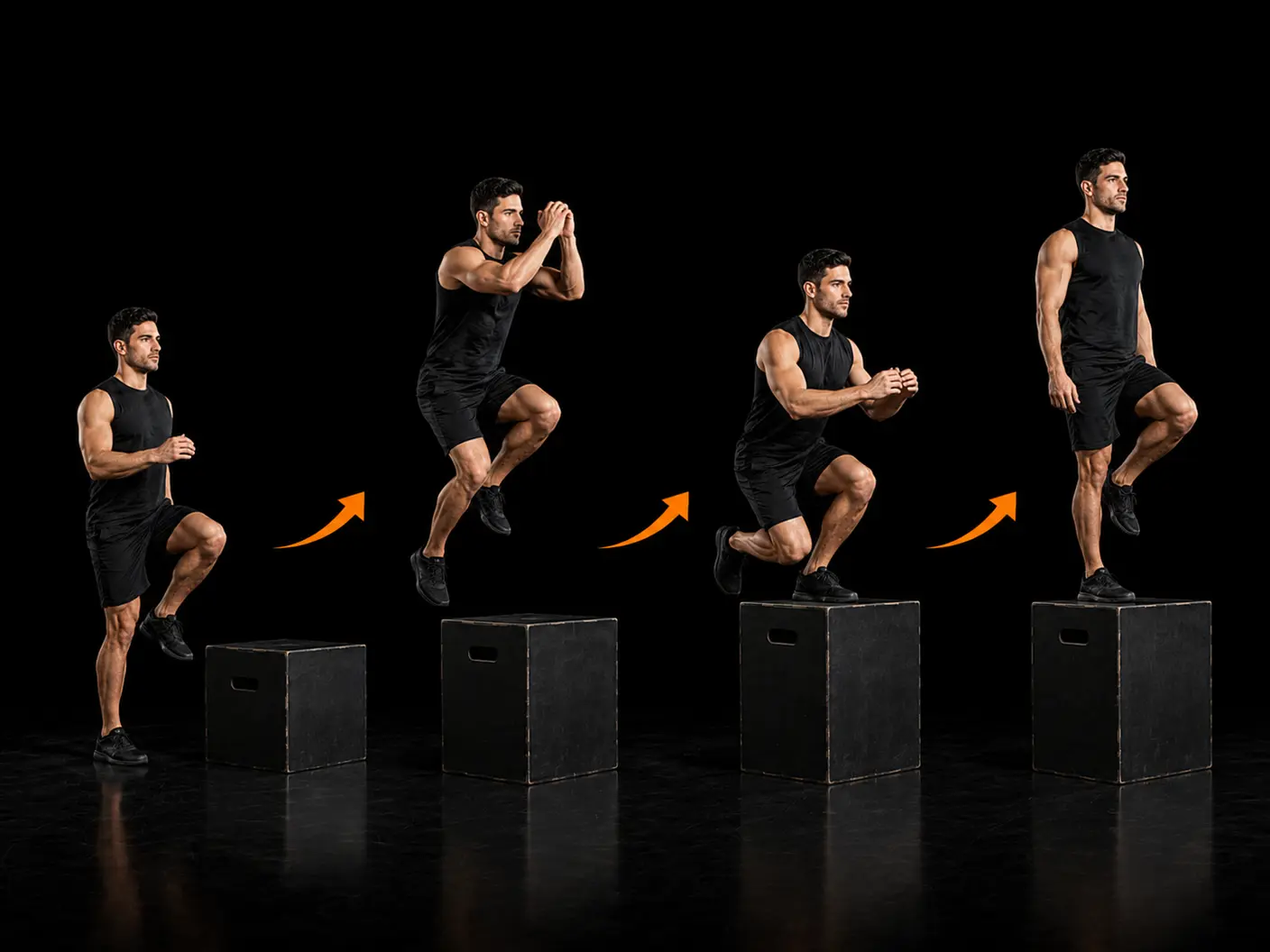
The single-leg box jump is an advanced plyometric exercise that trains explosive unilateral power through the full extension of the ankle, knee, and hip on one leg. It challenges the glutes, quadriceps, hamstrings, and calves as primary movers, while demanding meaningful contributions from the core, hip flexors, and ankle stabilisers to control both take-off and landing. It suits athletes and experienced lifters who already have a solid foundation in bilateral jumping and single-leg strength work.
How to do it
Stand on one leg, 1–2 feet from a box at an appropriate height (lower than bilateral box jump). Swing the arms back and dip on the single leg. Drive up explosively with the working leg, extending the ankle, knee, and hip. Land softly on the box on the same leg in a single-leg quarter-squat. Step down. Switch legs after all reps.
Coaching cues
- Single leg take-off and landing
- Soft landing
- Step down always
- Stable base
Why train it
- Develops unilateral explosive power, helping to address side-to-side asymmetries that bilateral jumping can mask.
- The single-leg landing demands significant stabilisation through the ankle, knee, and hip, building the reactive strength that underpins change-of-direction and sport-specific movement.
- Training through the triple-extension pattern on one leg transfers directly to sprinting, bounding, and cutting actions common across team and individual sports.
- Programming single-leg work alongside bilateral lifts increases total training volume for the glutes and quadriceps without simply adding more load to the barbell.
Common mistakes
- Choosing a box that is too high — select a height lower than your bilateral box jump until the movement is technically sound, then progress incrementally.
- Landing with a stiff, extended leg — absorb the landing by receiving it in a single-leg quarter-squat, allowing the ankle, knee, and hip to flex together.
- Jumping down from the box rather than stepping down — always step down after every rep to avoid unnecessary landing forces and maintain session quality.
- Neglecting the arm swing — driving the arms back during the dip and then forward and up on take-off contributes meaningfully to jump height, so use a deliberate, coordinated arm action rather than holding them passive.
Primary: Gluteus Maximus, Quadriceps, Hamstrings, Gastrocnemius.
Secondary: Rectus Abdominis, Hip Flexors.
Equipment
Good for
Easier variation
Bilateral box jump — removes the single-leg demand.
Similar movements
Frequently asked
- Which muscles does the single-leg box jump work?
- The primary movers are the glutes, quadriceps, hamstrings, and calves, all of which drive the triple-extension pattern on take-off and control the landing. The core, hip flexors, and ankle stabilisers work as secondary contributors to keep the body aligned and absorb force on the box.
- How many sets and reps should I do for single-leg box jumps?
- For athletic power development, 3–5 sets of 3–5 reps per leg is a well-established range, keeping total volume low enough to maintain quality throughout. Because this is a high-intensity plyometric movement, full recovery between sets — typically 2–3 minutes — is advisable.
- What are good alternatives if I am not yet ready for single-leg box jumps?
- Bilateral box jumps build the same triple-extension pattern with more stability and are the logical precursor. Single-leg broad jumps or single-leg jumps to a low step are also useful progressions, as they introduce unilateral demand at a lower intensity before committing to a full single-leg box jump.
- Is this exercise suitable for general fitness or only for athletes?
- The single-leg box jump is classified as an advanced compound movement with athletic performance as its primary goal, so it is best suited to those who already train with structure and have a baseline of unilateral strength. Recreational lifters without a background in plyometric work or single-leg training should build those foundations first.
- How do I know what box height to use?
- Start conservatively — lower than the height you would use for a bilateral box jump — so that you can land in a controlled quarter-squat position without compromising technique. If you are collapsing into a deep squat on landing or the leg buckles at all, the box is too high for your current level.
Want this movement in a plan built for you?
Adaptiv programmes the right exercises for your goal, equipment and experience — then adapts them as you train.
Build my programme