Single-Leg Bound
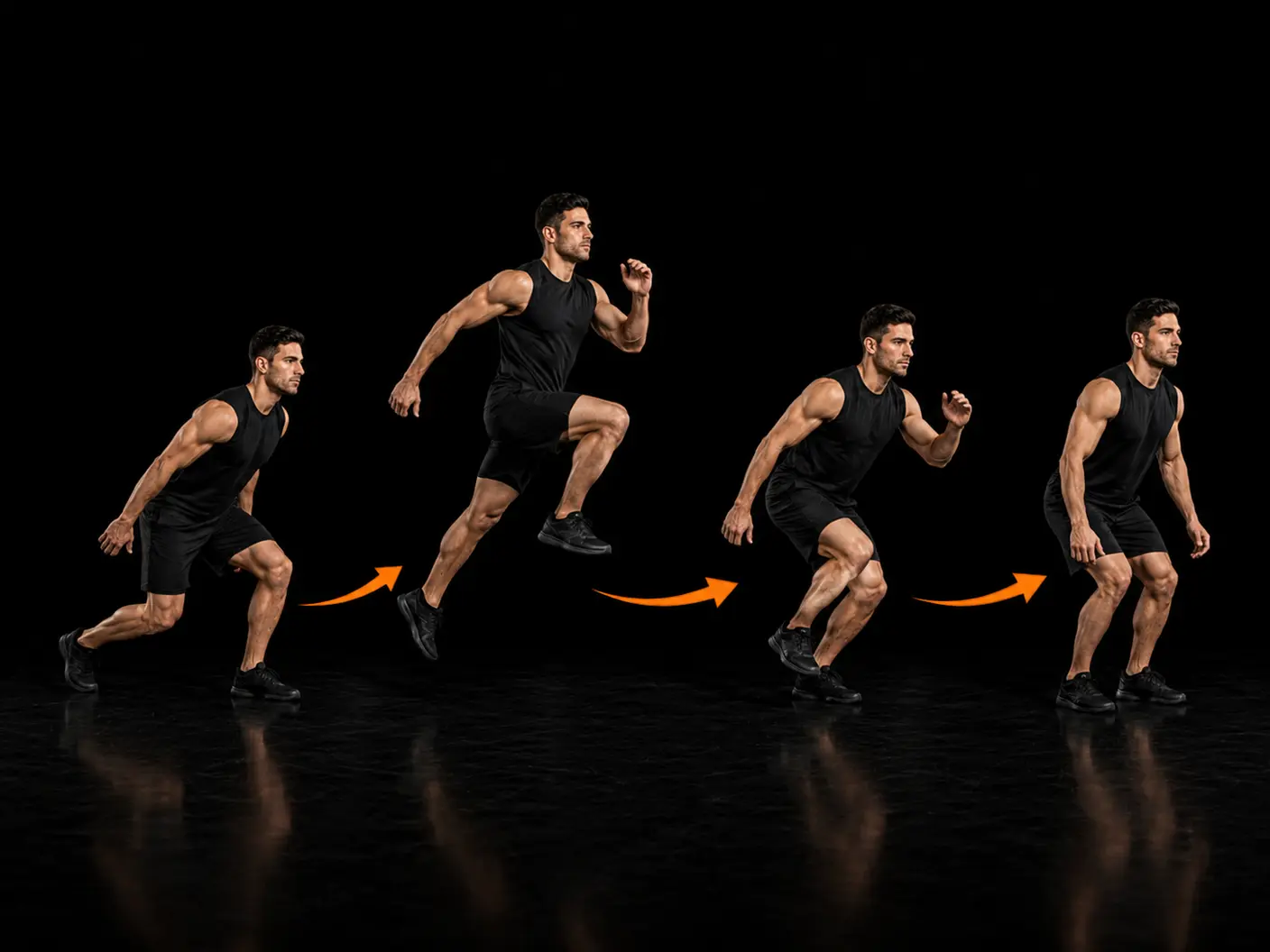
The single-leg bound is an advanced plyometric exercise in which the athlete drives off one leg for maximal horizontal distance, lands on the same leg, and immediately repeats the effort before switching sides. It trains the stretch-shortening cycle under single-leg loading, demanding explosive hip extension alongside precise landing mechanics. It suits athletes with a solid foundation in sprinting and bilateral jumping who are ready to develop unilateral power and reactive strength.
How to do it
From a jog, drive off one leg for distance; land on the same leg and immediately bound again. Each bound is a maximal single-leg effort for horizontal distance. Repeat for distance on one side, then switch.
Coaching cues
- Stay on one leg
- Drive for distance
- Arms swing
- Control the landing
Why train it
- Training each leg independently exposes and reduces asymmetries in power output that bilateral exercises can mask.
- The requirement to absorb and immediately redirect force on a single leg develops reactive strength directly relevant to sprinting, cutting, and jumping sports.
- Coordinated arm swing and core engagement under high-velocity loading reinforces the full-body mechanics that underpin athletic movement.
- Measuring performance by total distance covered gives a simple, objective marker for tracking lower-body power development over time.
Common mistakes
- Chopping the stride short — commit to driving the hip and knee through fully so each bound reaches maximal horizontal distance rather than becoming a series of small hops.
- Collapsing through the trunk on landing — brace the core before ground contact to keep the torso upright and transfer force efficiently into the next bound.
- Neglecting the arm swing — drive the arms in opposition to the legs to generate momentum and maintain rhythm across each bound.
- Landing with a stiff, locked knee — accept the load through a slightly flexed knee and hip to control the landing and protect the joint from excessive impact.
Primary: Gluteus Maximus, Hamstrings, Quadriceps, Gastrocnemius.
Secondary: Rectus Abdominis, Hip Flexors.
Equipment
Good for
Easier variation
Double-leg broad jump — easier bilateral version.
Similar movements
Frequently asked
- Which muscles does the single-leg bound work?
- The primary muscles are the glutes, hamstrings, quadriceps, and calves, which collectively produce the explosive push-off and control the landing. The core and hip flexors work as secondary contributors to stabilise the trunk and drive the free leg forward.
- How many sets and reps should I do for single-leg bounds?
- Because each bound is a maximal effort, quality deteriorates quickly with fatigue. Three to five sets of four to six bounds per leg, with full recovery of 90 to 120 seconds between sets, is a practical starting point for most athletes.
- What are good alternatives to the single-leg bound?
- If the single-leg bound is too demanding, single-leg broad jumps allow you to practise the same unilateral push-off and landing mechanics with a reset between efforts. Skipping for height or distance is another lower-intensity option that still develops the stretch-shortening cycle.
- Do I need any equipment to perform single-leg bounds?
- No equipment is required beyond a flat open space with sufficient run-up room. A marked surface or tape on the ground can be useful for measuring distance and tracking progress across sessions.
- Is this exercise suitable for beginners?
- Single-leg bounds are classified as advanced due to the combination of high-impact loading and single-leg landing demands. Athletes should first demonstrate competent technique in bilateral jumps, single-leg broad jumps, and basic sprint mechanics before progressing to continuous single-leg bounding.
Want this movement in a plan built for you?
Adaptiv programmes the right exercises for your goal, equipment and experience — then adapts them as you train.
Build my programme