Bounding
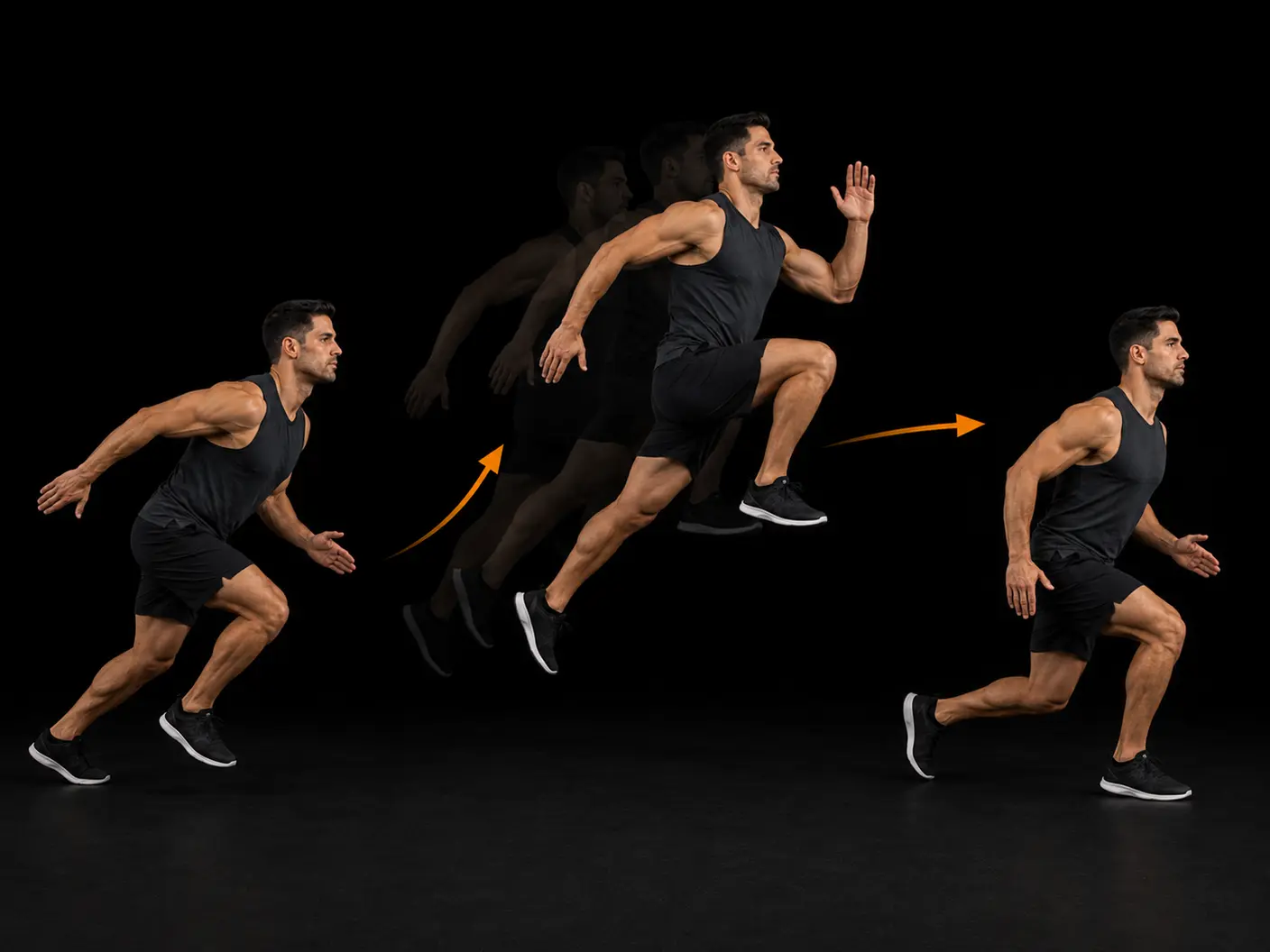
Bounding is an advanced plyometric drill in which the athlete propels themselves forward through a series of maximal single-leg jumps, emphasising both distance and height on each stride. It trains the stretch-shortening cycle of the lower limb — the ability to absorb force rapidly on landing and express it immediately on take-off — making it one of the most direct methods for developing athletic power. It suits experienced athletes who already possess solid strength and sprint mechanics, rather than those new to structured training.
How to do it
From a jog, drive one leg forward and up in an exaggerated stride — aiming for distance and height per step. Land on the opposite leg and immediately repeat. Each bound is a maximal single-leg jump. Use the arms aggressively.
Coaching cues
- Long strides
- Drive the knee
- Aggressive arm swing
- Float between steps
Why train it
- Bounding develops explosive hip extension through the glutes, hamstrings, and quads, directly transferring to sprint acceleration and jumping ability.
- Each landing demands rapid force absorption through a single leg, building the reactive strength and tendon stiffness that underpin speed and change-of-direction performance.
- The aggressive arm swing and trunk bracing required throughout the drill condition the core and hip flexors as integrated contributors to whole-body power rather than isolated structures.
- Because the only equipment required is open space, bounding can be programmed into outdoor athletic sessions, track warm-ups, or field-based conditioning blocks without logistical constraint.
Common mistakes
- Shortening the stride to stay safe — commit to maximal distance and height on every bound, as conservative effort defeats the purpose of the drill and reduces its training stimulus.
- Allowing a passive, quiet arm swing — drive the arms aggressively through a full range on each stride, as the arms directly regulate momentum and rhythm across the bounds.
- Collapsing into the hip and knee on landing — maintain a stiff, braced posture through the stance leg at contact, absorbing force through the muscles rather than folding into the joint.
- Rushing the ground contact and losing the float phase — aim to spend time in the air between each bound, as the sensation of floating between steps indicates you are achieving sufficient height and distance per stride.
Primary: Gluteus Maximus, Hamstrings, Quadriceps, Gastrocnemius.
Secondary: Hip Flexors, Rectus Abdominis.
Equipment
Good for
Easier variation
Skipping or A-skips — lower intensity variant.
Similar movements
Frequently asked
- What muscles does bounding work?
- The primary muscles trained are the glutes, hamstrings, quads, and calves, which collectively drive the explosive push-off and control the landing. The hip flexors and core work as secondary contributors, maintaining posture and co-ordinating the leg cycle throughout the drill.
- How many sets and reps should I do for bounding?
- Bounding is typically programmed by distance rather than repetitions — sets of 20 to 40 metres are a practical starting point, with two to four sets depending on the athlete's training age and the session's overall plyometric volume. Full recovery between sets, around two to three minutes, is appropriate because the drill demands maximal intent on every bound.
- What are good alternatives to bounding if I am not ready for it yet?
- Athletes who lack the single-leg strength or landing mechanics for bounding can build towards it with alternating broad jumps, single-leg hops for distance, or resisted march drills that reinforce knee drive and hip extension under control. Progressing through these movements first will develop the reactive strength and co-ordination the drill requires.
- Is bounding suitable for building muscle?
- Bounding is primarily a power and athletic performance drill rather than a hypertrophy stimulus — its value lies in training the nervous system to express force rapidly, not in creating the mechanical tension and volume associated with muscle growth. Athletes seeking hypertrophy in the lower limb would be better served by compound resistance exercises, with bounding used as a complement rather than a substitute.
- How should bounding fit into a training session?
- Bounding should be placed early in a session, after a thorough warm-up that includes jogging and dynamic mobility work, when the nervous system is fresh and fatigue has not compromised movement quality. Performing it under accumulated fatigue increases technical breakdown and reduces the power output the drill is intended to develop.
Want this movement in a plan built for you?
Adaptiv programmes the right exercises for your goal, equipment and experience — then adapts them as you train.
Build my programme