Single-Arm Kettlebell Swing
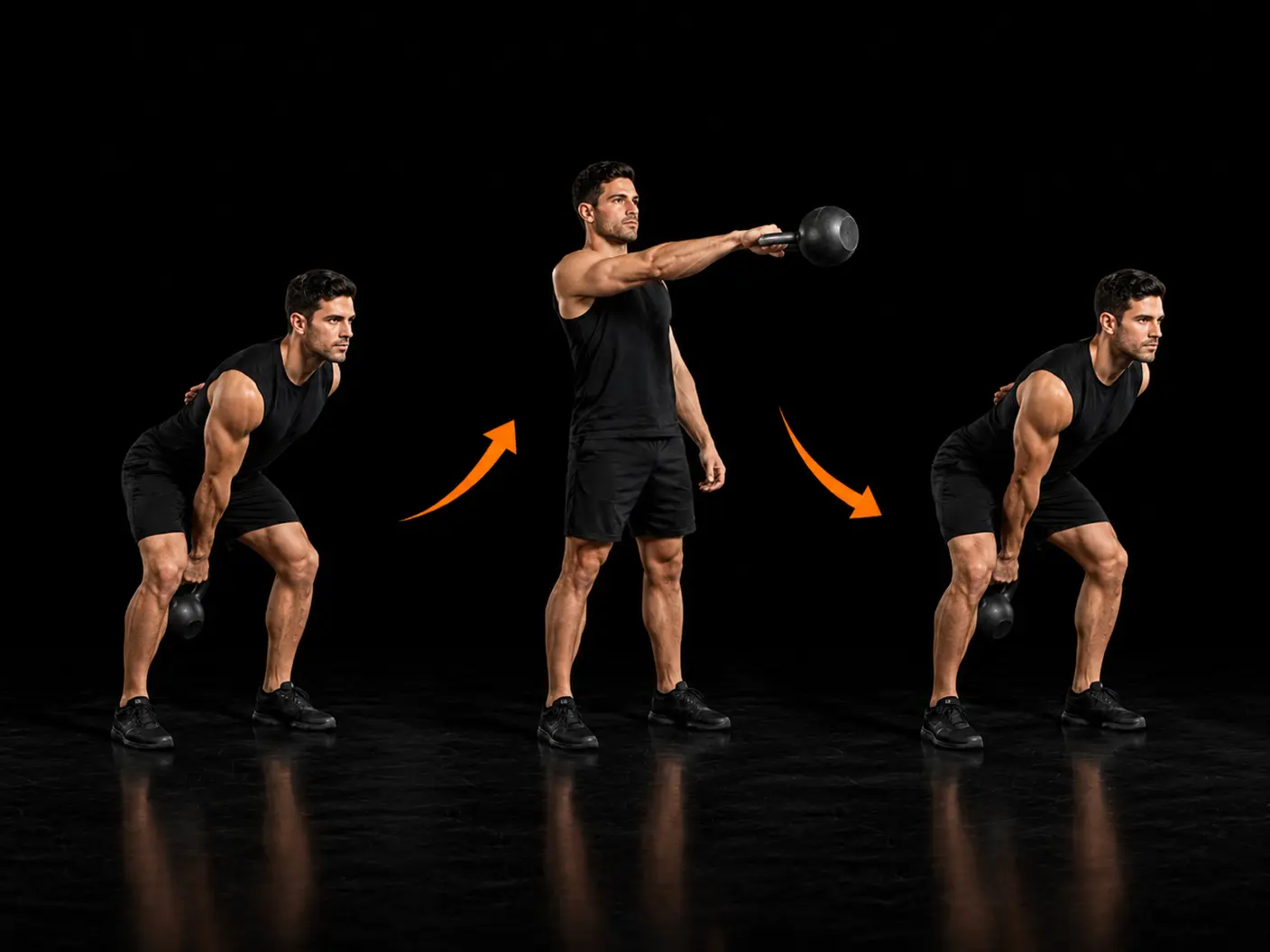
The single-arm kettlebell swing is a unilateral variation of the hip-hinge power pattern, trained with a single kettlebell held in one hand while the free arm acts as a counterbalance. It develops explosive hip extension through the glutes and hamstrings, while placing a significant demand on the core, obliques, and erectors to resist the rotational forces created by the asymmetrical load. It suits intermediate trainees who have already established sound mechanics in the two-arm swing and are looking to address side-to-side imbalances or increase anti-rotation demands.
How to do it
Stand over the kettlebell, feet shoulder-width. Hinge and grip with one hand. Hike the bell back between the legs, free arm counterbalancing. Drive the hips to swing the bell to chest height. Resist rotation through the torso — stay square. Let the bell fall, catch the hinge, and repeat.
Coaching cues
- Hike pass
- Resist rotation
- Square shoulders
- Explosive hips
Why train it
- The unilateral load forces the obliques and core to work hard against rotation, building rotational stability that carries over to sport and daily movement.
- Driving power through one side at a time helps identify and reduce strength asymmetries between the left and right posterior chain.
- The explosive hip extension pattern develops rate of force development in the glutes and hamstrings, directly supporting athletic performance qualities such as sprinting and jumping.
- The continuous cyclical nature of the swing elevates heart rate efficiently, making it a practical tool within fat loss and general fitness programmes without long setup time.
Common mistakes
- Letting the shoulders rotate toward the working arm — actively resist this by keeping both shoulders square to the front throughout the entire swing.
- Using the arm to pull the bell rather than driving with the hips — the arm should remain passive, with hip extension generating all the power to elevate the kettlebell.
- Neglecting the free arm counterbalance — allow the free arm to mirror the working arm's arc, as this assists in stabilising the torso against rotational pull.
- Losing the hip hinge on the backswing and squatting instead — push the hips back firmly to load the hamstrings and glutes, keeping the shins relatively vertical as the bell passes between the legs.
Primary: Gluteus Maximus, Hamstrings.
Secondary: Erector Spinae, Rectus Abdominis, Obliques, Forearm Flexors.
Equipment
Good for
Easier variation
Two-handed swing — removes the anti-rotation demand.
Similar movements
Frequently asked
- What muscles does the single-arm kettlebell swing work?
- The primary movers are the glutes and hamstrings, which produce the explosive hip extension. The erectors, core, obliques, and forearms work as secondary muscles, with the obliques and core particularly active in resisting the rotational torque created by the single-arm loading.
- How many sets and reps should I do?
- For power and athletic performance, sets of 5–8 reps per arm with full recovery between sets works well. For general fitness or fat loss, higher-volume sets of 10–15 reps per arm with shorter rest periods are more appropriate — prioritise quality of hip drive over simply accumulating fatigue.
- What is the difference between the single-arm swing and the standard two-arm swing?
- The two-arm swing distributes the load symmetrically, making it more accessible for beginners learning the hinge pattern. The single-arm variation introduces a rotational challenge that requires the torso to stabilise against an uneven load, increasing the demand on the obliques and core while also exposing any left-to-right strength differences.
- What are good alternatives if I cannot perform this exercise?
- The two-arm kettlebell swing is the most direct regression and should be trained first to establish the hip hinge pattern. The Romanian deadlift is another solid alternative for loading the same primary muscles through a controlled hinge without the ballistic component.
- Is the single-arm kettlebell swing suitable for fat loss?
- It is well-suited to fat loss goals because the compound, ballistic nature of the movement recruits a large amount of muscle mass and elevates cardiovascular demand simultaneously. Programming it in circuit or interval formats can make training sessions time-efficient without sacrificing meaningful muscular stimulus.
Want this movement in a plan built for you?
Adaptiv programmes the right exercises for your goal, equipment and experience — then adapts them as you train.
Build my programme