Kettlebell Clean
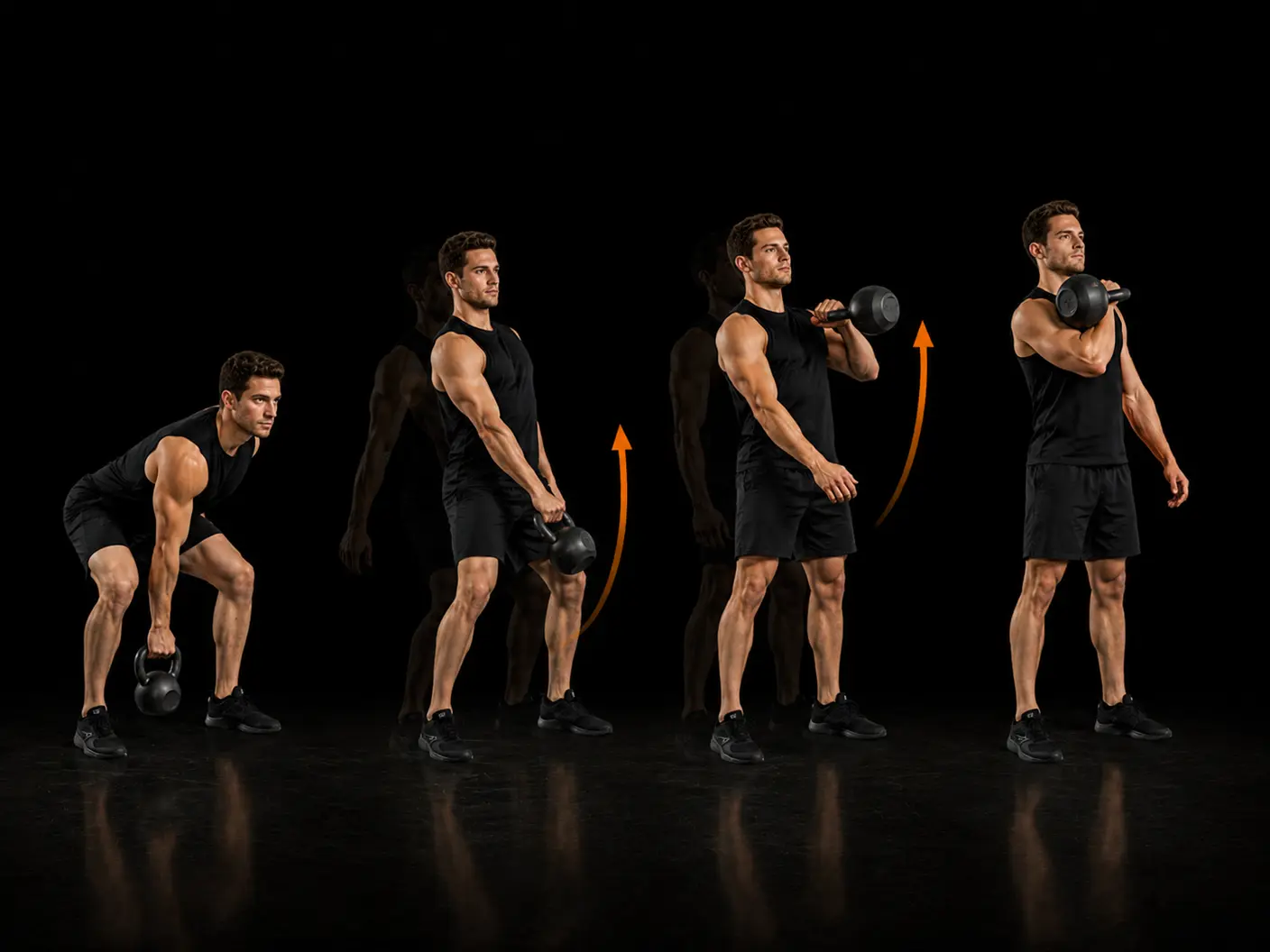
The kettlebell clean is a single-arm power movement that transitions the bell from the floor or swing position into the rack — forearm vertical, bell resting against the outside of the forearm at the shoulder. It trains the posterior chain through an explosive hip extension pattern, with the upper body acting as a guide rather than the primary driver. The movement suits intermediate trainees looking to develop athletic power, improve conditioning, or build towards more complex kettlebell combinations such as the clean and press.
How to do it
Stand over the kettlebell, feet hip-width. Grip the handle with one hand. Hike the bell back between the legs (like a single-arm swing). Drive the hips forward explosively; as the bell floats up, keep it close to the body and 'punch' the hand through to receive the bell in the rack position — forearm vertical, bell resting on the outside of the forearm at the shoulder. Lower by reversing the clean, hiking the bell back.
Coaching cues
- Hike back
- Hip drive
- Punch through
- Rack position with forearm vertical
Why train it
- It develops explosive hip extension through the glutes and hamstrings, translating directly to athletic qualities such as acceleration and jumping.
- The rack position demands active stabilisation from the traps, lats, and core, making it an efficient way to build shoulder and torso stability under load.
- Because it is cyclical and can be performed for higher repetitions, it places a significant demand on the cardiovascular system, supporting fat loss and general conditioning goals.
- It serves as a foundational skill for more complex kettlebell sequences, meaning time invested in the clean carries over to the press, jerk, and long-cycle work.
Common mistakes
- Swinging the bell away from the body — keep the bell close throughout the pull by driving the elbow back and up, as if zipping up a jacket.
- Muscling the bell up with the arm — the arm should guide the bell into the rack, not lift it; initiate every rep with a sharp hip drive.
- Receiving the bell with a limp wrist or horizontal forearm — actively punch the hand through at the top so the forearm is vertical and the bell sits on the forearm, not in the fingers.
- Neglecting the hike back on the descent — reverse the clean deliberately by hiking the bell back between the legs, which loads the hips for the next rep and protects the lower back.
Primary: Gluteus Maximus, Hamstrings, Trapezius.
Secondary: Rectus Abdominis, Forearm Flexors, Latissimus Dorsi.
Equipment
Good for
Easier variation
Single-arm kettlebell swing — builds the hip drive pattern without the catch.
Similar movements
Frequently asked
- What muscles does the kettlebell clean work?
- The primary muscles are the glutes, hamstrings, and traps. The core, forearms, and lats provide secondary support, particularly during the pull and in the rack position.
- How many sets and reps should I do with the kettlebell clean?
- For power and athletic performance, work in sets of 3–6 reps per side with a load that allows full hip extension on every rep. For conditioning or fat loss, sets of 8–12 reps per side at a moderate weight are common, often paired with a press or squat.
- What is the correct rack position for the kettlebell clean?
- In the rack position the forearm should be vertical, the elbow tucked close to the ribcage, and the bell resting on the outside of the forearm at shoulder height rather than sitting in the hand. A correct rack is compact and stable, not extended out in front of the body.
- What exercises can I do instead of the kettlebell clean?
- The dumbbell hang clean trains a similar hip-drive pattern if a kettlebell is unavailable. The kettlebell swing develops the same posterior chain mechanics without the overhead catch component, making it a useful regression for those still learning to hike and drive.
- Is the kettlebell clean suitable for fat loss?
- Yes — because it involves large muscle groups, demands coordination, and can be cycled continuously, it creates a high metabolic demand relative to its simplicity. It is commonly programmed in intervals or complexes for this purpose.
Want this movement in a plan built for you?
Adaptiv programmes the right exercises for your goal, equipment and experience — then adapts them as you train.
Build my programme