Side-Lying Hip Abduction
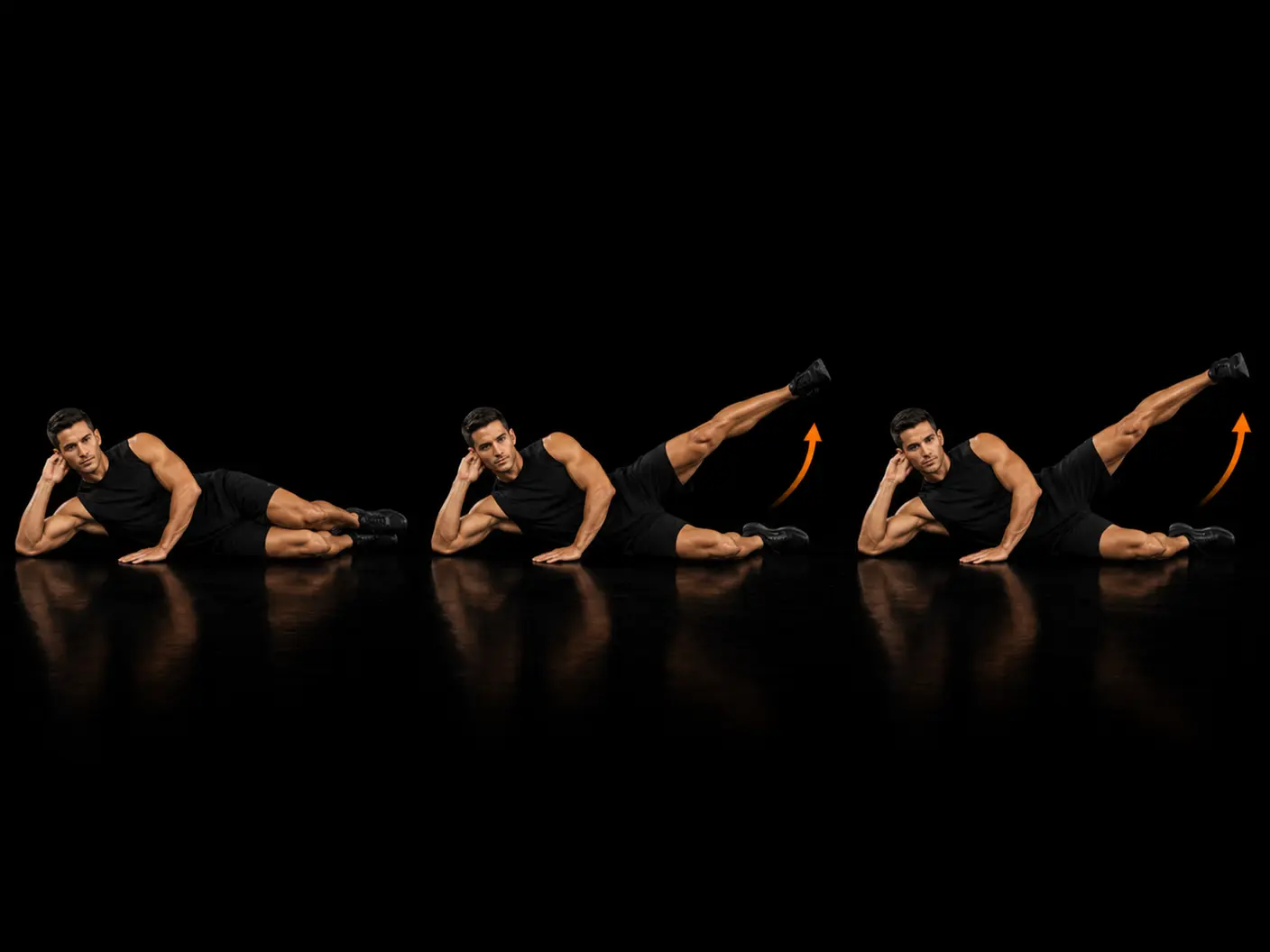
The side-lying hip abduction is a foundational isolation movement that trains the gluteus medius through its primary function of hip abduction. Performed on the floor with bodyweight or ankle weights, it requires no complex set-up and is well-suited to warm-up protocols, rehabilitation-adjacent conditioning, and anyone building baseline hip stability. Because load and skill demands are low, it allows a lifter at any stage to develop awareness of lateral hip musculature before progressing to compound work.
How to do it
Lie on your side, bottom leg bent for stability, top leg straight. Hips stacked. Raise the top leg to ~30–45° abduction, leading with the heel. Pause briefly. Lower with control. Keep the hip rotated slightly externally to bias glute medius over TFL.
Coaching cues
- Lead with the heel
- Hips stacked
- Slow and controlled
- Do not hike the hip
Why train it
- Directly targets the gluteus medius, a muscle frequently underdeveloped relative to the glutes as a whole, which supports pelvic control during single-leg activities such as running and lunging.
- The lying position removes the balance challenge entirely, allowing full attention to be placed on the quality of hip abduction rather than postural management.
- Ankle weights provide a simple and accessible means of progressive overload without specialist equipment.
- Consistent training of the lateral hip musculature can improve mechanics in compound lower-body movements by supporting better knee tracking and pelvic stability.
Common mistakes
- Hiking the hip to gain range — keep the pelvis stacked and move only through the hip joint, limiting the range if necessary to maintain position.
- Internally rotating the leg as it rises — maintain a slight external rotation throughout so the heel leads the movement and effort is directed to the glute medius rather than the TFL.
- Moving too quickly through the repetition — use a slow, deliberate tempo on both the lift and the lowering phase to maintain tension and control.
- Allowing the torso to roll backwards — brace the core lightly and keep the hips stacked vertically throughout each repetition.
Primary: Gluteus Medius.
Secondary: Tensor Fasciae Latae.
Equipment
Good for
Easier variation
Clamshell — bent-knee version is easier to execute.
Similar movements
Frequently asked
- What muscles does the side-lying hip abduction work?
- The primary muscle is the gluteus medius, which drives the upward movement of the leg. The gluteus minimus and tensor fasciae latae (TFL) assist as secondary muscles, though cueing a slight external rotation of the leg helps bias effort towards the glute medius rather than the TFL.
- How many sets and reps should I do?
- For general fitness and muscle awareness, 2–3 sets of 12–20 repetitions per side is a practical starting point. Because load is inherently modest, higher rep ranges tend to be more productive than very low ones for this movement.
- Should I use ankle weights or just bodyweight?
- Bodyweight is the appropriate starting point, particularly if you are unfamiliar with isolating the lateral hip. Once you can complete your target reps with clean form and no hip hiking, adding a light ankle weight is the logical progression.
- Where does this exercise fit in a programme?
- It works well as part of a warm-up or activation sequence before lower-body sessions, or as an accessory movement at the end of a session. It is less suited to being a primary strength exercise given its isolation nature and relatively low load ceiling.
- Is this exercise suitable for beginners?
- Yes — it is rated foundational precisely because the movement pattern is straightforward and the load is manageable. The main skill to develop is learning to move the leg independently of the pelvis, which most people can acquire within a few sessions of focused practice.
Want this movement in a plan built for you?
Adaptiv programmes the right exercises for your goal, equipment and experience — then adapts them as you train.
Build my programme