Clamshell
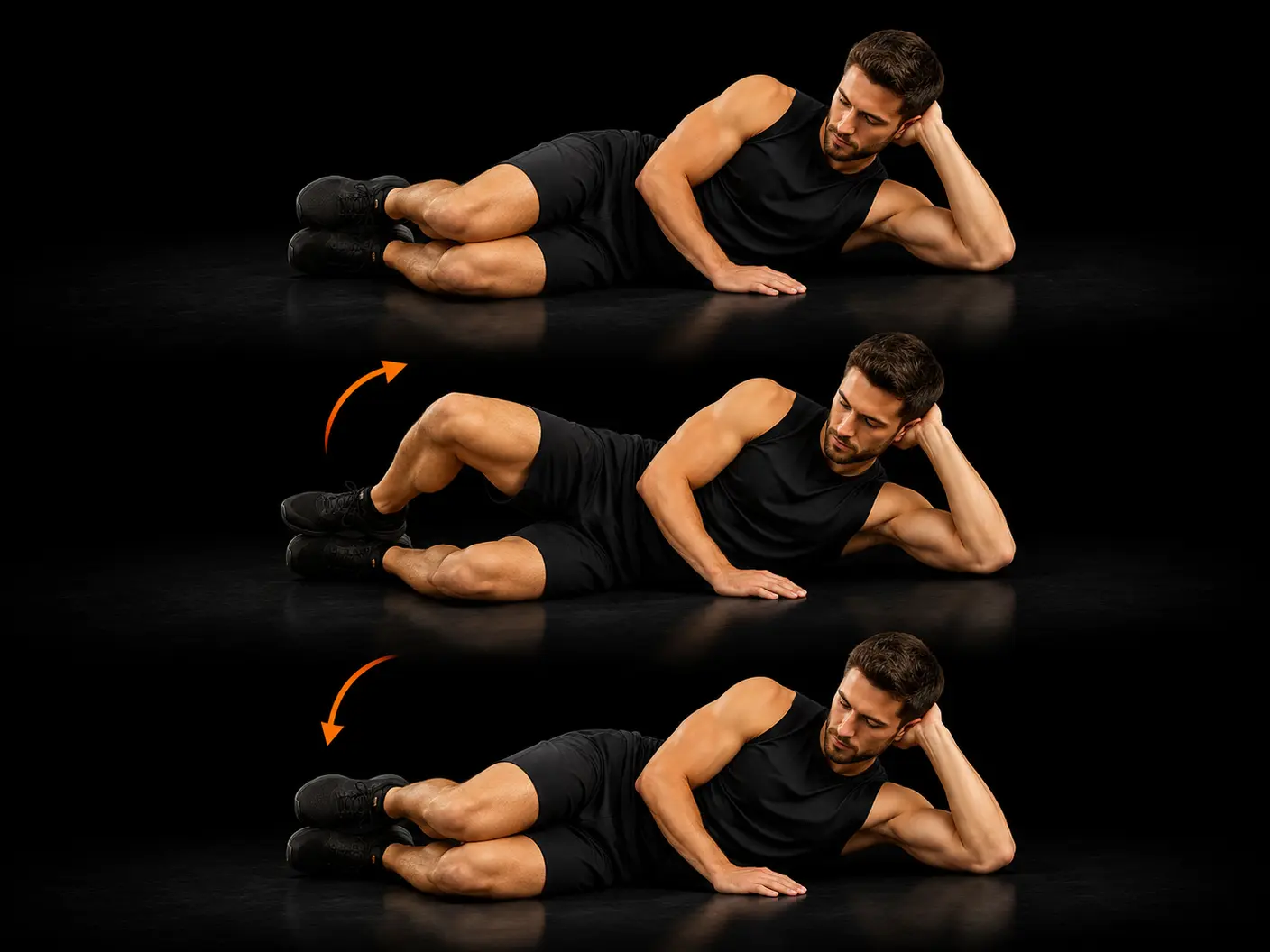
The clamshell is a side-lying isolation exercise that targets the gluteus medius through hip external rotation with the knees bent at 90°. It trains the often-neglected abductor and rotator function of the hip, making it a staple in warm-up protocols and corrective work alike. It suits beginners establishing foundational hip control as well as more experienced athletes looking to reinforce lateral hip stability before heavier loading.
How to do it
Lie on your side, knees bent at 90°, stacked hips. Optionally place a band above the knees. Keep the feet together. Rotate the top knee upward without rolling the pelvis back. Pause briefly at peak. Lower under control.
Coaching cues
- Hips stay stacked
- Small, focused range
- Pause at peak
- No pelvis roll
Why train it
- Directly targets the gluteus medius, a muscle frequently underdeveloped relative to the larger glutes, improving lateral hip stability during single-leg movements.
- Adding a mini-band above the knees increases resistance without requiring additional equipment, allowing progressive overload within a compact range of motion.
- The controlled, low-impact nature of the movement makes it a reliable option for general fitness clients and athletes alike who need to build hip function without loading the spine.
- Reinforcing the deep external rotators alongside the gluteus medius supports better hip alignment during squats, lunges, and running patterns.
Common mistakes
- Rolling the pelvis backwards to gain range — keep the hips stacked vertically throughout and accept a smaller, cleaner arc of movement.
- Using momentum to swing the knee upward — initiate and control every repetition deliberately, pausing briefly at the top to confirm muscular engagement rather than passive end-range.
- Allowing the feet to separate during the lift — keep the feet together for the full set, as separating them shifts the mechanics away from pure external rotation.
- Choosing too strong a band too early — if the pelvis tilts or the range collapses, reduce band resistance and prioritise quality of movement over added load.
Primary: Gluteus Medius.
Secondary: Gluteus Maximus, Hip External Rotators.
Equipment
Good for
Easier variation
Clamshell without band — pure bodyweight isolation.
Similar movements
Frequently asked
- What muscles does the clamshell work?
- The primary muscle is the gluteus medius, which drives the external rotation of the top hip. The upper portion of the gluteus maximus and the deep external rotators of the hip contribute as secondary movers throughout the movement.
- How many sets and reps should I do for the clamshell?
- For warm-up and activation purposes, two to three sets of 12 to 20 controlled repetitions per side is a practical starting point. If you are using it as a dedicated strengthening exercise within a programme, three to four sets in the 15 to 20 rep range with a mini-band provides sufficient stimulus for the gluteus medius.
- Do I need a mini-band to do clamshells?
- No — the movement is effective with bodyweight alone, particularly when learning the correct mechanics. The band is an optional progression that adds resistance once you can maintain stacked hips and a clean range of motion throughout every repetition.
- Is the clamshell suitable for athletic performance work?
- Yes, it is listed as appropriate for both general fitness and athletic performance. It is commonly used as part of a lower-body warm-up to activate the gluteus medius before sprint, jump, or multi-directional work, where lateral hip stability is a meaningful contributor to performance and movement quality.
- What is a good alternative to the clamshell?
- If you are looking to train a similar hip abduction and external rotation pattern, side-lying hip abduction or banded lateral walks target overlapping musculature. The best choice depends on your available equipment and where the movement sits within your session structure — if in doubt, a qualified coach can advise on the most appropriate substitution for your goals.
Want this movement in a plan built for you?
Adaptiv programmes the right exercises for your goal, equipment and experience — then adapts them as you train.
Build my programme