Banded Lateral Walk
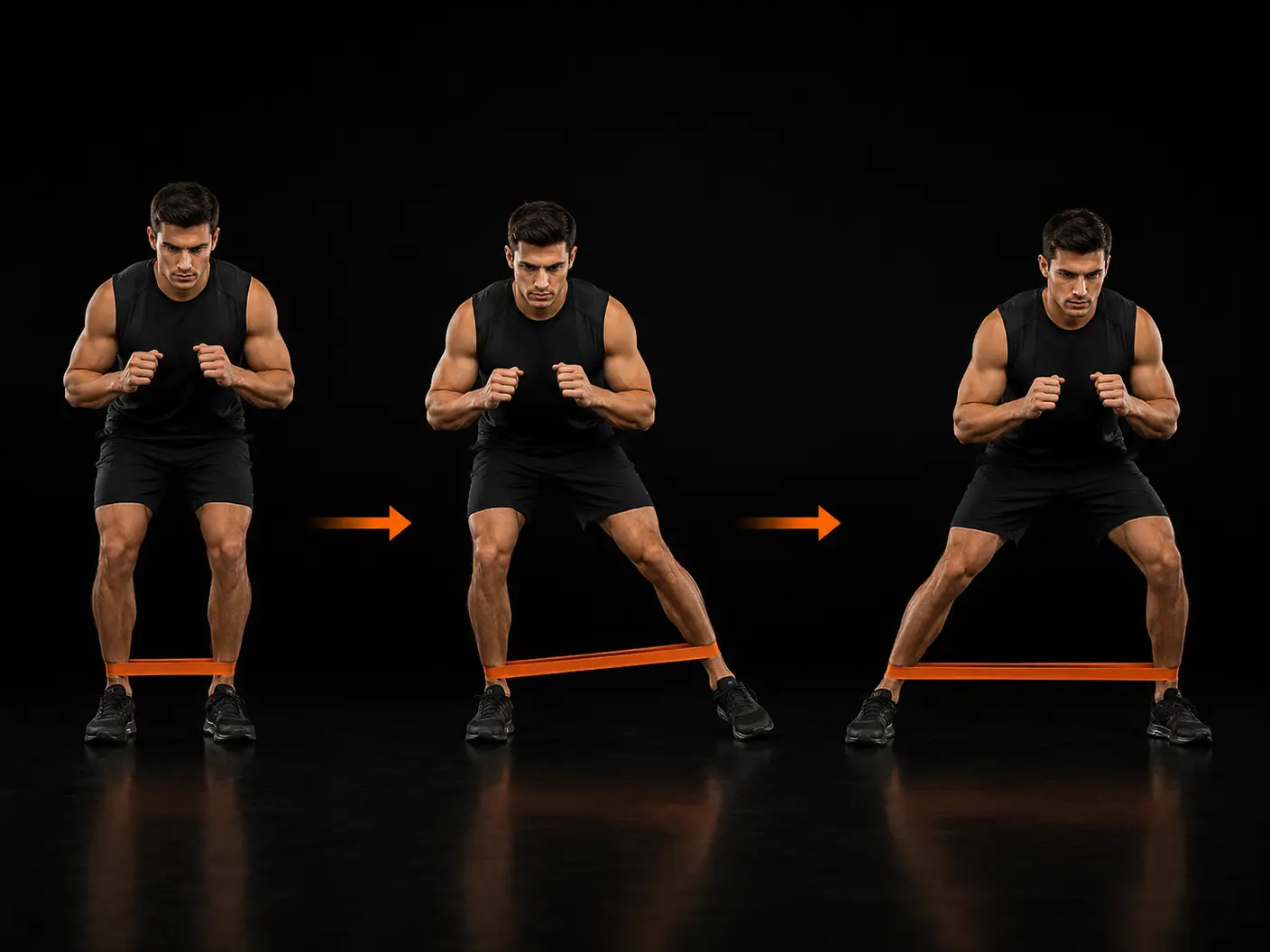
The banded lateral walk is a resistance band exercise that trains the hip abductors through repeated sideways stepping under continuous load. By keeping the band taut throughout the movement, the gluteus medius is forced to work both concentrically and isometrically — making this an effective isolation drill for a muscle that is often underworked in conventional training. It suits beginners building foundational hip stability, as well as athletes using it as a warm-up or accessory movement to reinforce lateral movement patterns.
How to do it
Place a mini-band above the knees or around the ankles. Drop into a quarter-squat. Step sideways, leading with the outside foot; the trailing foot follows without coming together. Keep tension on the band the whole time. Take 10–12 steps each direction.
Coaching cues
- Knees push out
- Low stance
- Constant band tension
- Small, controlled steps
Why train it
- Directly targets the gluteus medius, a muscle responsible for stabilising the pelvis during single-leg phases of walking, running, and jumping.
- Continuous band tension throughout the set means the hip abductors receive consistent stimulus rather than a brief peak load, improving endurance and motor control in the lateral plane.
- The quarter-squat position simultaneously engages the quadriceps and gluteus maximus, making this a more complete lower-body primer than isolated machine work.
- Requires only a mini-band or resistance band, making it straightforward to programme at home, in the gym, or as part of a field-based warm-up.
Common mistakes
- Allowing the feet to come together between steps — maintain a gap between the feet at all times so the band remains under tension throughout the set.
- Standing too upright rather than holding a quarter-squat — dropping the hips into a low stance and keeping them there ensures the glutes remain the primary driver.
- Taking steps that are too large — small, controlled steps give you better balance and keep the band from snapping the trailing foot inward.
- Letting the knees collapse inward — actively push the knees out in line with the toes on every step to reinforce proper hip abductor recruitment.
Primary: Gluteus Medius.
Secondary: Gluteus Maximus, Quadriceps.
Equipment
Good for
Easier variation
Clamshell — same gluteus medius target at lower intensity.
Similar movements
Frequently asked
- What muscles does the banded lateral walk work?
- The primary muscle is the gluteus medius, which drives the lateral stepping action and stabilises the hip. The gluteus maximus and quadriceps work as secondary muscles to maintain the quarter-squat position throughout.
- Where should I place the band — above the knees or around the ankles?
- Both positions are valid, but placement affects difficulty. Around the ankles creates a longer lever arm and more demand on the hip abductors, while above the knees is generally more accessible for beginners and places slightly less stress on the knee joint. Start above the knees if you are new to the movement.
- How many sets and reps should I do?
- A common approach is 2–3 sets of 10–12 steps in each direction, as outlined in the form description for this exercise. Focus on maintaining band tension and a consistent low stance rather than rushing through the repetitions.
- Can I use this exercise as a warm-up before squats or running?
- Yes — the banded lateral walk is well suited as a primer before lower-body training or running sessions because it activates the gluteus medius and reinforces lateral hip stability before higher-load or higher-velocity movements.
- Are there alternatives if I do not have a band?
- The movement pattern itself relies on the band providing continuous lateral resistance, so an alternative would need to replicate that. Bodyweight lateral lunges or side-lying hip abduction are reasonable substitutions if no band is available, though they train the pattern differently.
Want this movement in a plan built for you?
Adaptiv programmes the right exercises for your goal, equipment and experience — then adapts them as you train.
Build my programme