Monster Walk
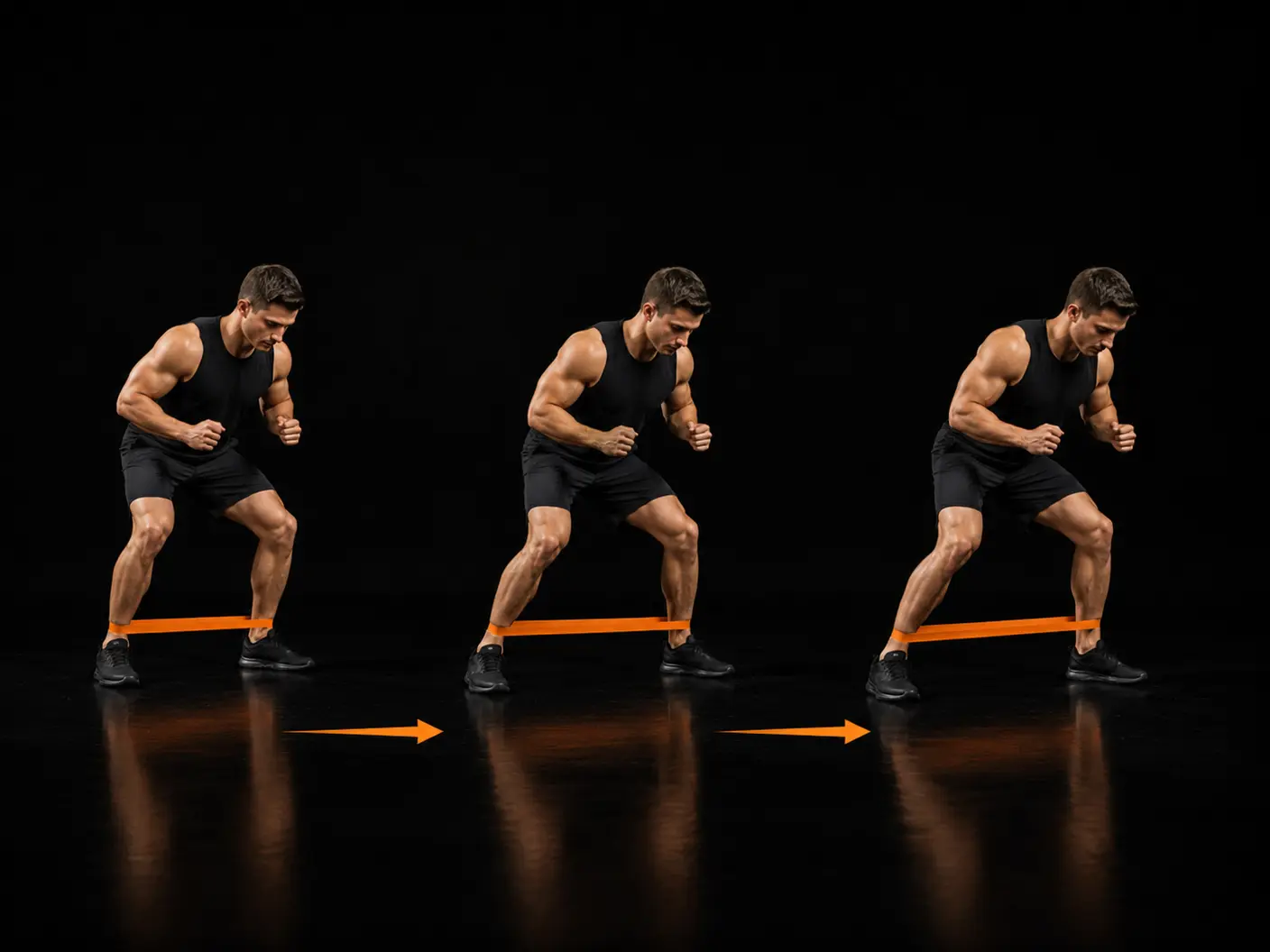
The monster walk is a foundational resistance band exercise that trains the hip abductors and extensors through a controlled, loaded gait pattern. Using a mini-band placed above the knees or ankles, the movement challenges the gluteus medius and gluteus maximus to maintain outward tension as you step forward in a quarter-squat position. It suits beginners establishing hip stability, athletes warming up for lower-body sessions, and anyone looking to reinforce correct knee tracking mechanics.
How to do it
Place a mini-band above the knees or ankles. Drop into a quarter-squat. Step forward and slightly outward with one foot; the other follows at an angle. Continue walking in a zigzag or straight line while maintaining band tension outward.
Coaching cues
- Knees out
- Low stance
- Tension on the band
- Steady pace
Why train it
- The continuous band tension directly targets the gluteus medius, a muscle frequently underdeveloped relative to its role in stabilising the pelvis during single-leg loading.
- Performing the movement in a sustained quarter-squat position also recruits the quadriceps, making it an efficient two-for-one primer before compound lower-body work.
- The walking pattern transfers well to athletic contexts — sprinting, change of direction, and jumping all demand the same hip abductor control this exercise trains.
- Because the load is modest and the technique is straightforward, it is accessible to a wide range of training ages and can be included in a warm-up without significant fatigue.
Common mistakes
- Allowing the knees to collapse inward — actively drive the knees out in line with the toes on every step to maintain band tension and reinforce correct tracking.
- Standing too upright rather than holding a quarter-squat — keep the hips hinged slightly and the knees bent throughout to ensure the glutes remain under load.
- Losing band tension by stepping feet too close together — maintain enough lateral distance between the feet that the band stays taut at all times.
- Moving at an uncontrolled pace — use a steady, deliberate tempo on each step so the stabilising muscles have to work continuously rather than relying on momentum.
Primary: Gluteus Medius, Gluteus Maximus.
Secondary: Quadriceps.
Equipment
Good for
Easier variation
Banded lateral walk — same pattern moving side-to-side.
Similar movements
Frequently asked
- What muscles does the monster walk work?
- The primary muscles are the gluteus medius and gluteus maximus. The quadriceps also contribute as secondary stabilisers, given the sustained quarter-squat position required throughout the movement.
- Where should I place the mini-band — above the knees or at the ankles?
- Both positions are valid. Placing the band above the knees reduces the moment arm and is generally more appropriate for beginners or as a warm-up drill. Moving it to the ankles increases the demand on the hip abductors and suits those who have already built a base of hip strength.
- How many sets and reps should I do?
- As a warm-up or activation drill, two to three sets of ten to fifteen steps in each direction is a practical starting point. If you are using it as a standalone strengthening exercise within a general fitness programme, three sets on the higher end of that range with a brief rest between sets is appropriate.
- Is the monster walk suitable for athletic performance goals?
- Yes. The movement is listed as suitable for both general fitness and athletic performance. Its value in a sports context lies in training the hip abductors under a dynamic, gait-like pattern, which has more direct carry-over to running and cutting actions than static abduction exercises.
- What exercises are similar to the monster walk?
- Lateral band walks train a comparable hip abduction pattern with a different direction of travel. Clamshells and standing hip abductions also target the gluteus medius, though without the walking component. If you are specifically looking for alternatives that keep the quadriceps involved, a banded squat hold with knee-out pulses is a reasonable substitute.
Want this movement in a plan built for you?
Adaptiv programmes the right exercises for your goal, equipment and experience — then adapts them as you train.
Build my programme