Serratus Wall Slide
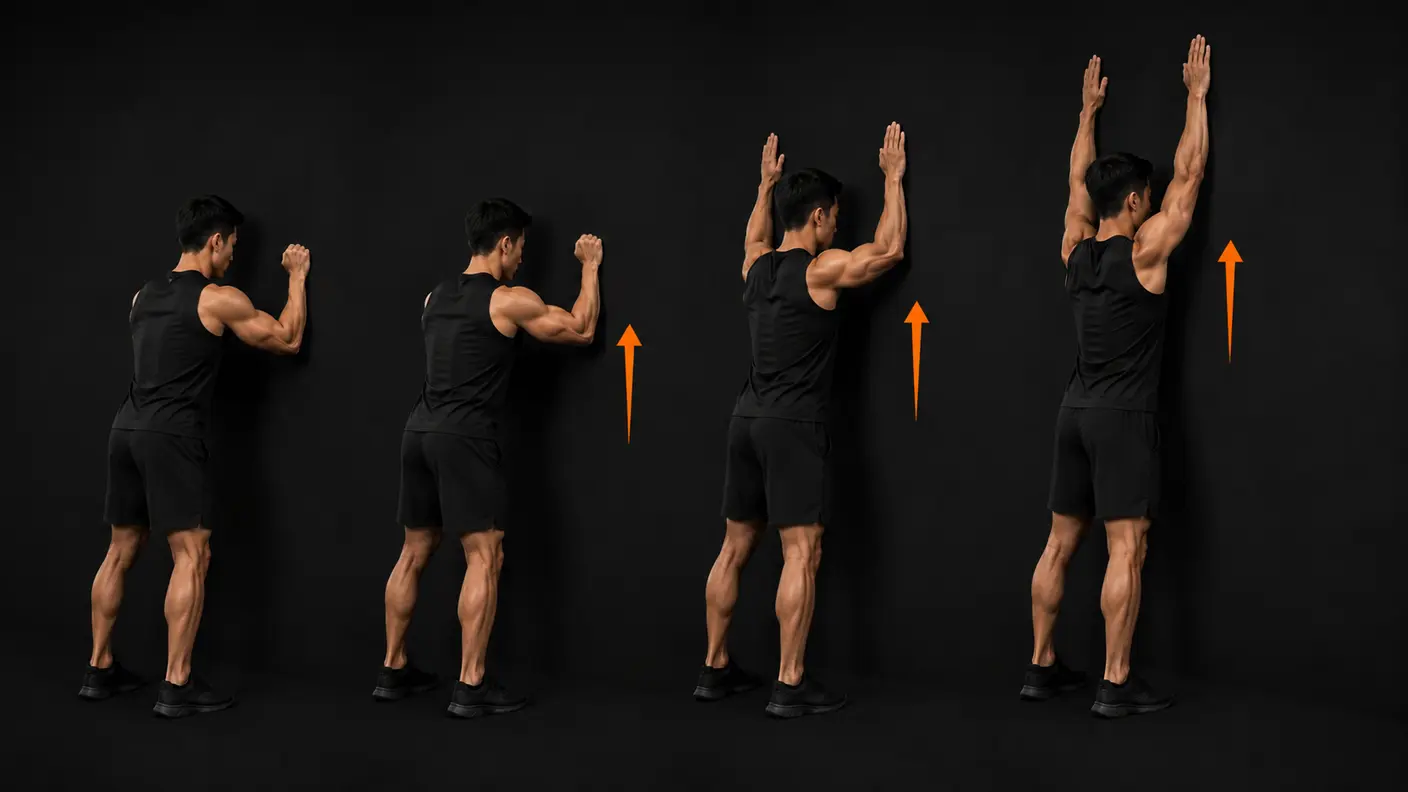
The serratus wall slide is a foundational mobility drill that trains scapular upward rotation and protraction through a controlled overhead range of motion. Using the wall as a fixed reference point, it challenges the serratus anterior and lower trapezius to work cooperatively as the arms travel overhead — a pattern that underpins pressing, pulling, and overhead movements. It suits beginners establishing shoulder mechanics as well as more experienced trainees addressing gaps in scapular control.
How to do it
Stand facing a wall, forearms flat on the wall in a goalpost shape. Maintain forearm contact. Slide the arms up the wall while protracting the shoulder blades at the top. Lower under control. The forearms stay in contact throughout.
Coaching cues
- Forearms pinned
- Protract at the top
- Control the descent
- Breathe throughout
Why train it
- It directly targets the serratus anterior and lower trapezius, two muscles frequently underactivated in lifters who spend significant time at a desk or under a barbell.
- The wall provides constant proprioceptive feedback, making it straightforward to self-monitor forearm contact and identify asymmetries in shoulder mobility.
- Training scapular protraction at end range builds the overhead stability that transfers to pressing and overhead carrying patterns.
- The low load and simple setup make it practical as a warm-up drill, a corrective between sets, or a standalone mobility session.
Common mistakes
- Losing forearm contact with the wall on the way up — focus on keeping both forearms pinned throughout the entire slide rather than allowing the elbows to flare away.
- Shrugging the shoulders towards the ears instead of rotating the scapulae upward — think of sliding the shoulder blades apart and upward rather than lifting the whole shoulder girdle.
- Rushing the descent — lower the arms deliberately under control, as the eccentric phase is where much of the motor control benefit is found.
- Holding the breath during the movement — breathe steadily throughout, as breath-holding tends to increase unnecessary tension through the neck and upper traps.
Primary: Serratus Anterior, Trapezius.
Secondary: Rotator Cuff.
Equipment
Good for
Easier variation
Standing wall slide without foam roller — simpler execution.
Similar movements
Frequently asked
- What muscles does the serratus wall slide work?
- The primary muscles are the serratus anterior and lower trapezius, which together control scapular upward rotation and protraction. The rotator cuff muscles work as secondary stabilisers throughout the movement.
- How many sets and reps should I do?
- Two to three sets of eight to twelve controlled repetitions works well for most people using this as a warm-up or corrective drill. Prioritise quality of movement over volume — if form deteriorates, stop the set.
- Is the serratus wall slide suitable for beginners?
- Yes, it is classified as a foundational movement and requires only a wall, making it accessible regardless of training experience. It is a sensible starting point for anyone learning how to engage the scapular stabilisers before progressing to loaded overhead work.
- What is an alternative to the serratus wall slide?
- A floor-based serratus push-up — holding the top of a push-up position and protracting the shoulder blades — trains a similar pattern without requiring wall space. The wall slide does, however, offer the advantage of vertical range of motion feedback.
- When in a session should I programme the serratus wall slide?
- It is best placed at the start of a session as part of a movement preparation routine, particularly before upper-body pressing or overhead work. It can also be used as an active rest drill between heavier working sets.
Want this movement in a plan built for you?
Adaptiv programmes the right exercises for your goal, equipment and experience — then adapts them as you train.
Build my programme