Scapular Push-Up
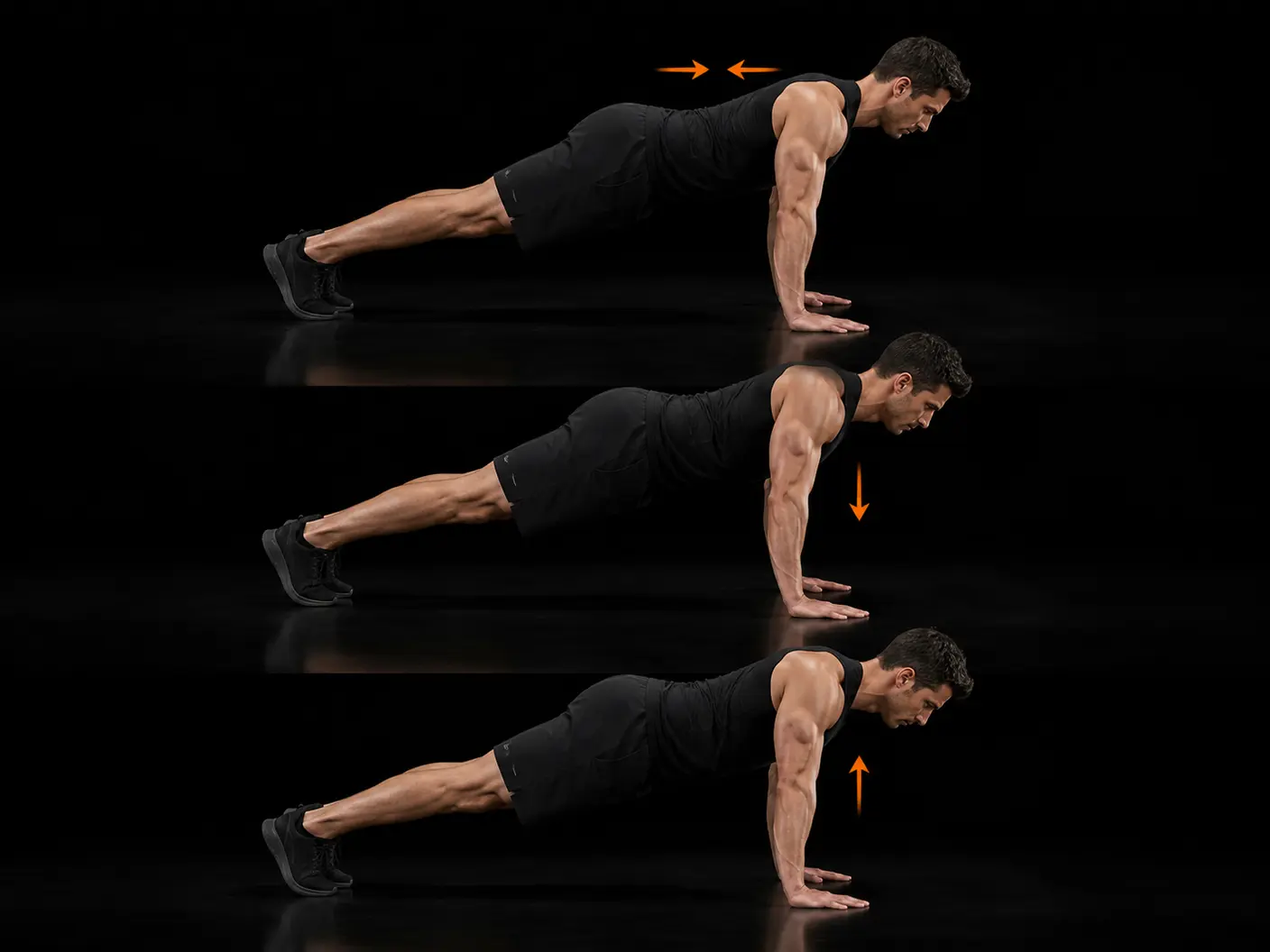
The scapular push-up is a bodyweight movement that isolates scapular retraction and protraction while the arms remain straight throughout — distinguishing it clearly from a standard push-up. It trains the serratus anterior and supporting shoulder-girdle musculature through a controlled, short-range motion from a high plank position. It suits beginners establishing shoulder mechanics, and more experienced trainees using it as a warm-up or accessory drill to reinforce scapular control.
How to do it
Start in a high plank. Keep the arms straight throughout. Lower the chest by retracting the shoulder blades (pinch them together). Then press the floor away, protracting the shoulder blades fully — the upper back rounds slightly at the top.
Coaching cues
- Arms stay straight
- Retract and protract
- No elbow bend
- Controlled tempo
Why train it
- Directly trains the serratus anterior, a muscle critical for upward scapular rotation and overall shoulder-girdle stability during pressing and overhead movements.
- Because the elbows never bend, the drill isolates scapular movement rather than arm strength, making it an efficient tool for building body awareness at the shoulder blade.
- The high plank position means no equipment is required, so it can be programmed as a warm-up, between sets, or in settings where loading is unavailable.
- Reinforcing full protraction at the top of each rep — where the upper back rounds slightly — establishes the end-range control that carries over to more demanding horizontal pushing patterns.
Common mistakes
- Bending the elbows during the movement — keep the arms locked straight throughout so the load stays on the shoulder blades rather than the triceps.
- Rushing through the retraction phase — slow the descent until the shoulder blades are fully pinched together before reversing direction, so both ends of the range are trained.
- Failing to reach full protraction at the top — press the floor away deliberately until the upper back rounds slightly, as a half-range rep underloads the serratus anterior.
- Allowing the hips to sag or pike — maintain a rigid plank position throughout so the shoulder mechanics are not compromised by an unstable base.
Primary: Serratus Anterior.
Secondary: Rhomboids, Pectoralis Minor.
Equipment
Good for
Easier variation
Scapular push-up on knees — reduced bodyweight load.
Similar movements
Frequently asked
- What muscles does the scapular push-up work?
- The primary muscle trained is the serratus anterior, which drives scapular protraction. The rhomboids and pectoralis minor contribute as secondary muscles, particularly during the retraction phase.
- How many sets and reps should I do?
- For a warm-up or activation context, two to three sets of ten to fifteen slow, controlled reps is a practical starting point. Prioritise full range and deliberate tempo over accumulating high repetitions quickly.
- What is the difference between a scapular push-up and a regular push-up?
- In a standard push-up the elbows bend and the chest approaches the floor, making it primarily an elbow and shoulder flexion exercise. The scapular push-up keeps the arms straight at all times, so the only movement is at the shoulder blade — making it a targeted scapular control drill rather than a general pressing exercise.
- Is the scapular push-up suitable for someone new to training?
- Yes — it is classified as a foundational movement and requires only bodyweight, making it accessible early in a programme. It is a useful drill for anyone learning to feel and control their shoulder blades before progressing to more demanding pressing variations.
- What are good alternatives or progressions from the scapular push-up?
- Once scapular control is established here, the standard push-up is the natural horizontal push progression. For continued serratus anterior development, banded or cable serratus punches offer a similar protraction focus with adjustable load.
Want this movement in a plan built for you?
Adaptiv programmes the right exercises for your goal, equipment and experience — then adapts them as you train.
Build my programme