Scapular Wall Slide
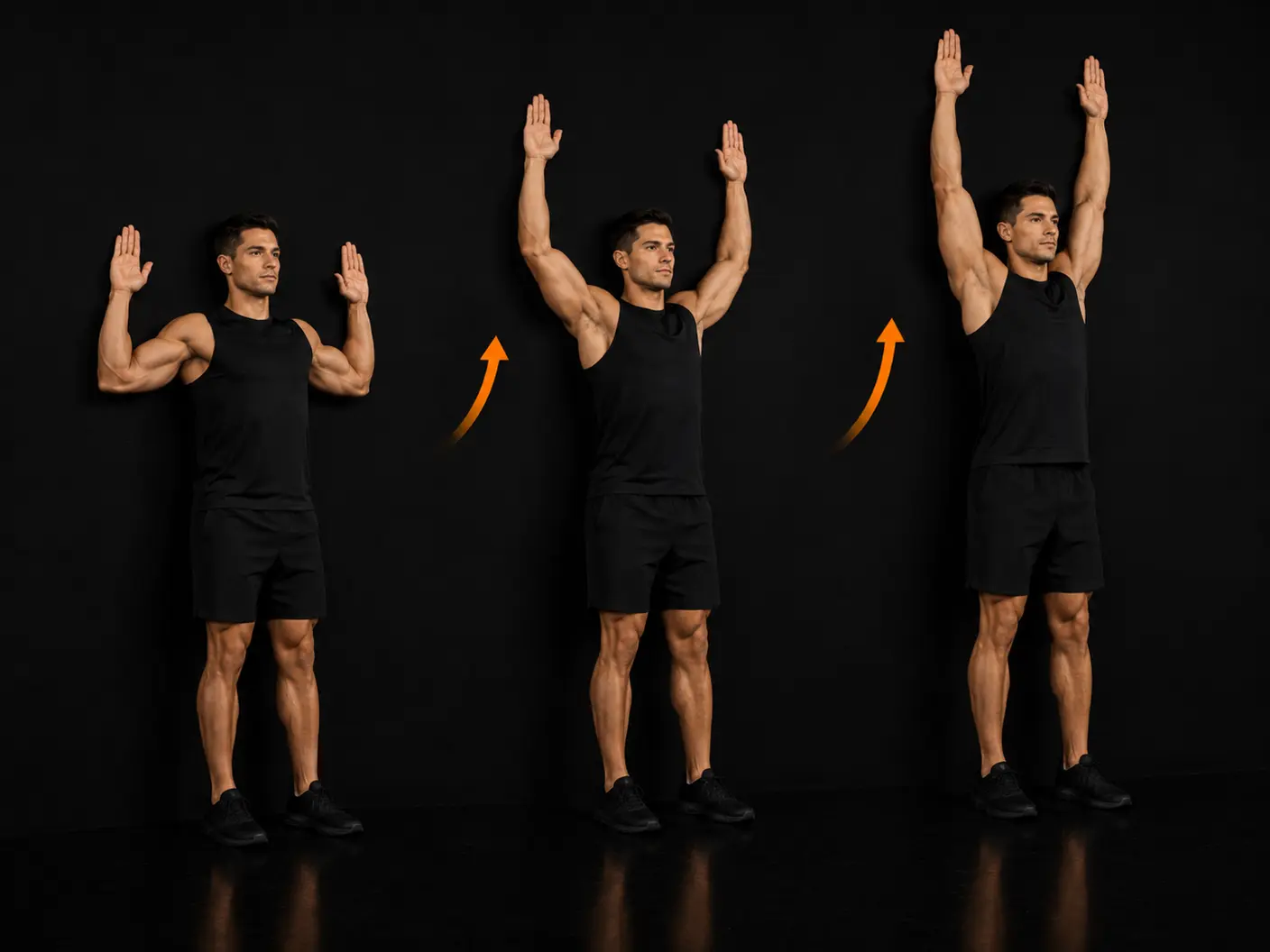
The scapular wall slide is a foundational mobility drill that trains upward rotation and elevation of the shoulder blades through a controlled overhead arc. Performed with the back flat against a wall, it reinforces the coordinated action of the lower trapezius and serratus anterior — two muscles that are frequently underactive in people who spend long hours seated. It suits beginners establishing shoulder mechanics as well as athletes looking to maintain healthy scapular function alongside heavier pressing work.
How to do it
Stand with back against a wall, feet a few inches out. Keep the lower back and head in contact with the wall. Forearms against the wall in a goalpost. Slide the arms up the wall while keeping all contact points. Lower under control.
Coaching cues
- Maintain all contact points
- Slow slide
- No lumbar flexion
- Protract at the top
Why train it
- Develops active upward rotation of the scapula, a movement quality that underpins safe and efficient overhead pressing.
- The wall provides immediate feedback on posture, making it straightforward to identify and correct excessive lumbar extension or loss of head position.
- Directly targets the serratus anterior and lower traps, which support scapular stability and are commonly neglected in conventional upper-body programmes.
- Its low loading demands make it suitable as a warm-up drill, a movement preparation tool, or a corrective exercise within a general fitness or athletic performance programme.
Common mistakes
- Allowing the lower back to peel away from the wall — keep the lumbar spine in contact throughout the entire slide to prevent the movement from becoming a lumbar extension exercise.
- Shrugging the shoulders towards the ears as the arms rise — consciously depress the shoulder blades and let the arms travel upward without the trapezius hiking them up.
- Moving too quickly through the range — use a slow, deliberate tempo on both the ascent and descent so the stabilising muscles are engaged rather than momentum doing the work.
- Failing to protract at the top of the movement — at the end range, actively push the forearms into the wall and reach slightly forward to fully engage the serratus anterior.
Primary: Trapezius, Serratus Anterior.
Secondary: Rotator Cuff.
Equipment
Good for
Easier variation
Foam roller wall slide — easier glide.
Similar movements
Frequently asked
- What muscles does the scapular wall slide work?
- The primary muscles are the lower trapezius and serratus anterior, which drive scapular upward rotation and protraction. The rotator cuff works as a secondary stabiliser throughout the movement.
- How many sets and reps should I do for scapular wall slides?
- Two to three sets of eight to twelve controlled repetitions works well for most purposes. Because this is a mobility drill rather than a strength movement, quality of movement and maintenance of all contact points matters far more than volume.
- Can I use scapular wall slides as a warm-up before overhead pressing?
- Yes — performed for two to three sets before a pressing session, they activate the lower traps and serratus anterior and reinforce the scapular mechanics you will rely on under load.
- Are scapular wall slides suitable for beginners?
- They are classified as a foundational movement, making them appropriate for those new to structured training. The wall removes the complexity of load management and provides clear tactile feedback, so beginners can focus entirely on the movement pattern.
- What is a good alternative to the scapular wall slide if I cannot maintain wall contact?
- If maintaining contact proves difficult, a floor-based version lying supine can reduce the demands on thoracic mobility and lumbar control while training the same scapular upward rotation pattern. Building consistency on the floor first often makes the standing wall version more accessible over time.
Want this movement in a plan built for you?
Adaptiv programmes the right exercises for your goal, equipment and experience — then adapts them as you train.
Build my programme