Seal Row
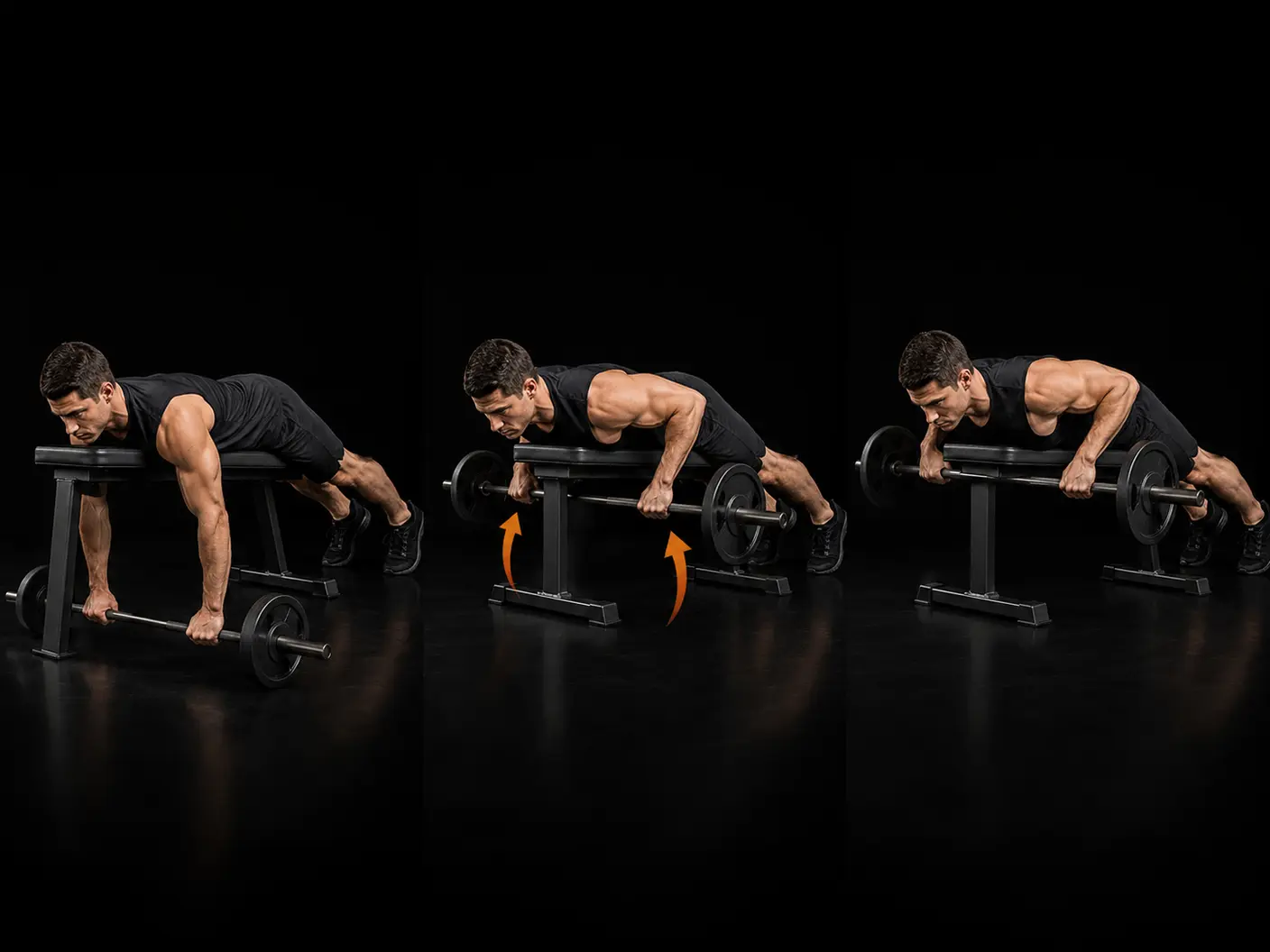
The seal row is a chest-supported barbell horizontal pull performed face-down on an elevated bench, with the lifter drawing the bar up to the underside of the bench on each repetition. By eliminating momentum and fixing the torso against the pad, it isolates the horizontal pulling musculature — the middle trapezius, rhomboids, and latissimus dorsi — with a level of strict control that standing or hinged rows rarely allow. It suits intermediate lifters looking to build genuine upper-back thickness or to identify and address side-to-side pulling imbalances.
How to do it
Lie face-down on an elevated bench (seal bench or stacked benches) with the barbell underneath. Grip the bar at shoulder-width. Pull the bar to the underside of the bench; drive elbows back. Pause briefly. Lower under control.
Coaching cues
- Chest supported
- Pull to the bench
- Drive elbows back
- Strict form
Why train it
- The chest-supported position removes the lower back from the equation entirely, allowing the upper-back musculature to be trained to a higher volume without axial fatigue accumulating.
- Driving the elbows back to a dead pause at the bench creates a consistent end-range position that maximises contraction of the rhomboids and middle trapezius with each repetition.
- Because momentum is effectively eliminated, the seal row is an honest test of horizontal pulling strength — load on the bar reflects actual upper-back capacity rather than technique compensation.
- The strict loading demands make it a reliable tool for hypertrophy programming, where controlled eccentric lowering and paused contractions drive the muscular stimulus needed for size development.
Common mistakes
- Letting the hips rise off the bench to generate momentum — keep the torso flat against the pad throughout and treat any body movement as a cue to reduce the load.
- Cutting the range of motion short on the pull — draw the bar all the way to the underside of the bench so the elbows travel fully behind the torso and the upper-back muscles reach peak contraction.
- Dropping the bar quickly on the descent — lower it under control to maintain tension through the lats and rhomboids and to protect the shoulder joint from sudden passive loading.
- Gripping too wide — set the hands at shoulder-width so the elbows can drive directly back, keeping the movement in the horizontal plane and reducing unnecessary stress at the shoulder.
Primary: Trapezius, Rhomboids, Latissimus Dorsi.
Secondary: Posterior Deltoid, Biceps Brachii.
Equipment
Good for
Easier variation
Chest-supported DB row — same principle with dumbbells.
Similar movements
Frequently asked
- What muscles does the seal row work?
- The primary muscles are the middle trapezius, rhomboids, and latissimus dorsi. The rear deltoid and biceps contribute as secondary movers throughout the pull.
- How many sets and reps should I do for the seal row?
- For hypertrophy, three to four sets of eight to twelve repetitions with a controlled tempo and a brief pause at the top works well. For strength development, four to five sets of four to six heavier repetitions is a practical starting point, though the chest-supported position naturally limits how much load you can handle compared to a barbell row.
- What is a good alternative to the seal row if I don't have a seal bench?
- You can replicate the position by stacking two flat benches or placing a flat bench on a sturdy raised platform that allows the barbell to hang freely beneath it. A chest-supported dumbbell row on an incline bench is also a reasonable substitute if a barbell set-up is not available.
- Is the seal row suitable for building a bigger back?
- Yes — the combination of a full range of motion, a dead pause at contraction, and the absence of momentum makes it one of the more effective barbell movements for upper-back hypertrophy, particularly for the rhomboids and mid-traps, which are often underdeveloped relative to the lats.
- How does the seal row differ from a barbell bent-over row?
- The key difference is that the bent-over row requires the posterior chain to isometrically hold the torso in a hinged position, which both limits upper-back volume and introduces lower-back fatigue. The seal row removes those demands entirely, meaning all effort goes into the horizontal pull itself.
Want this movement in a plan built for you?
Adaptiv programmes the right exercises for your goal, equipment and experience — then adapts them as you train.
Build my programme