Ring Muscle-Up
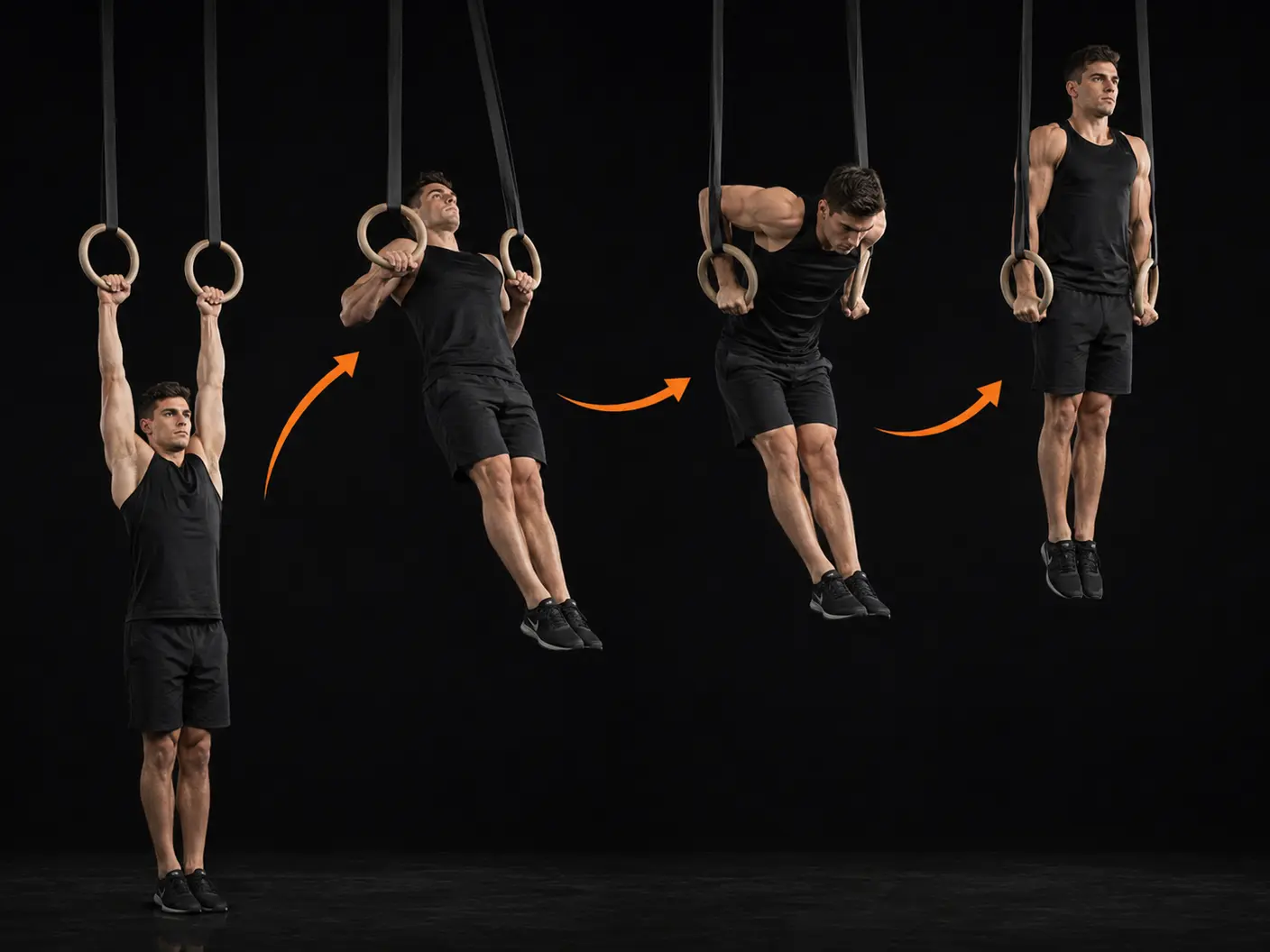
The ring muscle-up is an expert-level compound movement that combines a powerful vertical pull with a pressing transition, performed on gymnastic rings. It demands coordinated strength across the lats, chest, triceps, and biceps, while the instability of the rings places significant demand on the forearms and stabilising musculature throughout. It suits experienced gymnastic athletes and advanced strength-training athletes who have already developed solid pulling and pressing foundations.
How to do it
Hang from the rings with a false grip. Pull explosively with the rings tracking close to the chest. At the top, drive elbows forward and turn the rings out as the body rolls over. Press up through the dip to full lockout with rings turned out.
Coaching cues
- False grip
- Rings to the chest
- Fast transition
- Turn out at top
Why train it
- Develops integrated upper-body strength by requiring the athlete to produce force through both a pulling and pressing pattern within a single fluid movement.
- The false grip and ring instability place high demand on forearm and grip strength, building genuine functional capacity that transfers to other pulling movements.
- As a compound, multi-joint exercise, it trains the latissimus dorsi, pectoralis major, triceps, and biceps simultaneously, making it an efficient movement for athletic performance programming.
- The transition phase demands rapid coordination and body awareness, qualities that carry over meaningfully to broader athletic and gymnastic skill development.
Common mistakes
- Neglecting the false grip — establish the false grip before initiating the pull, as without it the transition becomes mechanically inefficient and the movement breaks down at the wrist.
- Letting the rings drift away from the body — keep the rings tracking close to the chest throughout the pull so the transition remains compact and the momentum is directed correctly.
- Stalling in the transition — the shift from pull to press must be fast and deliberate, so practise the hip drive and elbow punch forward to carry momentum through the sticking point.
- Failing to turn the rings out at lockout — actively rotate the rings outward at the top of the dip to reach full stabilised lockout, as stopping short reduces the muscular demand and reflects incomplete technique.
Primary: Latissimus Dorsi, Pectoralis Major, Triceps Brachii, Biceps Brachii.
Secondary: Rectus Abdominis, Forearm Flexors.
Equipment
Good for
Easier variation
Bar muscle-up — fixed surface is more stable.
Similar movements
Frequently asked
- What muscles does the ring muscle-up work?
- The primary muscles are the latissimus dorsi, pectoralis major, triceps, and biceps, which drive the pull and the subsequent pressing lockout. The core, forearms, and broader stabilising musculature work continuously to manage the instability of the rings throughout the movement.
- How many sets and reps should I programme for ring muscle-ups?
- For strength and athletic performance, two to four sets of two to five reps is a practical starting point given the technical and physical demands of the movement. Quality and control should take precedence over volume, particularly when first developing the skill.
- What should I be able to do before attempting a ring muscle-up?
- A solid foundation in strict pull-ups, ring dips, and ideally bar muscle-ups will give you the pulling and pressing capacity the movement requires. Developing comfort with the false grip on rings before attempting the full movement is also strongly advised.
- What are good alternatives if I cannot yet perform a ring muscle-up?
- Bar muscle-ups reduce the stability challenge and allow you to develop the transition mechanics on a fixed implement. Ring pull-ups and ring dips trained separately will also build the specific strength required at each phase of the movement.
- Is the ring muscle-up suitable for hypertrophy goals?
- While the movement does load the lats, chest, triceps, and biceps under meaningful tension, its primary value lies in strength and athletic performance rather than muscle building. Athletes with a hypertrophy focus would typically use it as a supplementary movement rather than a primary stimulus.
Want this movement in a plan built for you?
Adaptiv programmes the right exercises for your goal, equipment and experience — then adapts them as you train.
Build my programme