Muscle-Up (Bar)
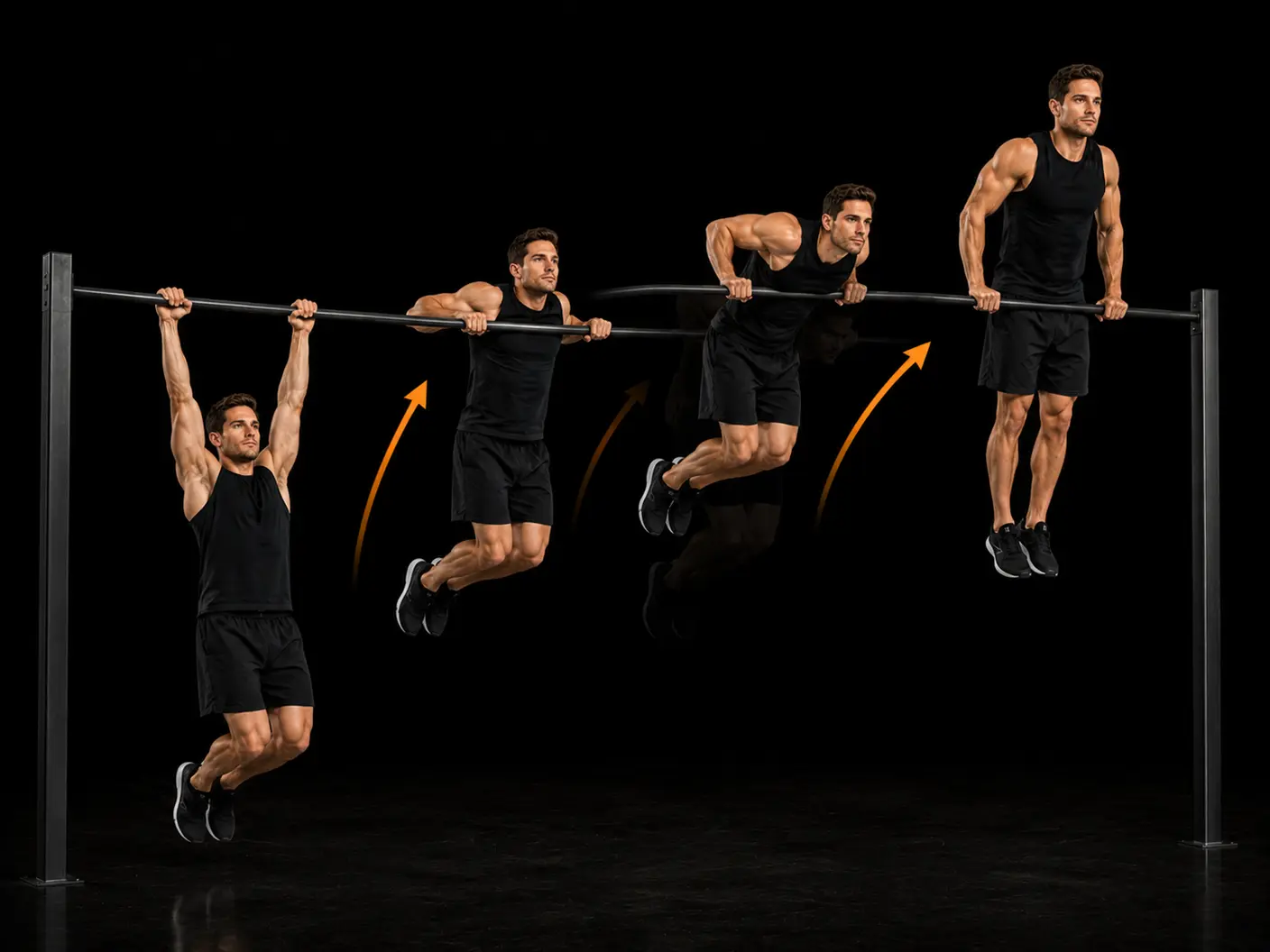
The bar muscle-up is an advanced compound movement that combines a powerful vertical pull with an immediate pressing transition, demanding coordination across the entire upper body in a single fluid sequence. It trains the latissimus dorsi, pectoralis major, triceps, and biceps simultaneously, while requiring the core and forearms to stabilise throughout. It suits experienced trainees who have already built a solid foundation in pull-ups and dips and are looking to develop integrated upper-body strength and athletic performance.
How to do it
Hang from a pull-up bar with a false grip (wrists over the bar). Pull explosively high — chest to bar with a slight backward lean. As the chest passes the bar, drive the elbows forward and roll over the bar into a dip position. Press out to full extension.
Coaching cues
- False grip
- Explosive pull
- Transition fast
- Press to lockout
Why train it
- The transition phase develops explosive pulling power that transfers directly to athletic movements requiring rapid upper-body force production.
- By combining a pull and a press into one continuous rep, the muscle-up trains a greater volume of muscle mass in a single set than either movement would achieve in isolation.
- The false grip and rapid elbow turnover build grip strength and wrist stability under load, reinforcing qualities that carry over to other bar and ring-based movements.
- As a bodyweight compound exercise requiring only a pull-up bar, it offers a high skill and strength stimulus without the need for additional loading equipment.
Common mistakes
- Pulling with a standard thumbs-around grip — adopt a false grip with the wrists draped over the bar from the outset, as this is the only position that allows a smooth transition over the bar.
- Losing height by pulling too slowly — the transition depends on generating enough momentum to bring the chest to bar level, so the initial pull must be as explosive as possible.
- Stalling in the transition by leaving the elbows behind — as the chest passes the bar, actively drive the elbows forward and rotate the torso over in one continuous motion rather than pausing mid-rep.
- Failing to reach full lockout at the top — the rep is only complete when the arms are fully extended above the bar, so press deliberately to lockout rather than settling for a partial press-out.
Primary: Latissimus Dorsi, Pectoralis Major, Triceps Brachii, Biceps Brachii.
Secondary: Rectus Abdominis, Forearm Flexors.
Equipment
Good for
Easier variation
Band-assisted muscle-up or banded pull-over practice.
Similar movements
Frequently asked
- What muscles does the bar muscle-up work?
- The primary muscles are the latissimus dorsi, pectoralis major, triceps, and biceps. The core and forearms work as secondary stabilisers throughout the pull, transition, and press phases.
- How many pull-ups should I be able to do before attempting a muscle-up?
- A reliable benchmark is being able to perform at least 10 strict pull-ups with full range of motion and controlled tempo. You should also be comfortable with explosive chest-to-bar pull-ups and solid dips, as the muscle-up demands proficiency in both patterns.
- What is a false grip and why does it matter?
- A false grip means positioning the wrists over the top of the bar rather than wrapping the thumbs underneath. This pre-loads the wrist angle needed to transition from the pull into the dip position, making the turnover mechanically possible without a break in momentum.
- How should I programme the bar muscle-up for strength development?
- Because of its technical demands and full upper-body recruitment, treat it as a primary movement and place it early in a session when the nervous system is fresh. Three to five sets of two to five quality reps works well for strength development, prioritising clean technique over accumulating high rep counts.
- What are the best alternatives if I cannot yet perform a bar muscle-up?
- Weighted pull-ups and explosive chest-to-bar pull-ups will build the pulling strength and height needed, while parallel bar dips develop the pressing capacity required for the lockout. Practising the transition separately — using a box to reduce load — can also help groove the elbow turnover pattern before attempting a full rep.
Want this movement in a plan built for you?
Adaptiv programmes the right exercises for your goal, equipment and experience — then adapts them as you train.
Build my programme